Showing posts with label dime store psychology. Show all posts

Wednesday, 17 August 2011

On Male Beauty


Readers, do you subscribe to the belief that a man can be too good-looking?

I was reading an excerpt from Rob Lowe's critically-acclaimed autobiography, "Stories I Only Tell My Friends" recently, and he believes that his good looks kept him from having the kind of film career in his youth he had hoped for.  Indeed, it's easy to believe that Rob's beauty could have been an obstacle.  (The modified mullet and shark tooth earrings weren't doing him any favors either.)


There are lots of different kinds of good-looking men (as there are different kinds of good-looking women) but the kind of good looks that seems to cause the most trouble, not only for the man himself but, if he is an actor, for his audience too (keep reading), are the ones considered "pretty."

It's hard to pinpoint exactly what it is that makes a handsome man pretty, but we know it when we see it.  Tyrone Power is a classic example of this phenomenon, and based on what I've read about his life, he suffered for it, both professionally and personally.


Power died young after a life of considerable self-abuse.  He was only in his mid-forties -- and considerably less pretty.


When you think about the most popular male movie stars of classic Hollywood cinema, they're generally not the best looking (and this holds true for the women as well, imo: think Bette Davis, Barbara Stanwyck, Claudette Colbert) -- the more rugged actors held on the longest and are best remembered, men like Humphrey Bogart, James Cagney, and Spencer Tracey.


Some actors started out as beauties -- Gary Cooper and John Wayne come to mind -- but aged rapidly into rugged-looking, craggy-faced heroes worshiped by men and women alike.


A lot of this "curse of the beautiful male" thing has to do with homophobia: there's a sense that a beautiful man is likely to be homosexual or -- due to his almost feminine looks (long lashes, bright, light eyes) -- not sufficiently masculine.  Americans like their men to look like men.  Actually, I think it's that heterosexual American males like their heroes to look more rugged for fear of being labeled homosexual themselves.  It's all a bit headache-inducing.

Of course, the fact that many beautiful male actors are now known to have been -- or consistently rumored to be -- gay (or its mid-Twentieth Century equivalent), doesn't help matters.  Tyrone Power, Montgomery Clift, and the late Farley Granger come to mind.  Even in the gay male community, many put a lot of value on being "straight-looking," i.e., traditionally masculine.  (Clifton Webb need not apply.)


What is a beautiful man supposed to do?  Facial hair seems to help -- or does it only call attention to precisely the features they're trying to hide?  (Think Johnny Depp and Zac Efron.)


I've often read that teen idols are usually of the pretty type because young girls find them less sexually threatening (subconsciously, of course).  This would apply to everyone from Troy Donahue to Ricky Nelson (remember him?) to Justin Bieber.


When these teen fans grow up, however, they prefer Clark Gable.


Friends of the man-loving persuasion, how do you like your men?

Do you have a preference for the iconic strong, silent type?  Are you uncomfortable around a man who might be considered prettier than you are?  Do you have nothing but empathy for Joanne Woodward (who wasn't exactly homely but she was no Paul Newman)?


Are you suspicious of a man who's too good looking, either because you think he's likely to be stuck up, or the constant target of the attention of decorators, florists, and male sewing bloggers?  (And he might like it.)

Can a man be too beautiful?

Jump in!

Wednesday, 13 July 2011

Are you sophisticated?


Reading blog comments in response to recent posts about summer comfort and contemporary style, I noticed that most of you are relieved to be able to wear what feels comfortable to you.

Many of you, however, aren't pleased with a world where people let it all hang out -- literally -- and think that the pendulum has swung too far in the direction of casualness.

This got me thinking about what's been lost since the days when men wore hats outside and ladies squeezed themselves into girdles and garter belts. It isn't so much what people wear that has changed (though that's part of it), as much as the way they wear it.

We've lost a sense of sophistication.

Sophistication is defined as "enlightenment or education; cultivated intellectual worldliness; savoir-faire."

It connotes "having, revealing, or proceeding from a great deal of worldly experience and knowledge of fashion and culture."

What was it that made, say, Marlene Dietrich seem sophisticated -- the knowing glance, the cigarette, or the German accent?


Parenthetically, I watched "Burlesque" last night on DVD, and rarely has a film tried so hard to evoke an air of sophistication and failed so miserably.  That said, I was never bored.


Maybe the problem is Christina Aguilera.  She's about as sophisticated as....well, Christina Aguilera.


Part of what's missing -- and some of you alluded to this in your comments -- is a lack of role models.  We've experienced real cultural losses in the past three or four decades.  There are things most men and women no longer know how to do, and dressing elegantly is only one of them.

Hence the ubiquity of the celebrity stylist.  But even then, the results look effortful rather than effortless.  The clothes are striking, but the result looks only superficially sophisticated to me.


Did the old stars seem sophisticated because we associated them with their on-screen personas (and all that witty dialogue), or is it something else, something on the inside they projected out?


Reader Toby recommended an excellent book to me a few weeks ago, "Elegance: the Seeberger Brothers and the Birth of Fashion Photography," and I recently found it at the library.


It's full of gorgeous photographs taken primarily during the Teens to late Thirties of European high society at leisure.  Of course we're going to expect them to look better than the rest of us, but these photographs really capture something special; it's not just the clothes -- it's an attitude.


Can some wise reader please define why these people look so friggin' sophisticated -- if you think they do?

I think sophistication, and sophisticated style, have to do with intelligence, particularly about oneself.  It's not so much getting it "right" -- which seems to be what so many celebrities today are obsessed with on the red carpet -- as expressing something unique about yourself.  It's knowing who you are and what you're about and expressing it through the language of fashion.

That's why this leaves me utterly cold:


And this evokes delight:


Perhaps actresses today aren't allowed to play fully fleshed-out characters and that's why they seem like paper dolls when they dress up.  We don't really know them -- or just the opposite: we know them too well to really care.


Once America became suburban, people spent more times tending their yards and driving their cars than strolling the streets.  Private space became more valued than public space, the latter sometimes lacking entirely (i.e, no sidewalks).

We're more likely bump into each other in the snack aisle of the 7-Eleven than dressed up to be seen.  We mainly move from one air conditioned space to another with a car trip in between, and there's nowhere to go but the mall.  It doesn't really inspire a person to take pains.

Then...


Now...


Readers, what do you think?  What is sophisticated style all about and where can you find it today?  Does it still exist in your corner of the world?

Do you consider yourself sophisticated in your style or approach to life?

If you had to blame one thing for the loss of sophistication today, would it be:

1) Reality TV

2) Stretch denim

3) Petticoat Junction

Jump in!

Thursday, 2 June 2011

Recipe for a Happy Life


Friends, let's not talk about sewing today.

I've been thinking a lot about the Alexander McQueen exhibit I saw on Tuesday, and why certain professions seem to create so much apparent unhappiness -- or attract those with a strong propensity for it.

It does seem that there's something about fame -- and grasping for it -- that creates misery.  The list of celebrity drug addicts, early deaths, and public breakdowns is a long one, and not just in the performing arts.

Wasn't it Nietschze who said that nobody who understands fame would want to be famous?

Certain fields attract those who are prodigiously talented, and their talent becomes the primary way they're valued.  People can't see beyond it (or beneath it).  Yet we all want to be accepted for who we are, not how well we perform or how much money we earn -- or can make for someone else.

Do you think -- based on what you've read or what you've experienced yourself -- that the field of fashion has more than its fair share of miserable people? 

I think any industry where competition is cut-throat and pressure to produce (artistically or financially) is tremendous, is bound to make people unhappy.   Fields that are focused on appearances, moreover, are apt to attract people who share those values.   Since aging is a part of life, professions that focus on chasing youth are not going to be healthy ones to grow old in.

It all comes down to learning how to love oneself, not for our talent, but for our simple existence.  We have to be OK as we are -- which doesn't mean we don't want more for ourselves, but rather that we don't need more to feel worthy. 

I think we love our pets more easily than we love ourselves.  We don't withhold love because our child is short, or fat, or not extraordinary as defined by the outside world.  We love our children unconditionally, at least until they start talking back to us.

Wise readers, how do you make your lives life meaningful and fun?  I know many people struggle with health or relationship problems and all sorts of personal setbacks, and yet still cherish life.

Is celebrity a recipe for misery -- or  are those who seek the spotlight the most emotionally needy to begin with, and therefore likely to be unhappy regardless of what they do?

A balanced life can be difficult to achieve today without consciously creating it.  I know many people whose professional ambitions have swallowed up their personal lives to the point where they have no time to pursue other interests or even cook for themselves.

The people I know, primarily from my past, who were the most achievement oriented have not turned into particularly loving people, alas.

Please share your recipe for a happy life with us today.  Take all the space you need.

Sunday, 22 May 2011

Roads Not Taken


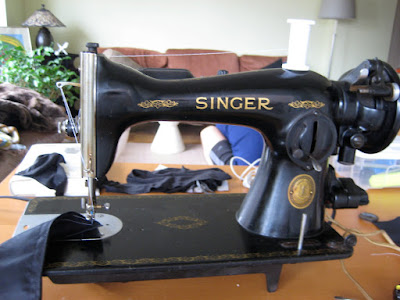
Readers, I was this close to buying a vintage Singer 401A sewing machine at the flea market yesterday.  The dealer was asking $80, but I'm pretty certain he'd have taken less.  It came complete with a box of slant attachments and a very nice carrying case, and it looked like such fun.

But I exercised some restraint (for a change) and walked away.  Let someone else buy it who really needs it, I thought or did I actually say it out loud?

I don't have the space and I don't need the clutter -- physical or mental; I have a lot of sewing to do.  Despite last winter's eight-machine purge, plus my impulse gift to Rain of a Singer 15-90, I still have what feels like an awful lot of vintage sewing machines:

Singer 15-91


Singer 99


Singer 221 Featherweight


Singer 66 treadle


Pfaff 30
 

Pfaff 139 zigzagger
 

Viking 3240 zigzagger


Plus my Brother 1034D serger -- which has performed flawlessly for more than 16 months.


That's a lot of sewing machines, no? 

No, I can't justify one more sewing machine, unless it were a vintage Elna Lotus, of course.  (If you know some good reasons for skipping the Lotus, please share them.)

I feel proud of myself and I know you feel proud of me too.  I mean, maybe if I had a dedicated room solely for sewing machines, as some of you have.  But I live in an apartment, and wherever I happen to be sewing, a lot of other things are going on too, including cooking, blogging, and chihuahua wrestling.


Still, every time I let a deal like the aforementioned Singer go by, I feel a brief pang of regret -- like, it would have been worth the money just to play with the machine for a while, and then pass it on to a sewing machine hoarder friend like Rain or Johanna.

I often get emails from MPB readers telling me about the fantastic deals they got via their local Craigslist or some estate sale.  The same reader I mentioned a few weeks ago whom I'd advised on a purchase of a Singer 99K (the very same day I found my 99K) just sent me this:

For $50 he picked up this stunning Singer 201 complete with attachments, table and stool!


Does this email seem a little insensitive to you, readers?  I always try to see the good in people.  He no doubt wanted to share his good fortune with me.  And who doesn't enjoy sharing others' (extraordinary) good fortune? 

In closing, friends, today I'd like to focus not on the things we have, but on the things we have chosen not to have.
  • Because we exercised some self-discipline. 
  • Because we were responsible adults to our insatiable inner children and said no, not this, not now.  
  • Because it was the right thing to do.
Tell me about a deal you passed up.  A good deal -- no, a great deal.  Tell me about how you at first tried to rationalize the purchase but ultimately resisted, and why.  Tell me how you never regretted it.

Make me feel better!

Wednesday, 18 May 2011

FASHION POLICE 101 or "How to Tell Someone You Love You Hate Their Outfit"


So I have this friend...

Hold it right there, I know what you're thinking: this is the oldest plot device in the book, used in every third episode of The Brady Bunch.  This is not about Cindy's friend, it's about Cindy.


I am shocked at your disbelief, readers, shocked.  Next, you'll be telling me that I don't have an identical cousin, when that rumor has been put to rest again and again, and again.

But back to my friend.

He's not the most stylish person in the world -- in fact he's something of a slob -- but he does know what goes with what, and has been a follower of fashion for many, many decades.

Now, the man he shares his life with is arguably much neater than he. But it's the what-he's-neat-with that's the problem.


You see, the partner of my friend has a tendency -- some might say a  compulsion -- to wear clothes that are alternately too large (baggy twenty-year-old pants), or too tight (think former Olympic gymnast Mitch Gaylord), or too something (over-bleached acid-wash jeans)  And while there's nothing wrong with mixing patterns occasionally, said mixing requires a great deal of care and skill, and an eye, readers, an eye -- or so my friend believes.

The problem my friend has is what to do about his admittedly-judgmental-sounding opinions.  You see, he believes -- with good reason, it turns out -- that his partner will sometimes intentionally mismatch patterns or otherwise dress provocatively, solely to push my friend's buttons.  He (the partner) told him (my friend) as much!

My stylish-if-slobby friend, in contrast, happily solicits others' advice and is open to receiving it, never interpreting it as threatening or challenging or nobody's business but my his own.

Stylish and sophisticated readers around the world, have you ever found yourself in my friend's cute-if-scuffed shoes?  If so, how do you handle it?

Some of you will say that if you love someone, as I know my friend does his partner, that you accept them as they are, end of story.  Some, perhaps with a few years of psychotherapy under their belt, might even argue that the problem is my friend's and only my friend's.  He is the one who is seeking to control another by criticizing his partner's choice of outfits -- never a healthy strategy in any relationship.

Some might say, moreover, that personal style is entirely subjective and that what my friend thinks looks unflattering on his partner, others will find just the opposite -- that there's no objective truth to what looks good and what does not, beauty being in the eye of the beholder and all that jazz.

Then there will be other more empathic souls who know that adults who dress themselves poorly need guidance and are only inviting the criticism of others.  Better that the loved one offer constructive criticism in private than a stranger his 2-cents in public.


In closing, readers with no-doubt highly-honed, read-between-the-lines abilities,  I ask you:

Should you tell someone you love you don't like what they're wearing (with the confidence that you know what you're talking about) or shouldn't you?

How do you handle giving advice to someone you love, when no advice has been solicited, and it might make them feel criticized?

Or if you don't give unsolicited advice, do you just keep quiet, offer (at most) a none-too-subtle, up-and-down look of dismay and leave it at that?  Do you ever ask if the person is open to your opinion, knowing full well that the very question suggests disapproval?

I need guidance -- to share with my friend of course.  Crimes are being committed.

Jump in!