Tuesday, 28 June 2011

"The Five Senses" At The Mark For Events... (:


Reinvention Specialist/Matchmaker Renee Piane, http://www.reneepiane.com/,  performer Lynn Rose, Mixocologist Nikolas Potocic, public relations expert Lisa Schneiderman and Kelly Breaux http://www.hooppitopworldwide.com/

Last nite, The Five Senses at The Mark for Events  (9320 W. Pico Boulevard -http://www.themarkforevents.com/) celebrated Biz Bash Nominees and Winners for 2010. Well attended by Event Industry leaders, the party featured terrific Molecular Cocktails by Nickolas Potocic and Grey Goose Vodka, a beautiful exhibit of World Portraits by Stephen Bennett, the dream-pop sounds of the Hear&Now Band, awesome Belly Dance by Josie Dance, a cool aroma therapy station and delicious cuisine by master culinary Chef Thomas Rivera.  Great Angus Sliders, Gruyere Gorges and shortrib stuffed mushrooms with Port Wine Glazewere  were the standouts for me...  "Goodbye diet"...for the nite(:  For more info about The Mark please contact Victoria Graham at vgraham1@me.com or Renee@ReneePiane.com  . Great Event.....   HH(:
Josie Dance
     www.youtube.com/josiebellydance
Charlie Charles of the band Hear&Now www.myspace.com/hearandnowband  and band manager/filmmaker Rodney Charles http://www.rodneycharles.com/
Nickolas Potocic http://www.oneevents.biz/

The Celebrity Pitch


Readers, many volumes have been written about advertising and its role as lubricant in our (rapidly rusting) consumer culture.  But after reading the many excellent comments to yesterday's post about models, I wanted to talk more about it. 

Reader Some Girl made a great point, that the message behind much of today's fashion advertising is "People who are this perfect wear our brand" as opposed to, by wearing such-and-such a brand (or label) you will look more whatever -- beautiful, alluring, sophisticated, etc.

I mean, how sophisticated can anybody look in their underwear?


The celebrity ad seems to operate in both realms.  We want to buy Lux soap flakes (up top) because Jane Wyman uses them, and because by using them we'll end up looking more like Jane Wyman.  (Wait -- am I the only one who still wants to look more like Jane Wyman?)

Consider this contemporary Louis Vuitton ad campaign, which I'm guessing most of you are familiar with.


That's Mikhail Gorbachev, the last head of state of the former USSR, and -- ahem -- not exactly a fashion plate.  Why on earth would anyone care what kind of luggage he uses?  Well, apparently whoever designed the ad campaign believes someone in their target market does care.

Here's another in the series.  Obviously, women without shoes are serious women, who have more important things to worry about.  Which is not to take anything away from Angelina Jolie -- a UN Goodwill Ambassador after all -- and what should she be carrying, a recycled burlap tote?


In the highly competitive luxury goods market, who knows what works and what won't?  When I was growing up, this Blackglama mink ad campaign was in full swing and I loved following them to see which old-time star would show up next. 


I wonder how many coats Joan Crawford really moved...but I digress.

Readers, are you seduced by celebrities in ads?  Are you able to see beyond the movie star and focus on what is being advertised?

On a somewhat related note, do ads featuring scantily clad, dissipated teenagers make you want to head off to the mall to buy jeans, gulp down a few Excedrin -- or both?


As in so many areas of life today, we seem to be throwing everything at the wall in hope that something will stick.  Nobody seems to know what works.

I had a sort of epiphany yesterday while tut-tutting over that Banana Republic "Inspired by Mad Men" photo: It doesn't matter what I think.  Those clothes are not supposed to work for me.


Their target market is likely decades younger, someone with no living memory of the styles, to whom this stuff looks fresh and edgy, not stale and derivative.

As so many have mentioned, the Sixties revisited the Twenties, the Seventies the Forties, and so on.  A lot of those styles were lifted piecemeal, without much reinterpretation.  Remember these record albums?


So what's wrong with a little early Sixties in the -- what are we in again, the teens?

Friends, I could talk about advertising all day, but I really must get a move on.

If you were advertising something like, say, Louis Vuitton luggage how would you sell it?

Is associating a bag with a former head of state a cynical ploy, a brilliant strategy, or both?

Why do we still fall for this stuff?  (Note to self: shower, change underwear, smile.)


Monday, 27 June 2011

Hamilton-Selway Fine Art Presents HSUS Reception with Wayne Pacelle Sunday, June 26th....


Wayne Pacelle author of the "The Bond"  and president of the The Humane Society of the United States (center) is joined by Filippo Marchino and Jenella Anderlie (left)  and Phil Selway of Hamilton-Selway Fine Art with producer director Mira Tweti (far right).


Nicki from Book Soup (:


Above, some of the art at the Gallery
During his tenure as CEO of The HSUS, Wayne Pacelle has successfully led more than 25 statewide ballot initiatives-including measures to outlaw cockfighting, factory farming abuses, bear baiting, and a range of other inhumane practises.  He and The HSUS (ww.humanesociety.org) have worked to pass 1,000 laws and more than 25 federal statutes to protect animals in the last decade.  In his book "The Bond" he seeks to disentangle the contradictory attitudes in our relationships with animals and to shows us a better way forward.  Wayne Pacelle has become America's foremost voice for those who cannot speak in their own defense, and has helped to bring animal protection from the margins to the mainstream.   

Models Then and Models Now


Friends, I'm back and ready to take on the world.  Of modeling.

Suzy Parker.  Dovima.  Jean Patchett.  Lisa Fonssagrives.

These are just a few of the most famous models of the 1950s and early 60s.  Like today's models, they were beautiful.  They were young.  And they were ballerina-skinny.


In those days, models modeled and that's about it.  They didn't star in reality shows (though Suzy Parker did have a role in The Best of Everything and a few other films) and they weren't seen much outside of magazine layouts and ads.  But they were recognizable and certainly embodied a standard of beauty and glamour (maybe more the latter than the former) few non-models could ever match.


Readers, what's different about models then and now?  Why do so many people focus on models today and critique their (genetically) tall, thin bodies? 


Haven't models always merely represented a highly art-directed ideal, human clothes hangers that showed off a dress to its best effect?


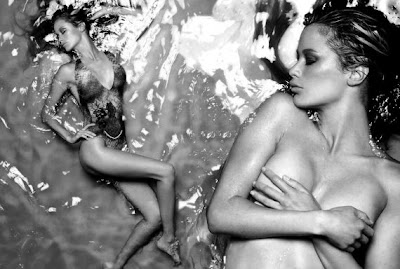
When I was looking at photos of models then and models now, the greatest difference I noticed was the amount of skin models are expected to display today.  Skimpy underwear, bikinis, nude shots -- almost nothing is left to the imagination.


Though Fifties models appeared in swimsuits, these tended to be modest one-piece numbers, as was the style back then, and the images were never sexually provocative, but rather, wholesome.


Direct sexuality was the stuff of pin-ups and other "adult" material (think Betty Page).  Today there's very little difference, aesthetically.  And this isn't just true of female models -- men are also expected to pose provocatively in underwear or nothing at all.


In the Fifties, women's clothes may have been restrictive and demanded corsets and cinchers, but the models bodies were covered.  Nudity was rare.


It's as if today, when so much of fashion is standardized, we're more interested in the hanger than the clothes.

Wise readers, your thoughts.

Just so we're on the same page, I'm operating under the assumptions that 1) models are more visible today, thanks to television and the Internet; 2) modeling itself is much more mainstream and often seen as a springboard to an acting or business career; 3) models -- their weight and how they are represented -- are more a focus of women than they were in generations past.  You may or may not agree with these.

Does the increase in nudity reflect our more body-conscious, sexually liberated times?  Does the constant exposure to models' (photoshopped always) bodies create more self-image problems for women than the more covered-up, highly stylized models of generations ago?

I'll have more to say about this later in the week, but why do these Banana Republic ads look like children playing dress-up...


...compared to the real thing?


Is it the makeup, or is it a life spent wearing corsets, heels, and gloves, that make the original models look mature and comfortable and the 2011 models look synthetic, derivative, and awkward?

Jump in!

Friday, 24 June 2011

Hope U Had A Great Week... Have A Great Weekend... HH(:

 Tina Saddington (center) was so good in a reading of the play "Private Practise" written  by our mutual friend  Dallas Bancroft.

Tuesday, 21 June 2011

The $4.6 Million Dress


Friends, by now you've all probably heard about the Debbie Reynolds Hollywood costume and memorabilia auction that happened last weekend.  The big news: Marilyn Monroe's infamous "subway dress" went for $4.6 million.

For that price it should have sleeves.


(NOTE: you can download a PDF of the auction catalog here, and I highly recommend you do.  It was an amazing collection  and beautifully documented in this catalog.)

Ten years ago I saw the soon-to-be auctioned Marilyn Monroe memorabilia collection on display at Christies and saw the famous Jean Louis "Happy Birthday, Mr. President" barely-there gown.  That one fetched $1,150,000, which seems like a bargain by comparison.  And it was beaded.


As you know, I am a huge old movie fan and melt at the sight of costumes from classic films.  I've blogged about the Diana Vreeland costume exhibit I saw in the Seventies at the Metropolitan Museum of Art as a child, as well as some of my favorite movie gowns.

Debbie amassed her collection over more than forty years, with a dream of founding a Hollywood memorabilia museum that never quite happened.


The whole thing makes me sad, for Debbie and for us Americans.  What larger cultural contribution has America made than "the movies" a.k.a., Hollywood?   As I said to someone yesterday, with all the billionaires we now have in this country, couldn't somebody cough up, say, $100 million to keep Debbie's collection intact and viewable by the public?   The fact that a dress associated with a famous star could fetch millions reflects the huge, lasting interest in Hollywood history.


Wise readers, your thoughts, please.

Why is this (Marilyn) dress so valuable, other than that we've seen that image upteen times till it's embedded in our DNA?  Is it really all that?  Have you ever seen The Seven-Year Itch (the movie the dress is from)?  It has not aged well, to put it mildly.

Also, do you think these costumes belong in one place -- i.e., a museum -- or is it only fair that they go to those who have the most interest in owning them and perhaps chopping them up into quilting squares and throw pillows? 

Is it important, given that the costumes can be seen, as they were intended to be seen, in the films themselves?

I'd love to hear what you think.

I'm going to be gone the rest of this week as I'll be taking care of my mother who gets out of rehab after her hip replacement today.  My mother doesn't have a computer -- she tried to master one about five years ago and failed -- nor does she have DSL or any other type of Internet service.  Her neighborhood, moreover, though just a (long) subway ride from where I live, is a wi-fi black hole.  I will be thoroughly disconnected -- pray for me.  I hope to return to daily blogging next week.

BTW, please feel free to read other blogs during my absence. It's healthy and can only strengthen our relationship, in the long run.

Have a great week, everybody, and see you soon!