We interrupt my work on a drawing of the three members of De La Soul for my currently-in-the-works, to-be-self-published book to bring you this special bulletin.
I don't know what Crutchfield is--the name sounds like a Syfy Original Movie(*) ripoff of Cloverfield--but I'd like to thank the site for a mostly positive review of the Fistful of Soundtracks channel that it posted a few weeks ago.
(*) Speaking of which, Battle of Los Angeles? Really, Syfy? Next time you run out of title ideas for your original movies, how about you take a cue from your own station tagline and imagine greater?
I've seen so many blogs with kind things to say about AFOS--and I always appreciate that--but they always get one or two tidbits about AFOS or me wrong. Crutchfield's review has none of that "every now and then it plays a random old movie trailer" bullshit. The reviewer actually did his homework and took the time to listen closely and note that "they aren't placed at random. If you hear the trailer for Big Trouble in Little China, you can be sure that the next selection will be from the soundtrack of that film." (However, for some odd reason, he never once uses the word "score" in his review to distinguish between "soundtrack" and "score.")
The reviewer wishes my channel had a better-quality bit rate and is probably wondering why it's just 32 kbps. Lengthy answer: I'm broke.
Showing posts with label Big Trouble in Little China. Show all posts
Friday, 18 March 2011
Thursday, 31 December 2009
Five favorite expanded or limited-edition score albums of 2009

Manigong Bagong Taon. This is the only year-end list I will do because I hate doing these year-end things. Selections from all five of the following CDs can be heard during "Assorted Fistful" on the Fistful of Soundtracks channel.

5. Big Trouble in Little China (La-La Land)
The cheesy end title song, in which director/composer John Carpenter does his own singing, hasn't aged as well as the rest of Carpenter's score or the movie itself, which remains subversive for giving its Asian American characters a chance to shine as the heroes of the piece for once in a genre that still doesn't care for Asian American protagonists (and no, Jackie Chan doesn't count as an Asian American lead, shitbird).
4. Batman: Mask of the Phantasm (La-La Land)
La-La Land followed up the long-overdue Batman: The Animated Series box set with an expanded version of the score from the show's 1993 feature-length spinoff. Before Christopher Nolan came along, the Bruce Timm incarnation of Batman was the definitive screen take on the Dark Knight. Batman: The Animated Series was also beautifully scored by the late Shirley Walker, who provided music for Phantasm that's both powerful and playful (the choir is actually singing backwards pronunciations of the names of Phantasm crew members and orchestrators).
3. The Split (Film Score Monthly)
I was on a Donald E. Westlake kick during the summer because of the release of Darwyn Cooke's adaptation of The Hunter and the debut--in any format--of an unknown and very sampleworthy Quincy Jones score to a forgotten 1968 Jim Brown flick based on The Seventh. Say the following five words--"caper movie score by Q"--and I'm there, baby.
2. Star Trek II: The Wrath of Khan (Film Score Monthly)
One cool thing about FSM's reissue of the Khan score is that it gives listeners the option of hearing the film's end title music without Leonard Nimoy's voiceover, an element of the 1982 Atlantic release that annoyed those who prefer not to hear dialogue during score albums. Also, it's nice to finally have the complete score. Somewhere, Ricardo Montalban's smiling.(*)
(*) I hate that Flanders-esque catchphrase from Fantasy Island. It's mostly because a former co-worker I couldn't stand liked to say "Smiles, everyone, smiles" a lot.

1. Bullitt (Film Score Monthly)
FSM also stands for Fulla Surprises, Man. Sometimes, I won't visit the FSM site for weeks, and I'll miss announcements like the debut release of Lalo Schifrin's Bullitt score as it was heard in the film (Schifrin's 1968 and 2000 re-recordings of his score, one of which is included on the CD, are both decent, but I always preferred the way the score originally sounded in the film). I didn't know about FSM's Bullitt CD until a couple of weeks ago and immediately snapped it up. The Bullitt score is my second favorite Schifrin film score after Enter the Dragon. The main theme has been covered so often that it's a shame the original rendition hasn't been available on CD until now.
Monday, 21 September 2009
My starting six for Asian American cinema
A discussion about supporting Asian American cinema inspired blogger and R&B/hip-hop scholar Oliver Wang to invite experts on Asian American cinema to post their lists of six films they would recommend to people whose idea of an Asian American film is Rush Hour. Phil Yu of angry asian man, who helped spread the word about Wang's little starting six project, contributed his own starting six and had a couple of surprising picks on his list, like the corny Flower Drum Song, which he even admitted had some cheesy moments.I saw Wang's starting six and wanted to post my idea of a starting six on my blog to show people who are underwhelmed by a lot of Asian American cinema that there are a few gems out there.
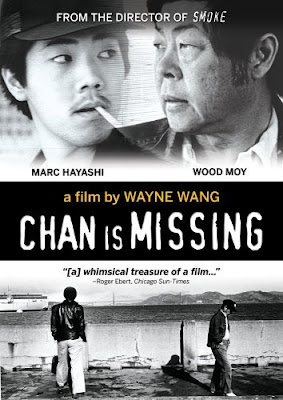
1. The Breakthrough Film: Chan Is Missing (director: Wayne Wang, 1982)
I first saw Wang's comedy about assimilation and Asian American identity on KQED when I was in high school, and I dug how the film is unsentimental, smart and documentary-like, whereas Wang's other signature Asian American film, the Joy Luck Club adaptation, is annoyingly sentimental, syrupy and cartoonish, with a point of view that constantly and Frankenstein-ishly screams out "Asian man bad!"
2. The Serious Filipino American Film: The Fall of the I-Hotel (director: Curtis Choy, 1983)
This outstanding hour-long documentary about the razing of San Francisco's Manilatown is a landmark work in the short history of Filipino American cinema, and it contains powerful footage of the 1977 protests against the eviction of 50 manongs (elderly Filipinos) from their soon-to-be-demolished Manilatown residential hotel.
3. The Actioner: Big Trouble in Little China (director: John Carpenter, 1986)
Twentieth Century Fox marketed BTILC as a movie in which Kurt Russell's Jack Burton is the hero ("Jack Burton's coming to rescue your summer"). In actuality, Jack is the buffoonish sidekick in a role that's usually reserved for the Asian guy, while the real heroes of the piece are the resourceful badass Wang Chi (Dennis Dun) and the wizardly tour bus driver Egg Shen (Victor Wong). That sly and subversive role reversal is one of the reasons why I admire Carpenter. It's a shame that no Asian American filmmaker has yet made an Asian American-centric action flick as enjoyable and empowering for APA viewers as BTILC (Enter the Dragon and later vehicles for the likes of Brandon Lee, Keanu Reeves, Jackie Chan and Lucy Liu don't count as APA-centric). When are we going to see the APA equivalent of Sweet Sweetback's Baadasssss Song, Shaft, Coffy or El Mariachi?
4. The Humorous Filipino American Film: The Flip Side (director: Rod Pulido, 2001)
José Sáenz is a comedic standout as an untalented Pinoy baller who thinks he's black in the most obscure of my six choices (it's never made it to DVD). Though Pulido's only feature film is more like an 80-minute sitcom than a movie, I prefer it over The Debut, and the sharpest and most dead-on parts of Pulido's screenplay deal with Pinoys who wish they were black and Pinays who pass themselves off as "Hawaiian," whitewash their looks and date only white guys. No other Asian American feature film has irreverently poked fun at self-hating Asian women like The Flip Side did (c'mon Pinoy screenwriters, it's time to rip Michelle Malkin a new one like Law & Order: Criminal Intent and Boston Legal did to Nancy Grace).
5. The Indie Film: Better Luck Tomorrow (director: Justin Lin, 2002)
I prefer the pre-MTV Films version with the ballsier, Taxi Driver-esque ending over the final cut with the slightly modified ending. The conclusion Lin opted for in the final cut is like if Martin Scorsese took Paul Schrader's Taxi Driver screenplay and tacked on a couple of lines at the end in which Travis Bickle says he plans to turn himself in for murder because he suddenly felt sorry for slaughtering all those pimps.
6. The Mainstream Film: Harold & Kumar Go to White Castle (director: Danny Leiner, 2004)
This hilarious cult favorite annoys Asian American film scholars who find it misogynist and slam it for being lowbrow. But it's lowbrow humor for smart people, and even Stephanie "Actresses with not-so-toned bodies should be allowed to do nude scenes too" Zacharek didn't call it misogynist and enjoyed how it's "so unaggressive in the way it addresses the issue of what it means to be a minority in this country that it coaxes you into thinking about it." (If those haters want to see better-written female characters, the somewhat inferior sequel Harold & Kumar Escape from Guantanamo Bay is up their alley. It appears to have been written to appease them.) The fact that many Asian American viewers like myself find Harold & Kumar--which was written and directed by white guys--to be more accurate about our experience than rather shrill and heavy-handed indie dramas with similarly aged lead characters made by Asian American filmmakers is a sign that those indie filmmakers need to step their game up.
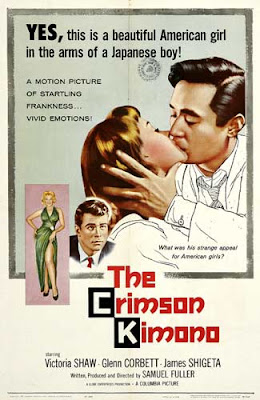
Six honorable mentionsThe Crimson Kimono (director: Samuel Fuller, 1959)
A lengthy Asian male/white female kiss in 1959? Wow. We have Fuller and his brass ones to thank for that.
Who Killed Vincent Chin? (directors: Christine Choy and Renee Tajima-Peña, 1987)
I don't think I can watch this hard-hitting staple of Asian American studies movie screenings again because the subject matter infuriates me so much.
Robot Stories (director: Greg Pak, 2003)
Matt Zoller Seitz is right. This low-budget anthology from Greg, whom I'm honored to be in the same graphic novel with, is a great sci-fi movie. It contains several terrifically written roles for actresses of color. Lesser-known actresses like Wai Ching Ho (as a grieving mother with a comatose son) and Julienne Hanzelka Kim (as a laconic yet very expressive android) are among the standouts in the cast. If that silent movie I always wanted to write ever gets made, Kim would be perfect for it.
Sucker Free City (director: Spike Lee, 2004)
I know it's a made-for-TV Spike Lee Joint, but this Alex Tse-penned unsold pilot about San Francisco gang life, which co-stars the always superb Ken Leung, premiered first at the Toronto International Film Festival before debuting on Showtime. It ranks with the Twin Peaks and EZ Streets pilots as one of the best feature-length pilots ever made, and it's a more satisfying Tse film than Tse's Watchmen adaptation.
The Motel (director: Michael Kang, 2005)
I appreciate how this indie comedy has none of the formulaic touches that Rotten Tomatoes Show hosts Ellen Fox and Brett Erlich skewered in their "Ode to the Indie."
Beerfest (director: Jay Chandrasekhar, 2006)
The first Broken Lizard flick I ever saw is the funniest one the troupe has done so far, with a hilarious performance by Chandrasekhar as a fallen beer pong legend who's turned to whoring himself out and giving $15 "ZJs."
Coming either later this year or next year: My starting six for Asian American comic books and graphic novels.
Tuesday, 25 August 2009
Extra mozzarella: Do the Right Thing concept art and behind-the-scenes photos from Spike Lee's companion book

After posting a bunch of interesting Batman concept drawings and set photos from the 20-year-old blockbuster's official movie souvenir magazine, I'm doing the same thing with a similar tie-in for summer 1989's other landmark film, Do the Right Thing. But instead of an official movie mag, the Spike Lee Joint spawned a now-out-of-print Fireside/Simon & Schuster companion book that Lee wrote with the assistance of ex-girlfriend Lisa Jones. The director has done several companion books for his films. Each of these books contain behind-the-scenes photos, the film's script and Lee's own production journal (some of the Do the Right Thing journal passages are like tweets with better spelling: "Haven't written in a couple of days. I've been busy trying to save School Daze from being dogged.").
(WARNING: Spoilers ahead. Yes, there are people out there who still haven't watched Do the Right Thing yet. They're like people who never saw Ghostbusters. They're weirdos.)

I've discussed before why Do the Right Thing is one of my favorite films and why writers of color like myself cite it as an influence. One aspect of the film that I don't think gets enough props is the terrific production design by Wynn Thomas, who drew this sketch of the We Love Radio and Sal's Famous Pizzeria set exteriors. Using an old Coney Island pizzeria as the basis for Sal's, the film's crew built it from scratch on an empty Bed-Stuy lot. "The ultimate compliment was when real people would walk off the street and try and buy a slice," said Thomas in an L.A. Times oral history about the movie. Thomas later created nifty-looking sets for Mars Attacks! and brought CONTROL Headquarters into the 21st century for Steve Carell's Get Smart.

Clockwise: The sets that are listed on this Do the Right Thing ground plan are the neighborhood church; generator storage; the home belonging to John Savage's gentrifying yuppie character; Da Mayor's home; the Puerto Rican stoop; We Love; Sal's; the street corner inhabited by the trash-talking Greek chorus of ML (Paul Benjamin), Coconut Sid (Frankie Faison) and Sweet Dick Willie (the late stand-up comic Robin Harris); the Korean market; Mother Sister's home; and Jade and Mookie's apartment. I like how the "Corner Men" are included on the ground plan. In the journal's February 21, 1988 entry, Lee wrote that he wanted to give Harris a part in which he could ad-lib ("I wouldn't dare to write his dialogue"), and a corner man character would be perfect for him. It sure was.

Rosie Perez, who at the time was a Soul Train dancer who was making her big-screen debut in Do the Right Thing and was a reason why its main titles are one of the illest openers in a film ever, sits with the child actor who played her character's son and his triplet brothers.

I'm posting this pic of Steve Park as Sonny the irritable Korean grocer simply because pics of Park or his Do the Right Thing character never turn up in Google image searches. Park will always be cool in my book for putting the Friends crew members on blast in 1997 because of a staffer's racist treatment of James Hong when both actors guest-starred on the sitcom. Lo Pan should have fried that douchenozzle's ass with his laser beam eyes.


Several of the most fascinating quotes in the companion book's photo gallery came from Giancarlo Esposito, who played wannabe activist Buggin' Out.

According to Lee, "At the last moment, Paramount asked me to change the ending. They wanted Mookie and Sal to hug and be friends and sing 'We Are the World.' They told me this on a Friday; Monday morning we were at Universal."

The Do the Right Thing crew, which shot the film from July to September 1988 and helped start diversifying New York film crews by employing mostly black crew members, poses in front of the We Love set.

Heat storyboard artist and Danny Deckchair director Jeff Balsmeyer drew these boards for the harrowing scene in which cops murder Radio Raheem. "If in a review, a critic discussed how Sal's Famous was burned down but didn't mention anything about Radio Raheem getting killed, it seemed obvious that he or she valued white-owned property more than the life of this young black hoodlum," said Lee to the L.A. Times. "To me, loss of life outweighs loss of property. You can rebuild a building. I mean, they're rebuilding New Orleans now but the people that died there are never coming back."


In Living Color once poked fun at Lee's "skinny legs and big feet." In Balsmeyer's storyboards for the Trash Can Toss Heard 'Round the World, Mookie looks like he's been hitting the NordicTrack.
Subscribe to:
Posts (Atom)
