Showing posts with label Spike Lee. Show all posts

Thursday, 13 October 2011

Every day I'm shufflin'

And no sappy James Horner ballads from James Cameron movies either.
Even though trying to keep track of the nearly 64 hours of music that are stored in A Fistful of Soundtracks' "Assorted Fistful" playlist (plus the two hours of music that make up AFOS' "Rock Box" playlist) can occasionally be a hassle, running AFOS(*) is a pretty simple task. I just hit "Shuffle" and Live365.com does the rest.

(*) It's AFOS. No bloody FOS or FFOS. It's always been AFOS. I've always wanted to shorten it to just AFOS because the acronym AFOS can stand for many different phrases besides A Fistful of Soundtracks, and I once jotted down a list of 12 of them (examples: "Ample Focus on Scores" and my personal favorite, "Asians Fucking Owning Shit"). The current iTunes Radio description of "Fistful of Soundtracks" is nine years old (it's taken from a summary of AFOS that I typed into Live365.com when I first launched AFOS over there in 2002, back when Live365 wouldn't let radio stations have names longer than 22 letters for some stupid reason). iTunes has never bothered to replace the old description with a present-day one.

Sometimes, weird things I have no control over start to happen on AFOS when it's in shuffle mode.

I'm not Jewish, but I'm all for seeing someone make another Hanukkah movie like The Hebrew Hammer and not so much like Adam Sandler's Eight Crazy Nights.
Mel Gibson, who's so famously fond of Jews, gets followed by a Jew.

To anyone who's sick of hearing 'Eye of the Tiger' and didn't like hearing it repeated that day, it wasn't intentional. I apolog... Nah, fuck that. Complaints from AFOS listeners are like the coverage of the Republican presidential candidate race: I don't give a flying fuck.
Yeah, I like "Eye of the Tiger" too, Live365, but I don't like it as much as you do apparently.

Where the Wild Things Are had a deleted scene where two of the island beasts have a three-way with Matt Dillon.
Same thing with the movie Wild Things...

Heh-heh, Asgard.
... or the end credits music from Thor.

'Corynorhinus'? Wasn't he one of the Coreys who starred in The Lost Boys?
Two different incarnations of Batman getting streamed back-to-back always amuses me...

Hey, Fox Movie Channel, HBO circa 1982 called. It wants its constant re-airings of Zorro, the Gay Blade back.
... as does Angel, Batman and Zorro getting streamed in the same hour. (Angel is like the Batman of the Whedonverse. Batman was modeled partly after Zorro. Also, in DC's pre-"New 52" continuity--I'm not sure if it's been changed in the current continuity--Bruce Wayne lost his parents to a mugger after they attended a Mark of Zorro screening. If it were a Legend of Zorro screening, all three Waynes would have lost the will to live and killed themselves afterward.)

The chase begins again and again and again...
Live365 occasionally does screwy things to the Bollywood-centric "Chai Noon" block. Das racist!

Shuffle mode sometimes results in nifty unintentional double shots or triple shots like:

Tessa from Suburgatory thinks the playlist is shitty.
Brian Tyler Fast and the Furious sequel theme double shots.

If Coffy and Foxy Brown had to fight each other, who would win? Everybody would win. It'd be one of the sexiest-looking fights ever.
Pam Grier movie theme double shots.

Killing off Jim Kelly in the middle of Enter the Dragon was kind of a mistake because he had the movie's most memorable lines. He could have easily defeated the metal-handed Han by whupping out a giant magnet or something.
Jim Kelly movie theme double shots.

 In Justin Lin's Finishing the Game, star Roger Fan slathers so much suntan oil all over his chest that he looks like a shiny Asian Ken doll.
Themes from movies about Bruce Lee movies getting streamed in the same hour.

I like how Ronald D. Moore refused to give Commander Adama a Star Trek-style chair inside the CIC on Galactica because sitting on your ass in front of a TV screen is for the weak! Here. On the street. In competition. A man confronts you...
Battlestar Galactica/Star Trek double shots.

You gotta love a movie that names its villain after film critic Andrew Sarris.
Galaxy Quest/Star Trek double shots.

The Battlestar Galactica series finale was disappointing because it didn't bother to address if Bob Dylan was a Cylon or not.
Trek/Galactica/Galaxy Quest triple shots.

I once heard a female British radio DJ hilariously mispronounce Michael Giacchino's last name as 'gee-uh-chee-no.' 'G, a Chino!' is something a cholo says to another cholo when he spots some poor middle-aged Vietnamese woman that he wants to carjack or mug.
J.J. Abrams/Michael Giacchino collabo triple shots.

Hans Zimmer and Johnny Marr's cover of that Boy George song 'Time (Clock of the Heart)' was the best part of the Inception soundtrack.
Christopher Nolan/Hans Zimmer collabo double shots.

Michael Giacchino comes up with the most amusing names for his end credits cues, although I would have titled it 'Up Your End Credits' to piss off Disney.
End credits music quadruple shots.

All that's missing is music from Run, Ronnie, Run. On second thought, maybe acknowledging that movie's existence isn't a good idea.
"Movies with Run in the title" double shots.

During The Long Goodbye, Arnold Schwarzenegger shows up looking very dignified and California governor-like in a goofy pornstache.
"Unexpectedly gory L.A. movies" double shots.

With his rolled-up blazer sleeves, Spike Spiegel may be the only bounty hunter on TV and film who dresses like a shitty '80s stand-up comic.
Live365 once caused a weird pattern in which a theme from a Spike Lee Joint ended up getting followed by a Cowboy Bebop track--twice in a row. I hope someone on Deviantart was listening to AFOS during that hour and thought about drawing a Spike Lee/Spike Spiegel mash-up someday. Make it happen, Internet!

Did NBC cancel Poker After Dark? If they did, that's too bad because if you had trouble sleeping late at night, Poker After Dark was a show you could always rely on to help you fall asleep because it was so fucking boring.
Wilfred the Matt Damon-loving dog must have tried to sabotage Live365 during this hour.

Friday, 5 August 2011

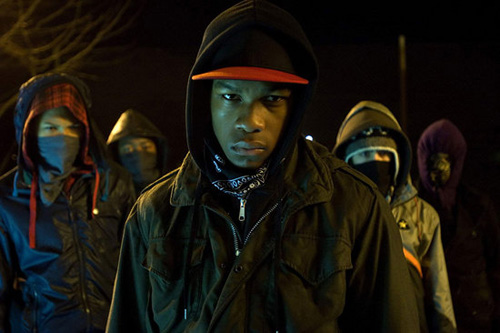
Attack the Block is the best summer movie you've never heard of

Moses is chuffed that he can see his flat from here.
Edgar Wright is a filmmaker whose film and TV work I've enjoyed so much that if the Shaun of the Dead and Hot Fuzz director tells me to jump off a bridge, I'll happily do it, but with a bungee cord tied around me. Or if Wright tells me during Doug Loves Movies or on Twitter to see a movie he co-executive-produced like Attack the Block, I'll go see it, even if it's only playing in eight theaters across the country, and I have to hop on a couple of planes, a train and an automobile to get to one of those theaters (luckily, that theater is the Metreon in San Francisco, so I didn't have to go very far).

I first heard about Attack the Block during a Doug Loves Movies episode recorded at SXSW with last-minute guest Simon Pegg (who showed up without his frequent collaborator Wright by his side but busted out a dead-on impression of his absent friend). At SXSW, Attack the Block was so well-received that Sony Pictures' Screen Gems division acquired it for distribution in America, and since its release last week, everyone from Wright himself to author Nelson George has taken to Twitter to urge everyone to see this little film that Screen Gems has barely advertised on TV. Attack the Block contains a wonderful premise that's never been done before (in a South London ghetto, both a predominantly black teenage gang and the white female nurse they mugged are pitted against extraterrestrial monsters) in a genre that's been done to death (the alien invasion genre--between the Steven Spielberg-produced TNT drama Falling Skies and three other Spielberg productions, Super 8, Transformers: Dark of the Moon and Cowboys & Aliens, aliens have had a busy summer). The directorial debut of British comedian Joe Cornish (who also wrote the screenplay), the low-budget actioner has no familiar faces in the cast, aside from Venus star Jodie Whittaker and Wright regular Nick Frost in a comedic bit part as a weed dealer, and most of the stars speak in lower-class British accents as thick as Dizzee Rascal's (for folks like me who are familiar with artists like Dizzee or The Streets, that kind of accent isn't too difficult to decipher, but for the rest of the moviegoing audience in America, it's like Klingon). So no wonder Screen Gems is giving Attack the Block a limited release and cautiously unveiling it to an audience that prefers their alien-invasion flicks to be bigger-budgeted, smoother-accented and well, let's face it, dumber.

Okay, Attack the Block isn't quite Shakespeare, but it has a certain inventiveness and vitality that's missing from all those aforementioned Spielberg-produced 2011 alien-invasion projects that aren't Super 8, although the treacly Falling Skies is redeemed by the presence of Colin Cunningham's not-so-treacly biker character Pope. Cornish's film takes its cues less from Spielberg and more from both Frost's previous film Shaun of the Dead and early John Carpenter, particularly one of my favorite Carpenter movies, the original Assault on Precinct 13, from its ghetto backdrop to its unconventional choice of a hero, a black wannabe thug who's like a mash-up of Precinct 13's two leads, Austin Stoker's untested black cop and Darwin Joston's antiheroic white convict. (Voice actor Yuri Lowenthal of Ben 10 fame calls Attack the Block "the best John Carpenter movie that John Carpenter never made.") Unknown John Boyega is a star in the making in his charismatic debut as Moses (when a mugging victim escapes from him and his gang, dig the way Boyega's laconic character simply commands his gang in his thick accent to "allow it," which must be his favorite phrase). Attack the Block is also like what would have happened if the showrunners of Falling Skies realized it was a mistake to make Noah Wyle's rather blandly written history professor character Mason the lead of the show and decided to shift the focus to Pope. At the start of Attack the Block, Moses is first seen doing something very Pope-like and not-so-heroic--he and his gang are mugging Whittaker's nurse character Sam--when he spots a meteorite crash-landing in his hood, and Moses, distracted by the meteorite and the dog-like creature it carried, runs off to kill the monster, not realizing that his killing of the beastie will ignite an alien invasion.

The nebbishy Ben Stiller and the even more nebbishy Matthew Broderick in the Tower Heist trailer are much more intimidating robbers than these kids.
Moses' trajectory from irresponsible thug to adult who decides to own up to his mistakes and clean up the mess he started when he killed the monster is believable and compelling, thanks to Boyega. He has a couple of intriguing little moments where the badass and authoritative gang leader façade disappears, and with some great acting by Boyega with just his eyes, we see a scared kid who's in over his head and whom the film later reveals--in one of its best scenes--to be much younger than he appears to be.

Another Carpenter-esque element is newcomer Steven Price's effective score, which evokes both instrumental hip-hop and Carpenter's synthesizer scores from his Precinct 13/Halloween heyday. The electronica duo Basement Jaxx brings some star power to the score, which Jaxx co-wrote with Price. (Selections from the Attack the Block score will be added to the Fistful of Soundtracks blocks "Assorted Fistful," "New Cue Revue" and "The Street" in the near future.)

Tia (Danielle Vitalis, second from left) is in love with Moses and is a fan of jeggings. Somewhere, a hipster douche is looking at this photo and wondering where he can find these awesome jeans these girls are wearing.
Attack the Block has four (or five or six or seven or eight) less screenwriters than Cowboys & Aliens and was made at a budget that's 10 times less than C&A's, and yet it has a smarter and better-constructed story. One of the cleverest touches in Cornish's script is the symmetry of Moses gaining a better understanding of the grizzly bear-like aliens (and why they're attacking him and everyone around him)(*) with Sam gaining a better understanding of her mugger Moses, who's basically an alien to her. Attack the Block is also about the "aliens" in our own neighborhoods due to racial and class divisions. Forced to turn to Sam for help when one of his cohorts gets injured during an alien attack, Moses realizes the stupidity of picking on good citizens like Sam, while Sam, along with the audience, discovers Moses' kind and vulnerable side, which Tia (Danielle Vitalis), a female friend of the gang's, already sees in Moses, whom Tia has an unspoken crush on. (Here's another reason to dig Attack the Block: it would probably cause that racist dickcheese Lou Dobbs to get his panties in a bunch over the kinds of characters it chooses to sympathize with.) Of course, by the film's climax, Sam and Moses no longer hate each other (enemies who are forced to put aside their differences to fight alien invaders is a thread that also appears in C&A), but Attack the Block wisely avoids the "Mookie and Sal hug and become friends and sing 'We Are the World'" ending that Paramount forced on Spike Lee when he pitched Do the Right Thing to them. Attack the Block is smarter and more ambiguous than that.

(*) I like Attack the Block's version of those pipe-smoking scientist characters in sci-fi B-movies who spout nothing but exposition and were memorably parodied by Pierce Brosnan in Mars Attacks! Instead of regular tobacco, Luke Treadaway's dorky white trust-fund kid Brewis prefers weed--and the sounds of KRS-One on his iPod--and is a zoology student who's watched enough National Geographic specials while baked to figure out why the aliens are invading the block and how to defeat them.

Moses prepares to go all Ghost Dog on an alien dog.
What also makes Attack the Block stand out from this year's batch of alien-invasion flicks is the absence of CGI (I'm not vehemently against CGI--I'm just against it when it's done poorly, which is way too often). All the creature effects in Cornish's film are practical. The alien attacks are fast and brutal, and this is a case where the fast-cutting that so many critics complain about when they see present-day action movies is absolutely necessary because here, it prevents us from noticing how cheap-looking the monsters are--they're essentially just guys running around in eyeless and coal-black bear suits outfitted with ginormous blue neon teeth. But because the Attack the Block aliens aren't CG, there's a realness and formidability to them that's missing from the CG creatures in films like Ang Lee's Hulk and Louis Leterrier's Incredible Hulk reboot, which both contain monster battles I've failed to get invested in and have found to be a chore to watch because the CGI in those sequences is as fake-looking as the cel-animated flying sequences in the '40s live-action Superman serials.

I'm not so worried about the fate of Attack the Block during its theatrical release here in America (though it played to a largely empty theater when I saw it, Screen Gems will expand its release to six more cities on August 19) because like other recent cult films that didn't attract huge crowds during their initial release, it'll eventually find a much bigger audience on Blu-ray and DVD. For now, it's a best-kept secret among us fans of little films that outshine most of the better-known and somewhat similar blockbusters they're competing against at the box office.

Monday, 14 February 2011

"Rock Box" Track of the Day: The Jackson 5, "Never Can Say Goodbye"

This is the final shot of Crooklyn before the awesome closing credits montage of Soul Train clips. The tune during this shot is not 'Never Can Say Goodbye.' It's 'Mighty Love' by The Spinners. I couldn't find any good shots from the 'Never Can Say Goodbye' sequence online. Plus, that compressed anamorphic shit Spike Lee did with the shots in that sequence ain't exactly easy on the eyes.
Song: "Never Can Say Goodbye" by The Jackson 5
Released: 1971
Why's it part of the "Rock Box" playlist?: It was featured in 1994's Crooklyn, one of my favorite Spike Lee Joints. In an A.V. Club "Random Roles" piece that was posted last week, Crooklyn star Delroy Lindo said his film, which flopped at the box office, found its fans on video:
One of the things that's been interesting about the legacy of the film is that I can't tell you how often I'm walking down the street and somebody will come up to me and say something like, "My daughter loves that film," "My daughter knows every scene in that film," "My daughter went through a period where she would come home from school and put in the VHS of Crooklyn." I mean, I hear that a lot, or people saying, "Oh my God, that was my family." And not just African-Americans. I've had white people say "You know what, I'm from Brooklyn, that was my film; that's so evocative for me of my family, of my past."
Which moment in Crooklyn does "Never Can Say Goodbye" appear?: The sequence where Troy (Zelda Harris) heads back to Brooklyn and says goodbye to both her Virginia-based cousin and compressed anamorphic widescreen (to the relief of viewers who were annoyed by the way Spike intentionally distorted the film's images to convey Troy's discomfort in Virginia).

Crooklyn is where I first heard "Never Can Say Goodbye," which was written by actor/minister Clifton Davis of That's My Mama and Amen fame. Thank you, Spike, for introducing me to so many fantastic pieces of music like the original version of "Never Can Say Goodbye" and "Chaiyya Chaiyya."

You know those Kidz Bop cover versions of pop hits? I'm looking forward to hearing the Kidz Bop crew take a stab at Cee Lo Green's "Fuck You."

Kidz Bop covers of songs like "Since U Been Gone" make no sense because they have kids sing about relationship baggage they haven't experienced yet. You don't have to be Lorne from Angel to be able to detect that in their soulless delivery. I can't take seriously a tune about relationship woes if it's sung by someone who still eats paste.

"Never Can Say Goodbye" should have been just as nonsensical because little Michael Jackson was also singing about adult heartache, but his voice in that tune is the opposite of soulless (it's also devoid of the showboating that a whole future generation of American Idol contestants is so fond of). I have no idea which moment from his effed-up childhood Jackson was recalling in order to embody the angsty character in "Never Can Say Goodbye"--Alex, I'm gonna go with "What is heartache over a rat he lost?"--but whatever it was, it fueled one hell of a performance during "Never Can Say Goodbye." That's what separates young Michael Jackson from whatever Village of the Damned they pluck those Kidz Bop studio singers from.

Friday, 28 January 2011

"Rock Box" Track of the Day: Harry Nilsson, "Jump Into the Fire"

Never have the words 'I gotta go home and get my hat' sounded so ominous.
Song: "Jump Into the Fire" by Harry Nilsson
Released: 1971
Why's it part of the "Rock Box" playlist?: It's featured in GoodFellas. Some IMDb research revealed that the track is also part of Bottle Shock, The Girl Next Door, A Good Year and a CSI: NY episode.
Which moment in GoodFellas does it appear?: It's one of six (!) existing songs in the unforgettable nine-minute "May 11, 1980" sequence that reportedly cost Martin Scorsese an arm and a leg... and a wing.

Last week, the music of Harry Nilsson--from his cover of Fred Neil's "Everybody's Talkin'" that was made famous by Midnight Cowboy to the charming original songs he penned for Robert Altman's Popeye--was the subject of an A.V. Club "Gateways to Geekery" piece. Below the article, several commenters cited "Jump Into the Fire" from Nilsson Schmilsson as the best part of GoodFellas.

The epic and apocalyptic-sounding "Jump Into the Fire" drum solo by Derek and the Dominos member and Gotham City police commissioner Jim Gordon is a great match with the cocaine-fueled descent of gangster Henry Hill (Ray Liotta). In the frenetic sequence (hey look, it's a young Kevin Corrigan as Henry's wheelchair-bound brother--and there's Isiah Whitlock Jr. not saying sheeeeeeeeeiiiiit!), GoodFellas music editor Christopher Brooks mashed up the kickass Nilsson track with The Stones' "Memo from Turner," a live version of The Who's "Magic Bus," The Stones' "Monkey Man," Muddy Waters' "Mannish Boy" and George Harrison's "What Is Life?" ("Ooh, that was an expensive scene," recalled Brooks in a fascinating GoodFellas oral history that GQ published last year). But the best piece of music during that sequence is silence. I'm referring to the ominous silence that surrounds Lois (Welker White), the smug and perpetually stoned babysitter/drug mule, as she pesters Henry about driving her home to pick up a lucky hat she can't fly on planes without, which leads him to his arrest. I love how Scorsese chose to leave that moment--the moment right before Henry gets pinched--unscored.

"He's one of the few people who knows how to match music and picture. It's not just about taking a great record and just slapping it up in there," said Scorsese fan Spike Lee in GQ's oral history. "That scene is directed, obviously, by someone who's used cocaine! Simple as that. And used it a lot. And if you've never tried cocaine, which I haven't, now I know what it feels like, after watching that scene."


All the other "Rock Box" Tracks of the Day from this week:
Aloe Blacc, "I Need a Dollar"
Spandau Ballet, "Gold"
Brother Noland, "Coconut Girl"
A Flock of Seagulls, "Space Age Love Song"

Tuesday, 20 April 2010

Guru (1961-2010)

Guru (1966-2010)"Lemonade was a popular drink and it still is/I get more props and stunts than Bruce Willis."
--Guru, "Dwyck"


The Gang Starr MC with the love-it-or-hate-it monotone delivery and a preference for "an alternative to James Brown samples" has died way too young from cancer. Guru's star-studded Jazzmatazz albums were among my favorite CDs during my university years--I remember trying to finish writing a term paper or two to the sounds of Volume II: The New Reality. Jazzmatazz introduced my ears to cats like Donald Byrd and Roy Ayers, who performed alongside the Brooklyn rapper, an admirer of their jazz albums since his childhood in Boston.

Together with DJ Premier, Guru (birth name: Keith Elam) recorded such hip-hop classics as "Manifest," "Just to Get a Rep," "Take It Personal," "Mass Appeal" and my favorite Gang Starr track, "Dwyck," an endlessly quotable collabo with Nice & Smooth ("I left my Philly at home/Do you have another?/I wanna get blunted, my brother").

Gang Starr's sole original contribution to movie soundtracks was the Mo' Better Blues end title theme "Jazz Thing."

Monday, 21 September 2009

My starting six for Asian American cinema

'Fry me to the moon.'A discussion about supporting Asian American cinema inspired blogger and R&B/hip-hop scholar Oliver Wang to invite experts on Asian American cinema to post their lists of six films they would recommend to people whose idea of an Asian American film is Rush Hour. Phil Yu of angry asian man, who helped spread the word about Wang's little starting six project, contributed his own starting six and had a couple of surprising picks on his list, like the corny Flower Drum Song, which he even admitted had some cheesy moments.

I saw Wang's starting six and wanted to post my idea of a starting six on my blog to show people who are underwhelmed by a lot of Asian American cinema that there are a few gems out there.

1. The Breakthrough Film: Chan Is Missing (director: Wayne Wang, 1982)
I first saw Wang's comedy about assimilation and Asian American identity on KQED when I was in high school, and I dug how the film is unsentimental, smart and documentary-like, whereas Wang's other signature Asian American film, the Joy Luck Club adaptation, is annoyingly sentimental, syrupy and cartoonish, with a point of view that constantly and Frankenstein-ishly screams out "Asian man bad!"

2. The Serious Filipino American Film: The Fall of the I-Hotel (director: Curtis Choy, 1983)
This outstanding hour-long documentary about the razing of San Francisco's Manilatown is a landmark work in the short history of Filipino American cinema, and it contains powerful footage of the 1977 protests against the eviction of 50 manongs (elderly Filipinos) from their soon-to-be-demolished Manilatown residential hotel.

3. The Actioner: Big Trouble in Little China (director: John Carpenter, 1986)
Twentieth Century Fox marketed BTILC as a movie in which Kurt Russell's Jack Burton is the hero ("Jack Burton's coming to rescue your summer"). In actuality, Jack is the buffoonish sidekick in a role that's usually reserved for the Asian guy, while the real heroes of the piece are the resourceful badass Wang Chi (Dennis Dun) and the wizardly tour bus driver Egg Shen (Victor Wong). That sly and subversive role reversal is one of the reasons why I admire Carpenter. It's a shame that no Asian American filmmaker has yet made an Asian American-centric action flick as enjoyable and empowering for APA viewers as BTILC (Enter the Dragon and later vehicles for the likes of Brandon Lee, Keanu Reeves, Jackie Chan and Lucy Liu don't count as APA-centric). When are we going to see the APA equivalent of Sweet Sweetback's Baadasssss Song, Shaft, Coffy or El Mariachi?

4. The Humorous Filipino American Film: The Flip Side (director: Rod Pulido, 2001)
José Sáenz is a comedic standout as an untalented Pinoy baller who thinks he's black in the most obscure of my six choices (it's never made it to DVD). Though Pulido's only feature film is more like an 80-minute sitcom than a movie, I prefer it over The Debut, and the sharpest and most dead-on parts of Pulido's screenplay deal with Pinoys who wish they were black and Pinays who pass themselves off as "Hawaiian," whitewash their looks and date only white guys. No other Asian American feature film has irreverently poked fun at self-hating Asian women like The Flip Side did (c'mon Pinoy screenwriters, it's time to rip Michelle Malkin a new one like Law & Order: Criminal Intent and Boston Legal did to Nancy Grace).

5. The Indie Film: Better Luck Tomorrow (director: Justin Lin, 2002)
I prefer the pre-MTV Films version with the ballsier, Taxi Driver-esque ending over the final cut with the slightly modified ending. The conclusion Lin opted for in the final cut is like if Martin Scorsese took Paul Schrader's Taxi Driver screenplay and tacked on a couple of lines at the end in which Travis Bickle says he plans to turn himself in for murder because he suddenly felt sorry for slaughtering all those pimps.

6. The Mainstream Film: Harold & Kumar Go to White Castle (director: Danny Leiner, 2004)
This hilarious cult favorite annoys Asian American film scholars who find it misogynist and slam it for being lowbrow. But it's lowbrow humor for smart people, and even Stephanie "Actresses with not-so-toned bodies should be allowed to do nude scenes too" Zacharek didn't call it misogynist and enjoyed how it's "so unaggressive in the way it addresses the issue of what it means to be a minority in this country that it coaxes you into thinking about it." (If those haters want to see better-written female characters, the somewhat inferior sequel Harold & Kumar Escape from Guantanamo Bay is up their alley. It appears to have been written to appease them.) The fact that many Asian American viewers like myself find Harold & Kumar--which was written and directed by white guys--to be more accurate about our experience than rather shrill and heavy-handed indie dramas with similarly aged lead characters made by Asian American filmmakers is a sign that those indie filmmakers need to step their game up.

This never happened to an Asian American male actor again until Dragon: The Bruce Lee Story 34 years later.Six honorable mentions

The Crimson Kimono (director: Samuel Fuller, 1959)
A lengthy Asian male/white female kiss in 1959? Wow. We have Fuller and his brass ones to thank for that.

Who Killed Vincent Chin? (directors: Christine Choy and Renee Tajima-Peña, 1987)
I don't think I can watch this hard-hitting staple of Asian American studies movie screenings again because the subject matter infuriates me so much.

Robot Stories (director: Greg Pak, 2003)
Matt Zoller Seitz is right. This low-budget anthology from Greg, whom I'm honored to be in the same graphic novel with, is a great sci-fi movie. It contains several terrifically written roles for actresses of color. Lesser-known actresses like Wai Ching Ho (as a grieving mother with a comatose son) and Julienne Hanzelka Kim (as a laconic yet very expressive android) are among the standouts in the cast. If that silent movie I always wanted to write ever gets made, Kim would be perfect for it.

Sucker Free City (director: Spike Lee, 2004)
I know it's a made-for-TV Spike Lee Joint, but this Alex Tse-penned unsold pilot about San Francisco gang life, which co-stars the always superb Ken Leung, premiered first at the Toronto International Film Festival before debuting on Showtime. It ranks with the Twin Peaks and EZ Streets pilots as one of the best feature-length pilots ever made, and it's a more satisfying Tse film than Tse's Watchmen adaptation.

The Motel (director: Michael Kang, 2005)
I appreciate how this indie comedy has none of the formulaic touches that Rotten Tomatoes Show hosts Ellen Fox and Brett Erlich skewered in their "Ode to the Indie."

Beerfest (director: Jay Chandrasekhar, 2006)
The first Broken Lizard flick I ever saw is the funniest one the troupe has done so far, with a hilarious performance by Chandrasekhar as a fallen beer pong legend who's turned to whoring himself out and giving $15 "ZJs."

Coming either later this year or next year: My starting six for Asian American comic books and graphic novels.

Friday, 4 September 2009

Let's do it to them before they do it to us (again): My obligatory thoughts on You Offend Me You Offend My Family's post

June Park of 'Sampler,' created by Jimmy J. Aquino and illustrated by Erwin Haya

You Offend Me You Offend My Family is a blog that was originally conceived to promote Finishing the Game, director Justin Lin's 2007 mockumentary about the obstacles Asian American male actors have to put up with in Hollywood. The blog name is derived from an Enter the Dragon line that the actor characters in Finishing the Game are asked to perform during auditions (the actual line is "You have offended my family, and you have offended the Shaolin Temple"). The people who worked on Finishing the Game recently became the talk of the Asian American blogosphere due to a You Offend Me post that points out the ineffectiveness of the Japanese American Citizens League's protests against a lame gag involving the beating of an Asian American used car salesman in ex-Chappelle's Show writer Neal Brennan's The Goods: Live Hard, Sell Hard (because hate crimes are funny!). Ken Jeong is a hilarious stand-up whom I've seen perform live, and I love his performance in Role Models, but what the hell was he thinking when he agreed to do that scene?

(If Silver Streak-era Richard Pryor were asked to do a scene like that, he would have walked off the set and caused the shoot to be halted so that the scene would have to be changed. That's exactly what Pryor did during the making of Silver Streak when he was uncomfortable with how the white writers scripted a sequence in which characters are fooled by Gene Wilder's lousy disguise as a black man. Pryor's angry protest resulted in a more believably written reaction to Wilder's disguise--the gag was changed to a black shoe shiner who sees his disguise and doesn't buy it at all--and the revision helped make the bathroom sequence the funniest part of Silver Streak.)

In "Hollywood and Asians: Why Protests Alone Won't Change Anything," the You Offend Me blogger suggests that instead of protesting like the JACL, what frustrated Asian Americans ought to do is concentrate their energy on supporting Asian American filmmakers and seeing their movies (easier said than done--the Asian American community is so fragmented and divided, and there are so many different sub-communities, from Chinese American to Filipino American, that it's impossible to get all these sub-communities to flock to these films). Many Asian American bloggers agree with You Offend Me's post, while a lone dissenter, my occasional boss TMM, has been fuming about it.

I don't have much to say on this subject other than the You Offend Me guy is mostly right, and the Angry Black Woman and Byron Wong have best articulated my thoughts on the subject.

First, the Angry Black Woman's thoughts:
But until Asian Americans as a whole are willing to put down our money to support the work of our Asian American filmmakers—nothing will change.

It’s a good point. But something about it bugs me.

Because it assumes something that I’m not sure is true, and feeds into a bigger problem. What Phillip suggests is that if Asian Americans just go and view more Asian American films, this will show Hollywood there’s a significant demand for positive portrayals. The same reasoning, IMO, underlies African Americans’ patronization of black films (and African American Interest books, and so on) — we’ve taken to heart the racist rationalization that if we don’t make it ourselves, and go see it ourselves, we can’t expect the mainstream to follow suit.

Except… African Americans have been making it ourselves, since the Sixties. We’ve been going to see those films, too, enough to create several blockbusters, catapult several African American filmmakers to auteur status, and launch a few subcultural film/theater movements.

But has all this success — all this proof that we will support our own — really changed anything in Hollywood?...

We’ve got to support the positive portrayals that are already out there. And that includes work by other PoC, because all this stuff feeds into each other. We’ll get more successful black actors in Hollywood once we prove that Latinos/as will go and see them. We’ll get more Asian actors when we can prove they appeal to black audiences. We’ll see fewer pretendians when audiences start going to see real Indians. And so on.
And now, Byron's thoughts:
I agree that things won’t change until we start paying, and I agree with his statement that a lot that comes from independent Asian American media “sucks.” ... The Debut was horrible. Yellow was beyond horrible. I couldn’t even finish One Hundred Percent, despite the fact that Tamlyn was in it. I’ve financially supported all of these...

I’ve said this from day one... the problem is the writing. If we improve the writing, if we work to improve our depth of vision by studying and developing writing, everything else will fall into place.
Good God, Yellow blew. That moment in The Limey when the otherwise understated Terence Stamp snaps and snarls, "Tell him I'm fucking comiiiiing!," with a deranged look on his face? Great shouty acting. The perpetually cranky and one-note lead actor in Yellow? The worst shouty acting I've ever seen.

I prefer not to march outside movie studios, multiplexes or--and this was really dumb--the Disney Store (huh?). Protests and letterwriting campaigns accomplish very little. In response to the JACL's furor, Paramount removed the Asian-bashing sight gag from the Goods commercials. So what? The scene is still in the movie. Yay, JACL.

A few months ago, I finished writing a two-week arc of my webcomic The Palace that's about the subject of grassroots protests against movies that are whitewashed remakes or are racially offensive, but I haven't illustrated the arc yet. In my script, the main character says to a classmate who's protesting against an Avatar: The Last Airbender-like martial arts flick, "Aren't there more important things to protest?... The way to fight Hollywood is not to keep organizing protests... but to go make your own fucking movies."

Personally, I think the best way to rob these racially offensive movies of their power is to publicly ridicule them and rip them and their creators to shreds through humor (hence the Hill Street Blues catchphrase that's part of the title of this post--I want to see more Asian American comedians be verbally aggressive towards our enemies and emulate the attitude in Sgt. Jablonski's morning battle cry). We need to do the same things that one of my comedy idols, Paul Mooney, did to Driving Miss Daisy and horror flicks that keep killing off white women or having them sleep with monsters and vampires in both his stand-up act and his 1993 album Race, one of my favorite examples of activism through comedy. To me, there's nothing more powerful than the comedic smackdown Mooney gave to mainstream Hollywood during Race.

Mooney's ridicule of Driving Miss Daisy ("I'll take a bagel and beat the shit out of Miss Daisy") and much less funny but equally dead-on comments about the inane 1989 Best Picture Oscar winner from black celebrities like Spike Lee did more to tarnish the reputation of that movie than any protest would have done. As Lee said to New York magazine about Do the Right Thing's impact in comparison to the Jessica Tandy/Morgan Freeman movie's impact, "No one's talking about Driving Miss Daisy now." When AFI announced its list of the 100 greatest American movies of all time, Driving Miss Daisy didn't make it. Do the Right Thing landed spot #96.

I'd love to see an Asian American comedian or actor ruin the box office grosses of an upcoming racist movie by snarking about that film while being interviewed by a talk show host or magazine writer. I wish that was the reason why The Goods tanked at the box office and quickly disappeared from theaters.

Bottom line? Let's take a cue from Byron and concentrate on improving our writing skills so that there can be more movies from us that people will remember far more than the Live Hard, Sell Hards and Driving Miss Daisys of the industry.

Tuesday, 25 August 2009

Extra mozzarella: Do the Right Thing concept art and behind-the-scenes photos from Spike Lee's companion book

Fireside Books' Do the Right Thing cover
After posting a bunch of interesting Batman concept drawings and set photos from the 20-year-old blockbuster's official movie souvenir magazine, I'm doing the same thing with a similar tie-in for summer 1989's other landmark film, Do the Right Thing. But instead of an official movie mag, the Spike Lee Joint spawned a now-out-of-print Fireside/Simon & Schuster companion book that Lee wrote with the assistance of ex-girlfriend Lisa Jones. The director has done several companion books for his films. Each of these books contain behind-the-scenes photos, the film's script and Lee's own production journal (some of the Do the Right Thing journal passages are like tweets with better spelling: "Haven't written in a couple of days. I've been busy trying to save School Daze from being dogged.").

(WARNING: Spoilers ahead. Yes, there are people out there who still haven't watched Do the Right Thing yet. They're like people who never saw Ghostbusters. They're weirdos.)

Wynn Thomas' sketch of Do the Right Thing's two most pivotal sets, We Love Radio and Sal's Famous Pizzeria
I've discussed before why Do the Right Thing is one of my favorite films and why writers of color like myself cite it as an influence. One aspect of the film that I don't think gets enough props is the terrific production design by Wynn Thomas, who drew this sketch of the We Love Radio and Sal's Famous Pizzeria set exteriors. Using an old Coney Island pizzeria as the basis for Sal's, the film's crew built it from scratch on an empty Bed-Stuy lot. "The ultimate compliment was when real people would walk off the street and try and buy a slice," said Thomas in an L.A. Times oral history about the movie. Thomas later created nifty-looking sets for Mars Attacks! and brought CONTROL Headquarters into the 21st century for Steve Carell's Get Smart.

Do the Right Thing ground plan
Clockwise: The sets that are listed on this Do the Right Thing ground plan are the neighborhood church; generator storage; the home belonging to John Savage's gentrifying yuppie character; Da Mayor's home; the Puerto Rican stoop; We Love; Sal's; the street corner inhabited by the trash-talking Greek chorus of ML (Paul Benjamin), Coconut Sid (Frankie Faison) and Sweet Dick Willie (the late stand-up comic Robin Harris); the Korean market; Mother Sister's home; and Jade and Mookie's apartment. I like how the "Corner Men" are included on the ground plan. In the journal's February 21, 1988 entry, Lee wrote that he wanted to give Harris a part in which he could ad-lib ("I wouldn't dare to write his dialogue"), and a corner man character would be perfect for him. It sure was.

Rosie Perez and the Toulson triplets on the Do the Right Thing set
Rosie Perez, who at the time was a Soul Train dancer who was making her big-screen debut in Do the Right Thing and was a reason why its main titles are one of the illest openers in a film ever, sits with the child actor who played her character's son and his triplet brothers.

Steve Park as Sonny in Do the Right Thing
I'm posting this pic of Steve Park as Sonny the irritable Korean grocer simply because pics of Park or his Do the Right Thing character never turn up in Google image searches. Park will always be cool in my book for putting the Friends crew members on blast in 1997 because of a staffer's racist treatment of James Hong when both actors guest-starred on the sitcom. Lo Pan should have fried that douchenozzle's ass with his laser beam eyes.

Giancarlo Esposito on Do the Right Thing's interaction with the Bed-Stuy neighborhood
Giancarlo Esposito recalls his ad-libs during Do the Right Thing's pizzeria argument scene.
Several of the most fascinating quotes in the companion book's photo gallery came from Giancarlo Esposito, who played wannabe activist Buggin' Out.

Spike Lee and Danny Aiello, from Lee's Do the Right Thing companion book
According to Lee, "At the last moment, Paramount asked me to change the ending. They wanted Mookie and Sal to hug and be friends and sing 'We Are the World.' They told me this on a Friday; Monday morning we were at Universal."

The Do the Right Thing crew
The Do the Right Thing crew, which shot the film from July to September 1988 and helped start diversifying New York film crews by employing mostly black crew members, poses in front of the We Love set.

Jeff Balsmeyer's storyboards for Radio Raheem's death sequence
Heat storyboard artist and Danny Deckchair director Jeff Balsmeyer drew these boards for the harrowing scene in which cops murder Radio Raheem. "If in a review, a critic discussed how Sal's Famous was burned down but didn't mention anything about Radio Raheem getting killed, it seemed obvious that he or she valued white-owned property more than the life of this young black hoodlum," said Lee to the L.A. Times. "To me, loss of life outweighs loss of property. You can rebuild a building. I mean, they're rebuilding New Orleans now but the people that died there are never coming back."

The storyboard version of the riot sequence is featured in its entirety as an extra on the 20th anniversary DVD and Blu-ray releases.
Jeff Balsmeyer's storyboards for Mookie's garbage can toss
In Living Color once poked fun at Lee's "skinny legs and big feet." In Balsmeyer's storyboards for the Trash Can Toss Heard 'Round the World, Mookie looks like he's been hitting the NordicTrack.

Wednesday, 1 July 2009

"20, motherfucker, 20": Do the Right Thing's 20th anniversary, Part 3

Paul Benjamin, Robin Harris and Frankie Faison as the Statler and Waldorf, and uh, Statler of Do the Right Thing.Previously on A Fistful of Soundtracks: The Blog: Parts 1 and 2.

Do the Right Thing, which turns 20 years old this week, caused quite a stir at the 1989 Cannes Film Festival, dividing the audience, the jurors and the guest filmmakers. German filmmaker and Cannes juror Wim Wenders complained that Mookie was not enough of a hero for throwing the trash can in the film's climax. Later on, star/director Spike Lee would say that somewhere in his closet is a baseball bat with Wenders' name on it.

When the film was first released, some critics feared it would incite black moviegoers to riot or start fights in the theaters, while more open-minded critics praised it for its ambiguity. Desson Thomson of the Washington Post called Do the Right Thing radical filmmaking at its best, and Roger Ebert said "it comes closer to reflecting the current state of race relations in America than any other movie of our time... this movie is more open-ended than most. It requires you to decide what you think about it... Do the Right Thing doesn't ask its audiences to choose sides; it is scrupulously fair to both sides, in a story where it is our society itself that is not fair."

The Los Angeles Film Critics Association was as equally awed by Do the Right Thing, and they awarded the film with Best Picture, Best Director, Best Supporting Actor (for Danny Aiello as Sal) and Best Music honors. Meanwhile, the Oscars acted like the film didn't exist, although it was nominated for Aiello's performance and Lee's screenplay. In one of the most memorable moments from the Oscar telecast that year, a nervous and trembling Kim Basinger criticized the Academy for snubbing Do the Right Thing, which she called "the film that might tell the biggest truth of all." Barely anybody applauded, but Lee, who was in the audience, passed on a note of thanks to Basinger after her shout-out.

This week, Do the Right Thing makes its debut on Blu-ray with a few more extras than the already fully loaded 2001 Criterion DVD. This series of partial transcripts of segments from A Fistful of Soundtracks' 1999 episode about one of my favorite films concludes with more comments from S. Craig Watkins, the author of Hip Hop Matters: Politics, Pop Culture and the Struggle for the Soul of a Movement (Beacon Press, 2005), and Mark A. Reid, the editor of Cambridge Film Handbooks' volume on Do the Right Thing (Cambridge University Press, 1997), whom I interviewed separately for the show.

----------------------------------------------------------------------------

Jimmy J. Aquino: Let's talk about Spike Lee's portrayals of the white characters in Do the Right Thing. What fascinates you about these characterizations?

S. Craig Watkins: What's really interesting about Spike's representation of whiteness is a number of things. I think that was the first of his feature films that actually involved white characters. Prior to that, most of his movies had been all-black casts, all-black-themed types of movies. So one of the questions that was actually posed to him as Do the Right Thing was being released was "Spike, how was it trying to direct white actors? How was it trying to write characters who are white?" The presumption for having that question was that a black filmmaker really had little of any knowledge or familiarity with whiteness, so therefore, he or she would have difficulty imagining, creating and directing white characters. Obviously, there's some sort of racial implications embedded in that in terms of... It's okay, I guess... White filmmakers are never asked, "Well, how is it creating or directing a black character?" So the question then is "Why is it that black filmmakers should have difficulty?," particularly given the sort of savvy ways in which blacks see, experience and understand whiteness in our society today anyway.

The annoying government agent from Transformers hates both robots and black people.
The other interesting thing about Spike Lee and his representation of whiteness and the white characters in the movie is that Sal is by far the most fully developed character in that movie, in terms of being a well-rounded, three-dimensional character. We see multiple sides of whiteness, multiple kinds of conflicting values around race, class, community, pride and ethnicity that are articulated via Sal's character. In that sense, it really showed how Spike on occasion is able to create very interesting, very nuanced types of characters.

The other thing too that I thought was very important about his portrayal of whites in that movie is I think it would have been very easy for Spike Lee and later African American filmmakers to play on what we might call counterracial stereotypes of whites, and that is depicting whites as the villains, in very one-dimensional, flat ways. I think what he was able to do in Do the Right Thing is to show and suggest that there are multiple ways in which whiteness gets expressed. There are multiple racial attitudes that white Americans develop. So in that sense, the way in which each of the white characters in the movie--and I'm talking specifically about Sal the father and his two sons--they all in some ways represented very different kinds of white racial sensibilities, white racial experiences and white relationships to blacks and blackness.

----------------------------------------------------------------------------

Reid explains why Lee's perspective gave Do the Right Thing an edge over other films about race relations.

----------------------------------------------------------------------------

JJA: How does Do the Right Thing succeed in its portrayal of racial animosity and racism, whereas other films about racism have failed?

Mark A. Reid: Like what other films would you say have failed?

JJA: Not so much as failed, but more problematic. For instance, films that portray tumultuous episodes in African American or African history, but it's really the story about the white friend of the black leader.

MAR: Oh, those types of films. I see. I think it's very important that a black directed the film. I'm not saying that any film directed by a black is going to be successful about portraying racism, but I think it's very important that Spike Lee's an African American. I think it's important also, to add on to that, that he's an African American that is aware of racism. In his film, the active characters are not just white people. It's very important to have a large swipe of different types of blacks that are involved, as opposed to one unique black and maybe two or three whites. I think that's what Spike Lee films do. They activate those blacks who are involved...

When you think of... Who Killed Vincent Chin? I don't think a white person could have made that film. I know somebody's going to call me an essentialist. I think at that point in time, when that film was made, I think it was very important that an Asian person made the film--and an Asian person who's talented, just like Spike Lee. Although he has a lot of flaws, he's a very talented filmmaker, and his language is well-versed in black culture.

'Aiiight, Radio Raheem, I feel ya, man. Now can you take it easy on my hand? I need it for delivering this pizza.'
I think it comes down to that--who the director and the writers are, when you work in a collective where you have mixed people, and you listen to all their different cultural stories and languages, to create a film... Because when Spike Lee made that film, his Italian American stars wrote a lot of what they'd say, and if they didn't believe in what they were doing, they'd say, "You know, we should do it this way." Spike Lee was a strong enough director to accept that. I think that's very important. Although I think he had a problem dealing with that in Jungle Fever, when Annabella Sciorra... I think he was unable to accept her reading of that relationship. But I think he's a director that's able to work with actors and be led by them sometimes.

JJA: Mark Reid, thank you.

MAR: Oh, you're welcome very much, and I enjoyed this. I learned something.

JJA: What did you learn?

MAR: That I didn't know that much about Spike Lee's films. [A woman in Reid's office can be heard laughing in the background.]

"20, motherfucker, 20": Do the Right Thing's 20th anniversary, Part 2

Previously on A Fistful of Soundtracks: The Blog: Part 1.

Duel of the tapes
"I've been listening to 'Cool Jerk' by the Capitols. It's a real classic, fast and upbeat, and it brings to mind summer in the city. This may be the song for the opening credits sequence. I see Rosie Perez dancing to 'Cool Jerk' all over Brooklyn at the first heat of dawn. Rosie doing the Cool Jerk on the Brooklyn Bridge, on the promenade, and on various rooftops."

--Spike Lee, the May 17, 1988 entry in his production journal, Do the Right Thing (Fireside Books, 1989)

Do the Right Thing wouldn't have been the same without Public Enemy's rousing and confrontational original song, "Fight the Power." I can't imagine the film opening with Lee's earlier choice of "Cool Jerk." The series of excerpts from my 1999 A Fistful of Soundtracks interviews with African American Do the Right Thing experts continues with a discussion with S. Craig Watkins, a UT Austin professor of sociology, African American studies and radio-television-film, about one of the film's most powerful and effective elements, its soundtrack.

The Do the Right Thing soundtrack consisted of original songs by artists ranging from P.E. to Take 6 and a Copland-esque original jazz score composed by Lee's father Bill and performed by the Natural Spiritual Orchestra, which you can hear selections from on the Fistful of Soundtracks channel. For the film, Bill Lee assembled a septet that included saxman Branford Marsalis and trumpeter Terence Blanchard (who later became Lee's regular composer), as well as a 48-piece string section.

(WARNING: These interviews contain spoilers.)

----------------------------------------------------------------------------

'This goes out to all the baby mamas, including the white ones. Much love, Amy Po-Po.'
Jimmy J. Aquino: Although Do the Right Thing was a pivotal moment in black cinema, the mainstream films directed by African Americans in the next couple of years were from the gangsta genre instead of being influenced by the Spike Lee Joints, which were more cerebral. Why was that so?

S. Craig Watkins: Much of black cinema, I would argue, tends to be influenced by what's happening in black popular music. In Do the Right Thing, you see Spike using a number of different kinds of black musical genres, styles and traditions. The one song that really, really drives the movie and I think is the most remembered is the song "Fight the Power" by Public Enemy, which is playing into this kind of hyper-racialized neo-black nationalist politics that were taking place during that time, and so he features that and uses that as the energy that drives his movie. But as that's happening, at the same time, we see in 1988/1989/1990 a new trend taking place within the field of black American popular music, more specifically rap music, in terms of the emergence of gangsta rap, and what we see eventually in the film industry, again tapping into that same energy, tapping into that same vibe, tapping into what gangsta rap was saying, doing and how it was resonating with consumers. So we see the movies also turning more and more in that direction...

JJA: Is there anything else that you find intriguing about Spike Lee's use of music in Do the Right Thing?

SCW: Yeah, one of the things I like to say in terms of giving Spike Lee some props regarding his movies is that he's always understood that black musical styles and traditions have a long history, a long legacy and are very diverse. Compare, for example, soundtracks that were typically associated with a lot of popular action ghetto-themed movies throughout the 1990s. Most of these soundtracks are most exclusively gangsta rap music, hardcore, harder-edged kind of music, which in some ways, don't necessary illuminate the complex and rich history of black music.

On the other hand, soundtracks that Spike Lee generally compiled for his movies--and Do the Right Thing is a perfect example--you've got your traditional R&B songs on there, a reggae-style joint on there, you have the rap music by Public Enemy, you have the black female rhythm and blues tradition... He did a jazz score for the movie and subsequently released a jazz score CD. So my main point is that Do the Right Thing, that soundtrack, as well as a number of his other films--particularly School Daze comes to mind--he draws from a broad cross-section of black musical traditions, tapping into an understanding, just how complex, diverse and dynamic black American music has been.

----------------------------------------------------------------------------

Not all the films we love are perfect. The Cambridge Film Handbooks volume on Do the Right Thing that UF Gainesville English professor Mark A. Reid edited is a compilation of essays that both praise and critique Lee's controversial film. The book also reprints film critics' reviews of Do the Right Thing from the summer of 1989. During A Fistful of Soundtracks' 1999 episode about Do the Right Thing, I wanted to hear from Reid what he thought were the film's merits and if there was anything that was missing from Lee's depiction of 1989 Bed-Stuy.

----------------------------------------------------------------------------

JJA: In the film's portrayal of Bed-Stuy and the interracial tensions... is there anything in this portrayal of racial politics that it overlooks?

Mark A. Reid: Well, one would have to know the Bedford-Stuyvesant area pretty well to be able to say that it overlooks it, but I think it gives an ample picture of the different types of African Americans that live there. You have the West Indians and the different types, and you have the African Americans. You have the fact that there are Korean shopkeepers. Perhaps when Spike was younger, they weren't Korean. They were probably either Jewish or maybe Arab. The fact that there's gentrification going on in Bed-Stuy. But gentrification isn't always white yuppie. It's also buppies. We can see that in Jungle Fever, when in fact, the people who live in that area--and I think it's Harlem--the people that gentrified that area, and they're all upwardly mobile African American couples. You do have the hanger-on who's probably been there a long time... and you have different types of reactions by this Italian American family. I think that's interesting.

'1989, the number, another summer...'
You don't get much of an art community around there, and I think there is a black art community that developed because they couldn't afford to live in Manhattan. You don't get the fact that there's drugs, and everybody has criticized him for that. I think if he introduced that, he'd have to develop it, and it would probably overtake the story he's trying to tell...

Do the Right Thing, although it's interesting and everything, I still think it's a very thin film. I think it's an important film because politically, how it was used when it came out and what is criticized in the film, not only Koch, but the brutality that some law officers--although that, I think, was an accident--they abuse their power. It does talk about the tension that was mounting, that would later erupt, and not only in Bedford-Stuyvesant, but in Los Angeles, the trial of Rodney King. It's like a marker. It sees certain things that are happening in the urban situation between blacks and other ethnics. Because ultimately, it did happen between the Korean businesspersons in Los Angeles.

JJA: And also, years before in New York, there were conflicts between the Korean shopkeepers and the blacks.

MAR: Right. But the thing is that what would have been interesting is that also--which is I guess it's hard to do in most films since you have a singular narrative that dominates a film--is that it's very important to understand who those Koreans are and their culture, and that's what we don't get. If Koreans come from a culture where you don't touch people when you're handing back the money or other things, and other people who aren't Korean read it differently, then there's a miscommunication, and it's on both parts, the Koreans and whoever the other community is, be it African American or Mexican American or whatever. It would be interesting to have a film that dealt with that and dealt with what Do the Right Thing did.

----------------------------------------------------------------------------

Watkins explains why even some black viewers thought Do the Right Thing fell short.

----------------------------------------------------------------------------

SCW: I would argue that the problem with Do the Right Thing in retrospect is that it also illuminated some of the limitations with the kind of racial politics, the racial ideology, that the movie both played on and used as a driving and narrative force. Some thought that it was a bit overdone, in terms of the black racial politics. Some thought that the black racial politics were articulated in ways that weren't either nuanced or very sophisticated, in terms of the kinds of characters who were the leading proponents of a prism of the black progressive agenda. Here, I'm talking about, for example, the character of Buggin' Out, who many argue--and I think accurately so--was basically more of a caricature than a character per se.

----------------------------------------------------------------------------

I asked Reid about some black viewers' gripes with Giancarlo Esposito's Buggin' Out character.

----------------------------------------------------------------------------

Mookie and respected black scholar Buggin' Out
JJA: There's this interesting criticism about Buggin' Out, that Spike Lee's portrayal of Buggin' Out is a mockery of black political activism.

MAR: It's a mockery in a sense that what Buggin' Out wants to do is boycott Sal's, as opposed to... In the history of African Americans, we boycott, and we also choose another alternative to Sal at the same time. What Buggin' Out wants to do is change pictures, which really doesn't mean that much. It's superficial.

JJA: It's about image.

MAR: Right. Why wouldn't he say, "Hire more people from the community"? Why wouldn't he help support somebody else who wants to build a small restaurant and teach them--an internship? That's what a boycott could do. A boycott to change photographs on a wall? "You put up Muhammad Ali and you put up a basketball player"? So what? That's decoration.

But even within the film, the characters didn't take Buggin' Out that seriously. Spike Lee using those characters and taking that not so seriously means that they're waiting for a more serious type of political activism than what Buggin' Out offers them. So I wouldn't look at it totally as a critique of black activism. I'd look at it as a critique of a certain type of black activism, which might, in fact, be a critique of Al Sharpton. That hasn't ever been discussed, but you could see that at that point in time. I don't know what "Tawana Told the Truth" means. Are we supposed to take it seriously or is it like a critique of the Tawana Brawley thing? That's the problem too... But the thing is that do we want a conclusive "Yes, this is what it's about"? Or do we want to be forced to think about these issues? I think that maybe that's what Spike Lee is doing.

----------------------------------------------------------------------------

Watkins offers his take on the film's open-endedness.

----------------------------------------------------------------------------

JJA: Another intriguing aspect about Do the Right Thing is the narrative techniques. What's unconventional about these narrative techniques?

SCW: What Spike does in Do the Right Thing in some ways is indicative of the way he approached film early on in his career--adopting and incorporating very stylized, very non-conventional kinds of cinematic techniques into his own narratives. One of the problems that a lot of people had with Do the Right Thing is that the narrative structure was very unconventional, both in terms of the way the story evolves, but perhaps more importantly, in terms of the way in which the story is concluded. That is how he goes about trying to engage in narrative closure, when in fact, he engages in a more open-ended kind of narrative structure.

Later, Domino's moved into Bed-Stuy after the end of Sal's, and the neighborhood pizza was never the same again.We as filmgoers are so accustomed to movies where there's a definitive beginning, definitive middle and decisive end. I think that Do the Right Thing threw a lot of people off and was perhaps part of what made it a sensational movie in 1989--sensational in the sense that perhaps more so than any other movie during that year, it attracted considerable media attention. It attracted considerable attention within the academic community. There was a very interesting and profound buzz about the movie, and I think part of that was because the movie ended on a series of question marks as opposed to definitive conclusions and definitive statements. It left people wondering, "What was the right thing?" Was Mookie right or justified when he threw the trash can through Sal's pizzeria window and then started the incident that ensued from that point on? What are the right racial politics and black political ideology? Is it Malcolm's version or is it Martin Luther King Jr.'s version? What are the best and most effective ways for blacks to deal with perceived racial injustices and real racial injustices?

So because the movie ended in that way, I think it caught a lot of people off guard and left a lot of people pondering a lot of different questions, which I actually liked because what it does is, unlike most films, which pretend that the kinds of issues, conflicts and crises that it might address during the middle of the film, instead of pretending that those conflicts, tensions and crises can be easily resolved through some heroic individual or some heroic stance, what Do the Right Thing suggests is that many of society's deepest and most profound social problems are in some ways almost unfortunately... very difficult, and you can't come up with a very tidy ending to address these issues. This is something that we need to leave open-ended. This is a debate that we need to have, an ongoing conversation. I think the movie, in terms of a narrative sense, provoked that kind of discourse, provoked that kind of conversation. When I was in graduate school at the time, I could remember a number of different panels and a number of different forums. Even one of the local theaters in the city where I was in school in Michigan actually screened the movie and then had a post-film discussion.

----------------------------------------------------------------------------

To be concluded. In Part 3 of this series of excerpts from archived interviews about Do the Right Thing, Watkins praises the film's nuanced characters.