As someone who's unemployed and has been part of the 99 Percent for a long-ass time, Sammy Davis Jr.'s "Eee-O Eleven" from the original Ocean's Eleven is like the story of my life ("I nearly had me that chauffeur/And that block-long limousine/Eee-O Eleven...").
What does that song title mean? Some people think the phrase is a reference to the game of craps. Hey, Sammy Cahn and Jimmy Van Heusen, the lyricists behind "Eee-O Eleven," would know. Too bad they're dead. Reeeal dead.
Showing posts with label film music. Show all posts
Friday, 11 November 2011
Tuesday, 1 November 2011
This is not a sequel to "11 songs by fictional musicians from movies and TV that are surprisingly not terrible"
After reading my post in which I listed standout tunes by fake bands like "Find It" by The Kelly Affair, a.k.a. The Carrie Nations, from Beyond the Valley of the Dolls (catch "Find It" during "Assorted Fistful" on A Fistful of Soundtracks), retroRechercher tweeted to me the title of another standout original Stu Phillips-penned song from the 1970 Russ Meyer flick. It's been a while since I saw Beyond the Valley of the Dolls on the Fox Movie Channel, so I forgot about "In the Long Run."
I'm relieved that the Fox cable channels that aren't Faux News--FX, Fox Movie Channel and Fuel, to name a few--have settled their beef with DirecTV, which I currently subscribe to (and have lately considered ditching for Xfinity). I would have hated being forced to watch the latest episodes of Justified, Louie and It's Always Sunny in Philadelphia a year after everybody else would first see them on FX. Also, if I'm not mistaken, Fox Movie Channel is the only channel that airs Beyond the Valley of the Dolls in its original 2.35:1 aspect ratio. The "In the Long Run" montage makes great use of the wide frame as it details Carrie Nations manager Harris Allsworth's wordless resentment of record producer Z-Man's control over the band. In pan-and-scan, the montage is the victim of a massacre that's as awful as the one during the movie's climax.
A live cover of "In the Long Run" by the Pittsburgh band The Garment District:
I'm relieved that the Fox cable channels that aren't Faux News--FX, Fox Movie Channel and Fuel, to name a few--have settled their beef with DirecTV, which I currently subscribe to (and have lately considered ditching for Xfinity). I would have hated being forced to watch the latest episodes of Justified, Louie and It's Always Sunny in Philadelphia a year after everybody else would first see them on FX. Also, if I'm not mistaken, Fox Movie Channel is the only channel that airs Beyond the Valley of the Dolls in its original 2.35:1 aspect ratio. The "In the Long Run" montage makes great use of the wide frame as it details Carrie Nations manager Harris Allsworth's wordless resentment of record producer Z-Man's control over the band. In pan-and-scan, the montage is the victim of a massacre that's as awful as the one during the movie's climax.
A live cover of "In the Long Run" by the Pittsburgh band The Garment District:
Monday, 31 October 2011
Friday, 28 October 2011
"Rich on personality": 11 songs by fictional musicians from movies and TV that are surprisingly not terrible
1. "This Is a Low" by Swipe (Tamara Drewe)
In High Fidelity director Stephen Frears' entertaining 2010 adaptation of Posy Simmonds' Far from the Madding Crowd-inspired comic strip-turned-graphic novel, childish drummer Ben Sergeant (Dominic Cooper) romances Gemma Arterton's title character, a London newspaper columnist and rock music journalist who, unlike most rock music journalists, looks smokin' in a red tanktop and a pair of Daisy Dukes. Ben may be what's known in the U.K. as a git, but the tunes by him and his Britpop band Swipe are pretty damn catchy, especially "This Is a Low," perhaps the catchiest song about a guy getting his ass kicked by his temperamental girlfriend ever written ("This is a call for a domestic dispute/She's got me by the collar and she's going to shoot"), which is why I've added it to the "Assorted Fistful" and "New Cue Revue" blocks on A Fistful of Soundtracks.
Not to be confused with the Blur tune of the same name, "This Is a Low" (stream it here) has an interesting pedigree. In the movie, the song is a source of tension between Swipe and the disgruntled Ben, who wrote "This Is a Low" and is steaming mad that the rest of the band doesn't give him enough credit for his work, but offscreen, it was actually written by Cooper's younger brother Nathan. (In another interesting tidbit, the female vocalist during "This Is a Low" is Sexy Beast star Ray Winstone's daughter Lois, who has a wordless bit part in Tamara Drewe as Ben's female bandmate and ex-girlfriend.)
Cooper's appearance as the younger version of Tony Stark's industrialist father Howard in Captain America: The First Avenger was an amusing bit of casting because in his Tamara Drewe emo garb, Cooper is a dead ringer for the effeminate partyman characters his cinematic son Robert Downey Jr. played in Weird Science and Back to School.
2. "Black Sheep" by The Clash at Demonhead (Scott Pilgrim vs. the World)
One of the best jokes in HBO's Flight of the Conchords TV series was that Bret and Jemaine were nothing like the Bret and Jemaine they imagined themselves to be in the show's fantasy sequences/musical numbers. In those sequences, Bret and Jemaine were expressive, self-confident and brimming with musical ability, while outside those sequences, Bret and Jemaine were inexpressive, socially awkward and sucky as musicians (they were always seen performing the same song, some terrible acoustic clone of Moby's "Bodyrock," and only one person liked their music, Kristen Schaal's child-like stalker Mel). That decision to make Bret and Jemaine untalented musicians that hardly anybody likes is what distinguishes Flight of the Conchords from other shows about fictional wannabe musicians that are filled with elaborate musical numbers but are worshipful of those characters, like The Monkees, Fame and Glee.
A similar joke recurs throughout Bryan Lee O'Malley's Scott Pilgrim graphic novels and Edgar Wright's film version of Pilgrim: Scott (Michael Cera) may be someone we're supposed to root for, despite his dickishness, but the Toronto band he plays bass for, Sex Bob-omb, sounds mediocre (and their Mel is Knives Chau). One of the charms of the original music in Wright's film is the way that Beck, who wrote Sex Bob-omb's material (while Metric, an actual band from Toronto, represented Sex Bob-omb's rival, The Clash at Demonhead, whose wardrobes O'Malley patterned after Metric's), purposely downgraded the quality of his own sound to capture how an amateurish band in the Toronto indie scene would sound like (that is until the climax, when Sex Bob-omb starts to gel at about the same time as Scott gains the power of self-respect).
Scott and his Sex Bob-omb bandmates view the glitzy Clash at Demonhead--led by Scott's ex-girlfriend Envy Adams (Brie Larson)--to be evil corporate sellouts, but the ironic truth is The Clash at Demonhead don't sound as mediocre as Sex Bob-omb do, as we discover during "Black Sheep," sung quite nicely by Larson in the film (while sung by Metric frontwoman Emily Haines in the album version).
"I think that it probably is poking fun at pop music and a band that's just so completely commercialized," said Larson about "Black Sheep" to Collider, "but at the same time, you can't deny that the song is the most infectious song."
No wonder "Black Sheep" was the first tune off the Pilgrim song soundtrack that was introduced to the public (stream the Larson version here). And no wonder Heather Morris likes to do what I imagine are butt crunches to "Black Sheep" while she hears it on her iPod.
3. "Odyssey" by Andromeda (Buck Rogers in the 25th Century, "Space Rockers")
If Buck Rogers in the 25th Century is as accurate about the 25th century as I expect it to be, then in the future, we'll all be dancing with some giant rubber band/hula hoop/glowstick thing wrapped around us like we're some cross between a raver and Tony Randall and Jack Klugman awkwardly doing the Maypole dance in Central Park in the opening credits of The Odd Couple.
The dancing during the Buck Rogers "Space Rockers" episode may be on the lame side, but the music isn't. Scottish composer Johnny Harris, whose other dope contribution to film and TV music is the funktastic score to the 1970 British psychological thriller Fragment of Fear, came up with the proto-Daft Punk synth-pop instrumental sound of Andromeda, the 25th century's most popular rock band.
Twelve years before actor/song-and-dance man Jerry Orbach took on his most famous and final role, Law & Order's Detective Lennie Briscoe (sort of a kinder, gentler version of his crooked cop character in Prince of the City), he was on the opposite side of the law as Andromeda's evil manager Lars Mangros, who plots to use the synth-pop trio's music as a form of mind control on its teen fans.
Besides its guest stars (in addition to Orbach, the episode also features a Landers sister and Bull Shannon, or as I prefer to remember Richard Moll because I'm a Batman: The Animated Series fan, Two-Face), "Space Rockers" is my favorite non-Princess Ardala Buck Rogers episode because of the catchy "Odyssey." The Harris instrumental experienced a bit of a resurgence in 2004 when it turned up on the playlist of the Grand Theft Auto: San Andreas funk radio station Bounce FM.
"Odyssey" is surprisingly good synth-pop that's aged well. (The opposite of "Odyssey"--a.k.a. the worst synth-pop ever--has to be that wack "I Am America" song in Herman Cain's weird and creepy cigarette-smoking campaign ad, recorded by some right-wing version of Lady Gaga.) The instrumental is ideal popping-and-locking music. Speaking of which, the Andromeda footage in "Space Rockers" would be much more badass if the Jabbawockeez were on the dance floor instead of those whitebread-looking rubber band/hula hoop/glowstick ravers because the Jabbawockeez are what 25th-century dancing will look more like.
4. "I Would Die 4 U/Baby I'm a Star" by The Kid (Purple Rain)
Actually, every song by Prince's onscreen alter ego The Kid is not terrible. But the one-two punch of "I Would Die 4 U" and "Baby I'm a Star" (stream it here) has to be my favorite part of both the movie's performance footage and the Purple Rain album. As Jeremy Ohmes notes in PopMatters, "If 'I Would Die 4 U' was Purple Rain's spiritually anguished yin, then 'Baby I'm a Star' was its cocky, narcissistic yang... More than any other song on Purple Rain, 'Baby I'm a Star' documents the unbridled energy and graceful sleaziness that was Prince live."
5. "Let's Duet" by Dewey Cox and Darlene Madison (Walk Hard: The Dewey Cox Story)
Director Jake Kasdan's Walk Hard has forever ruined musician biopics for me. It points out how clichéd all musician biopics are by taking aim at every single cliché, from the Oscar-bait moments where the star portrays the subject's emotional meltdown (not since the Sexy Beast underwater heist sequence has a film done so much damage to bathroom sinks) to the dialogue that has all the subtlety of a jackhammer ("That was freaking transcendental, Paul McCartney. Don't you agree, John Lennon?").
What separates Walk Hard from the Epic Movies and Meet the Spartanses of the film parody genre are the intelligence that Kasdan and co-writer Judd Apatow poured into every gag in Walk Hard, whether highbrow or lowbrow, and the Walk Hard songwriters' ability to make Dewey Cox's fake songs, particularly the Johnny and June Carter Cash-inspired double-entendre-fest "Let's Duet," not just authentic and hilarious but also good songs outside the context of the movie. As The A.V. Club's Nathan Rabin notes in his "My Year of Flops" entry on Walk Hard, "Like 'Let's Duet,' Walk Hard is blessed with a fundamental sweetness and a loving attention to detail." Walk Hard is so funny I convulse with laughter even when I'm reading dialogue from it on IMDb's Walk Hard quotes page.
6. "Something He Can Feel" by Sister and the Sisters (Sparkle)
Loosely based on the turbulent history of The Supremes, Sparkle, the story of the rise and fall of the fictional girl group Sister and the Sisters, is exactly the kind of overwrought and poorly written movie about troubled and drug-addicted musicians that Walk Hard rips apart mercilessly.
"[Sparkle singer character Delores] tells her mother that there's more to life than being a maid (which is true) but her speech is some White guy's idea of Black power. She says she's leaving because she's tired of taking the White man's shit. Fine, but where the fuck is she going when she leaves? It's 1958," wrote blogger Odienator in his funny 2008 takedown of the Joel Schumacher-scripted, currently-being-remade 1976 melodrama. "I have no fucking idea why Sparkle is beloved by us [African American viewers]. It's a terrible film, despite the acting and the soundtrack."
Yes, that Curtis Mayfield-produced soundtrack is--like all of the late Mayfield's other film music work--amazing and an example of how much of an outstanding and insightful lyricist Mayfield was. "Something He Can Feel" was a big 1976 hit for Aretha Franklin, who, with the Kitty Haywood Singers on backup, sung all the tracks on the Sparkle soundtrack album instead of Sparkle stars Lonette McKee, Irene Cara and Dwan Smith (many fans of the film feel that the actresses got gypped big-time when their vocals were ditched for Franklin's).
My first exposure to "Something He Can Feel" wasn't through Sparkle or Aretha. It was through En Vogue's sultry video for "Giving Him Something He Can Feel," one of two cover versions of Sparkle numbers that the girl group recorded for their hit 1992 album Funky Divas. The video features cameos by Sparkle cast member Dorian Harewood, Johnny Gill and El DeBarge and an appearance by a pre-Oz-and-Lost Adewale Akinnuoye-Agbaje. Harewood, Gill, DeBarge and Akinnuoye-Agbaje are among the nightclub audience members in the video who are enthralled (or in some cases, reduced to a sweaty and trembly mess) by Cindy, Dawn, Terry and Maxine in their slinky red dresses. The video dropped when I was in my teens, so the way Cindy, Dawn, Terry and Maxine looked during "Giving Him Something He Can Feel" had a similar effect on me: that video was probably the one that made my voice turn from falsetto to baritone.
7. "I Can Dream About You" by The Sorels (Streets of Fire)
Walter Hill's rock n' roll musical tanked big-time in the summer of 1984, but the movie's R&B number "I Can Dream About You" was a smash, and it's not hard to see why. I hate the word "transcendent" because it's so pompous-sounding and James Lipton-y, but that's the best adjective that could describe the late Dan Hartman's slice of blue-eyed soul.
Both versions of "I Can Dream About You" are terrific. Hartman performed the single version, while the film version was sung by the late Winston Ford (and lip-synched by a moonwalking Stoney Jackson) and was the version that MCA Records used in the "I Can Dream About You" video that aired frequently on MTV in the summer of 1984. The latter version is particularly noteworthy because two of the members of the film's fake doo-wop group The Sorels (pronounced "SIR-ells"--thanks, Rocklopedia Fakebandica!) are a pre-Hollywood Shuffle Robert Townsend and a pre-Forrest Gump Mykelti Williamson.
8. "Find It" by The Kelly Affair (Beyond the Valley of the Dolls)
Was '70s Battlestar Galactica composer Stu Phillips aware that he came up with an early version of punk when he composed "Find It" for Russ Meyer and Roger Ebert's 1970 comedic masterpiece?
9. "Say No More (Mon Amour)" by Rex Manning (Empire Records)
We've all had a "Say No More (Mon Amour)" in our lives: a dumb and overplayed pop song we refuse to admit liking, even though we might dig its rhythm section or choice of samples, whether it's "Rump Shaker" by Wreckx-N-Effect, "I Know You Want Me (Calle Ocho)" by Pitbull or any song by The Fratellis. One of the best and most dead-on touches in the otherwise inconsistently and sloppily written Empire Records (besides how brilliant a parody of vapid late '80s/early '90s pop music "Say No More" is) is how the title store's employees continually diss Adam Ant-esque, puffy shirt-clad pop star Rex Manning (Maxwell Caulfield) and view him as a toolish sellout but are utterly powerless when exposed to the sounds of Rex's biggest and cheesiest hit and can't help but dance to it.
Aspiring graphic designer A.J. (Johnny Whitworth) is an emo dumbass who refers to the very Japanese Mr. Miyagi as "the Chinese guy from The Karate Kid" and is someone we'd wish would slip off the Empire Records rooftop and fall to his death whenever we have to hear him attempt to tell his co-worker Corey (Liv Tyler) he loves her. But A.J. has one likable moment where he tries to cheer up the suicidal Deb (Robin Tunney in shaven-headed riot grrrl mode) by dancing like an idiot to "Say No More" and getting her to join him (everyone else in the store who's not Anthony LaPaglia ends up joining A.J. and Deb in their dance too). Aside from the The The "This Is the Day" dance (stutter-lanche!) on the rooftop in the film's finale, it's the happiest we see A.J. or Deb look in the film.
10. "I'm Just a Human" by New Human Formantics (Fear of a Black Hat)
Influenced by This Is Spinal Tap, star/director Rusty Cundieff's 1993 mockumentary poked fun at the excesses of gangsta rap and even imbued the members of N.W.H. (Niggaz with Hats) with a Spinal Tap-like trait: a tendency to try on and then quickly discard musical trends as if those trends were groupies. At one point, an N.W.H. member dabbles in pseudo-political, C&C Music Factory-style dance pop with "Come Pet the P.U.S.S.Y." (the acronym stands for "Political Unrest Stabilizes Society, Yes").
But the funniest of Fear of a Black Hat's fake tunes has to be ex-N.W.H. member Tone Def's solo effort "I'm Just a Human," a parody of the New Age rap duo P.M. Dawn's 1991 hit "Set Adrift on Memory Bliss" (that's Mark Christopher Lawrence, a.k.a. Big Mike from Chuck, as Tone Def, espousing his Stephen Colbert-style "I don't see color" philosophy to the documentarian character played by future Talk to Me director Kasi Lemmons). A plea for racial tolerance ("You are just like me/I'm just a human") morphs into one of the most delightfully disgusting songs ever written ("'Cause black, white, yellow, red, brown or gold/Our shit all comes from the same little hole"). And as a bonus, the album version of "I'm Just a Human" gets even more delightfully disgusting ("Sometimes I smell the lint from my belly button/How could something so small make a stench so rotten?").
11. B-Rabbit's freestyle against Papa Doc, the top battle rapper in Detroit (8 Mile)
Troubled and unconfident Detroit battle rapper B-Rabbit (Eminem) is ashamed of his white-trashiness. But at the end of 8 Mile, B-Rabbit gains the power of self-respect like another fictional musician, the aforementioned Scott Pilgrim, and learns to wear his trailer-park background with pride--with the help of the instrumental version of Mobb Deep's tough-as-nails, Quincy Jones Dollars soundtrack-sampling "Shook Ones (Part II)"--in one of the greatest using-your-weakness-as-a-strength moments on film since, I don't know, John Cusack skied on one ski in Better Off Dead.
Okay, on second thought, that was more awesome than the Cusack-skiing-on-one-ski scene in Better Off Dead.
In High Fidelity director Stephen Frears' entertaining 2010 adaptation of Posy Simmonds' Far from the Madding Crowd-inspired comic strip-turned-graphic novel, childish drummer Ben Sergeant (Dominic Cooper) romances Gemma Arterton's title character, a London newspaper columnist and rock music journalist who, unlike most rock music journalists, looks smokin' in a red tanktop and a pair of Daisy Dukes. Ben may be what's known in the U.K. as a git, but the tunes by him and his Britpop band Swipe are pretty damn catchy, especially "This Is a Low," perhaps the catchiest song about a guy getting his ass kicked by his temperamental girlfriend ever written ("This is a call for a domestic dispute/She's got me by the collar and she's going to shoot"), which is why I've added it to the "Assorted Fistful" and "New Cue Revue" blocks on A Fistful of Soundtracks.
Not to be confused with the Blur tune of the same name, "This Is a Low" (stream it here) has an interesting pedigree. In the movie, the song is a source of tension between Swipe and the disgruntled Ben, who wrote "This Is a Low" and is steaming mad that the rest of the band doesn't give him enough credit for his work, but offscreen, it was actually written by Cooper's younger brother Nathan. (In another interesting tidbit, the female vocalist during "This Is a Low" is Sexy Beast star Ray Winstone's daughter Lois, who has a wordless bit part in Tamara Drewe as Ben's female bandmate and ex-girlfriend.)
Cooper's appearance as the younger version of Tony Stark's industrialist father Howard in Captain America: The First Avenger was an amusing bit of casting because in his Tamara Drewe emo garb, Cooper is a dead ringer for the effeminate partyman characters his cinematic son Robert Downey Jr. played in Weird Science and Back to School.
2. "Black Sheep" by The Clash at Demonhead (Scott Pilgrim vs. the World)
One of the best jokes in HBO's Flight of the Conchords TV series was that Bret and Jemaine were nothing like the Bret and Jemaine they imagined themselves to be in the show's fantasy sequences/musical numbers. In those sequences, Bret and Jemaine were expressive, self-confident and brimming with musical ability, while outside those sequences, Bret and Jemaine were inexpressive, socially awkward and sucky as musicians (they were always seen performing the same song, some terrible acoustic clone of Moby's "Bodyrock," and only one person liked their music, Kristen Schaal's child-like stalker Mel). That decision to make Bret and Jemaine untalented musicians that hardly anybody likes is what distinguishes Flight of the Conchords from other shows about fictional wannabe musicians that are filled with elaborate musical numbers but are worshipful of those characters, like The Monkees, Fame and Glee.
A similar joke recurs throughout Bryan Lee O'Malley's Scott Pilgrim graphic novels and Edgar Wright's film version of Pilgrim: Scott (Michael Cera) may be someone we're supposed to root for, despite his dickishness, but the Toronto band he plays bass for, Sex Bob-omb, sounds mediocre (and their Mel is Knives Chau). One of the charms of the original music in Wright's film is the way that Beck, who wrote Sex Bob-omb's material (while Metric, an actual band from Toronto, represented Sex Bob-omb's rival, The Clash at Demonhead, whose wardrobes O'Malley patterned after Metric's), purposely downgraded the quality of his own sound to capture how an amateurish band in the Toronto indie scene would sound like (that is until the climax, when Sex Bob-omb starts to gel at about the same time as Scott gains the power of self-respect).
Scott and his Sex Bob-omb bandmates view the glitzy Clash at Demonhead--led by Scott's ex-girlfriend Envy Adams (Brie Larson)--to be evil corporate sellouts, but the ironic truth is The Clash at Demonhead don't sound as mediocre as Sex Bob-omb do, as we discover during "Black Sheep," sung quite nicely by Larson in the film (while sung by Metric frontwoman Emily Haines in the album version).
"I think that it probably is poking fun at pop music and a band that's just so completely commercialized," said Larson about "Black Sheep" to Collider, "but at the same time, you can't deny that the song is the most infectious song."
No wonder "Black Sheep" was the first tune off the Pilgrim song soundtrack that was introduced to the public (stream the Larson version here). And no wonder Heather Morris likes to do what I imagine are butt crunches to "Black Sheep" while she hears it on her iPod.
3. "Odyssey" by Andromeda (Buck Rogers in the 25th Century, "Space Rockers")
If Buck Rogers in the 25th Century is as accurate about the 25th century as I expect it to be, then in the future, we'll all be dancing with some giant rubber band/hula hoop/glowstick thing wrapped around us like we're some cross between a raver and Tony Randall and Jack Klugman awkwardly doing the Maypole dance in Central Park in the opening credits of The Odd Couple.
![]() |
| (Photo source: Gary Dunaier) |
Twelve years before actor/song-and-dance man Jerry Orbach took on his most famous and final role, Law & Order's Detective Lennie Briscoe (sort of a kinder, gentler version of his crooked cop character in Prince of the City), he was on the opposite side of the law as Andromeda's evil manager Lars Mangros, who plots to use the synth-pop trio's music as a form of mind control on its teen fans.
Besides its guest stars (in addition to Orbach, the episode also features a Landers sister and Bull Shannon, or as I prefer to remember Richard Moll because I'm a Batman: The Animated Series fan, Two-Face), "Space Rockers" is my favorite non-Princess Ardala Buck Rogers episode because of the catchy "Odyssey." The Harris instrumental experienced a bit of a resurgence in 2004 when it turned up on the playlist of the Grand Theft Auto: San Andreas funk radio station Bounce FM.
"Odyssey" is surprisingly good synth-pop that's aged well. (The opposite of "Odyssey"--a.k.a. the worst synth-pop ever--has to be that wack "I Am America" song in Herman Cain's weird and creepy cigarette-smoking campaign ad, recorded by some right-wing version of Lady Gaga.) The instrumental is ideal popping-and-locking music. Speaking of which, the Andromeda footage in "Space Rockers" would be much more badass if the Jabbawockeez were on the dance floor instead of those whitebread-looking rubber band/hula hoop/glowstick ravers because the Jabbawockeez are what 25th-century dancing will look more like.
4. "I Would Die 4 U/Baby I'm a Star" by The Kid (Purple Rain)
Actually, every song by Prince's onscreen alter ego The Kid is not terrible. But the one-two punch of "I Would Die 4 U" and "Baby I'm a Star" (stream it here) has to be my favorite part of both the movie's performance footage and the Purple Rain album. As Jeremy Ohmes notes in PopMatters, "If 'I Would Die 4 U' was Purple Rain's spiritually anguished yin, then 'Baby I'm a Star' was its cocky, narcissistic yang... More than any other song on Purple Rain, 'Baby I'm a Star' documents the unbridled energy and graceful sleaziness that was Prince live."
5. "Let's Duet" by Dewey Cox and Darlene Madison (Walk Hard: The Dewey Cox Story)
Director Jake Kasdan's Walk Hard has forever ruined musician biopics for me. It points out how clichéd all musician biopics are by taking aim at every single cliché, from the Oscar-bait moments where the star portrays the subject's emotional meltdown (not since the Sexy Beast underwater heist sequence has a film done so much damage to bathroom sinks) to the dialogue that has all the subtlety of a jackhammer ("That was freaking transcendental, Paul McCartney. Don't you agree, John Lennon?").
What separates Walk Hard from the Epic Movies and Meet the Spartanses of the film parody genre are the intelligence that Kasdan and co-writer Judd Apatow poured into every gag in Walk Hard, whether highbrow or lowbrow, and the Walk Hard songwriters' ability to make Dewey Cox's fake songs, particularly the Johnny and June Carter Cash-inspired double-entendre-fest "Let's Duet," not just authentic and hilarious but also good songs outside the context of the movie. As The A.V. Club's Nathan Rabin notes in his "My Year of Flops" entry on Walk Hard, "Like 'Let's Duet,' Walk Hard is blessed with a fundamental sweetness and a loving attention to detail." Walk Hard is so funny I convulse with laughter even when I'm reading dialogue from it on IMDb's Walk Hard quotes page.
6. "Something He Can Feel" by Sister and the Sisters (Sparkle)
Loosely based on the turbulent history of The Supremes, Sparkle, the story of the rise and fall of the fictional girl group Sister and the Sisters, is exactly the kind of overwrought and poorly written movie about troubled and drug-addicted musicians that Walk Hard rips apart mercilessly.
"[Sparkle singer character Delores] tells her mother that there's more to life than being a maid (which is true) but her speech is some White guy's idea of Black power. She says she's leaving because she's tired of taking the White man's shit. Fine, but where the fuck is she going when she leaves? It's 1958," wrote blogger Odienator in his funny 2008 takedown of the Joel Schumacher-scripted, currently-being-remade 1976 melodrama. "I have no fucking idea why Sparkle is beloved by us [African American viewers]. It's a terrible film, despite the acting and the soundtrack."
Yes, that Curtis Mayfield-produced soundtrack is--like all of the late Mayfield's other film music work--amazing and an example of how much of an outstanding and insightful lyricist Mayfield was. "Something He Can Feel" was a big 1976 hit for Aretha Franklin, who, with the Kitty Haywood Singers on backup, sung all the tracks on the Sparkle soundtrack album instead of Sparkle stars Lonette McKee, Irene Cara and Dwan Smith (many fans of the film feel that the actresses got gypped big-time when their vocals were ditched for Franklin's).
My first exposure to "Something He Can Feel" wasn't through Sparkle or Aretha. It was through En Vogue's sultry video for "Giving Him Something He Can Feel," one of two cover versions of Sparkle numbers that the girl group recorded for their hit 1992 album Funky Divas. The video features cameos by Sparkle cast member Dorian Harewood, Johnny Gill and El DeBarge and an appearance by a pre-Oz-and-Lost Adewale Akinnuoye-Agbaje. Harewood, Gill, DeBarge and Akinnuoye-Agbaje are among the nightclub audience members in the video who are enthralled (or in some cases, reduced to a sweaty and trembly mess) by Cindy, Dawn, Terry and Maxine in their slinky red dresses. The video dropped when I was in my teens, so the way Cindy, Dawn, Terry and Maxine looked during "Giving Him Something He Can Feel" had a similar effect on me: that video was probably the one that made my voice turn from falsetto to baritone.
7. "I Can Dream About You" by The Sorels (Streets of Fire)
Walter Hill's rock n' roll musical tanked big-time in the summer of 1984, but the movie's R&B number "I Can Dream About You" was a smash, and it's not hard to see why. I hate the word "transcendent" because it's so pompous-sounding and James Lipton-y, but that's the best adjective that could describe the late Dan Hartman's slice of blue-eyed soul.
Both versions of "I Can Dream About You" are terrific. Hartman performed the single version, while the film version was sung by the late Winston Ford (and lip-synched by a moonwalking Stoney Jackson) and was the version that MCA Records used in the "I Can Dream About You" video that aired frequently on MTV in the summer of 1984. The latter version is particularly noteworthy because two of the members of the film's fake doo-wop group The Sorels (pronounced "SIR-ells"--thanks, Rocklopedia Fakebandica!) are a pre-Hollywood Shuffle Robert Townsend and a pre-Forrest Gump Mykelti Williamson.
8. "Find It" by The Kelly Affair (Beyond the Valley of the Dolls)
Was '70s Battlestar Galactica composer Stu Phillips aware that he came up with an early version of punk when he composed "Find It" for Russ Meyer and Roger Ebert's 1970 comedic masterpiece?
9. "Say No More (Mon Amour)" by Rex Manning (Empire Records)
We've all had a "Say No More (Mon Amour)" in our lives: a dumb and overplayed pop song we refuse to admit liking, even though we might dig its rhythm section or choice of samples, whether it's "Rump Shaker" by Wreckx-N-Effect, "I Know You Want Me (Calle Ocho)" by Pitbull or any song by The Fratellis. One of the best and most dead-on touches in the otherwise inconsistently and sloppily written Empire Records (besides how brilliant a parody of vapid late '80s/early '90s pop music "Say No More" is) is how the title store's employees continually diss Adam Ant-esque, puffy shirt-clad pop star Rex Manning (Maxwell Caulfield) and view him as a toolish sellout but are utterly powerless when exposed to the sounds of Rex's biggest and cheesiest hit and can't help but dance to it.
Aspiring graphic designer A.J. (Johnny Whitworth) is an emo dumbass who refers to the very Japanese Mr. Miyagi as "the Chinese guy from The Karate Kid" and is someone we'd wish would slip off the Empire Records rooftop and fall to his death whenever we have to hear him attempt to tell his co-worker Corey (Liv Tyler) he loves her. But A.J. has one likable moment where he tries to cheer up the suicidal Deb (Robin Tunney in shaven-headed riot grrrl mode) by dancing like an idiot to "Say No More" and getting her to join him (everyone else in the store who's not Anthony LaPaglia ends up joining A.J. and Deb in their dance too). Aside from the The The "This Is the Day" dance (stutter-lanche!) on the rooftop in the film's finale, it's the happiest we see A.J. or Deb look in the film.
10. "I'm Just a Human" by New Human Formantics (Fear of a Black Hat)
Influenced by This Is Spinal Tap, star/director Rusty Cundieff's 1993 mockumentary poked fun at the excesses of gangsta rap and even imbued the members of N.W.H. (Niggaz with Hats) with a Spinal Tap-like trait: a tendency to try on and then quickly discard musical trends as if those trends were groupies. At one point, an N.W.H. member dabbles in pseudo-political, C&C Music Factory-style dance pop with "Come Pet the P.U.S.S.Y." (the acronym stands for "Political Unrest Stabilizes Society, Yes").
But the funniest of Fear of a Black Hat's fake tunes has to be ex-N.W.H. member Tone Def's solo effort "I'm Just a Human," a parody of the New Age rap duo P.M. Dawn's 1991 hit "Set Adrift on Memory Bliss" (that's Mark Christopher Lawrence, a.k.a. Big Mike from Chuck, as Tone Def, espousing his Stephen Colbert-style "I don't see color" philosophy to the documentarian character played by future Talk to Me director Kasi Lemmons). A plea for racial tolerance ("You are just like me/I'm just a human") morphs into one of the most delightfully disgusting songs ever written ("'Cause black, white, yellow, red, brown or gold/Our shit all comes from the same little hole"). And as a bonus, the album version of "I'm Just a Human" gets even more delightfully disgusting ("Sometimes I smell the lint from my belly button/How could something so small make a stench so rotten?").
11. B-Rabbit's freestyle against Papa Doc, the top battle rapper in Detroit (8 Mile)
Troubled and unconfident Detroit battle rapper B-Rabbit (Eminem) is ashamed of his white-trashiness. But at the end of 8 Mile, B-Rabbit gains the power of self-respect like another fictional musician, the aforementioned Scott Pilgrim, and learns to wear his trailer-park background with pride--with the help of the instrumental version of Mobb Deep's tough-as-nails, Quincy Jones Dollars soundtrack-sampling "Shook Ones (Part II)"--in one of the greatest using-your-weakness-as-a-strength moments on film since, I don't know, John Cusack skied on one ski in Better Off Dead.
Okay, on second thought, that was more awesome than the Cusack-skiing-on-one-ski scene in Better Off Dead.
Thursday, 20 October 2011
Occupy anti-Halloween conservatism with A Fistful of Soundtracks' "Buckets of Score"
Do you have a conservative neighbor or two who are part of the anti-Halloween camp and are trying to recruit people to their cause? On October 31, show those opponents of Halloween how much you feel about their hatred of fun by paying them a visit and then taking out your phone and blasting A Fistful of Soundtracks' "Buckets of Score" block in their faces.
From 5pm to 11pm on Halloween, AFOS will be streaming for the second Halloween in a row original music written for the horror, thriller and paranormal genres. The playlist--which is full of Goblin tracks, cues from Elmer Bernstein's out-of-print score to Ghostbusters and original music from either non-glittery vampire flicks (The Omega Man, From Dusk Till Dawn) or supernatural genre shows (Buffy, Angel)--will be joined this year by selections from Alan Howarth and Larry Hopkins' new re-recording of the mostly synthesized cues Ennio Morricone and John Carpenter separately composed for the 1982 version of The Thing.
Howarth, who collaborated with the filmmaker/composer on the scores to such classic Carpenter flicks as Escape from New York, Big Trouble in Little China and They Live, recreated with Hopkins the tracks from the long-out-of-print Thing soundtrack album (with some help from the Digital Orchestra Toolbox) and re-sequenced them so that they're in the chronological order of the 1982 film. The re-recording is being released by the record label wing of BuySoundtrax (a site I once had such a lousy mail-order experience with--and I'm relieved to see I'm not alone--that every time I receive an e-mail from BuySoundtrax, I angrily delete it without reading it).
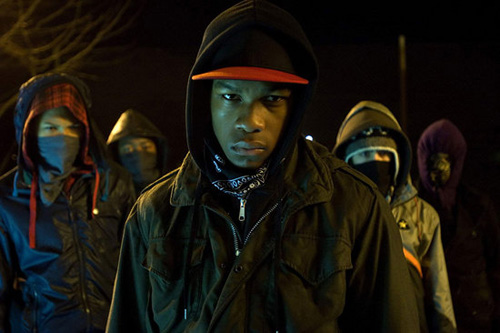
Also added to "Buckets of Score" this year are selections from Steven Price and Basement Jaxx's terrific, if-Carpenter-were-a-dubstepper score to the recent inner city-vs.-outer space thriller Attack the Block, a film that's now on Blu-ray (I disagree with the opinion that Attack the Block loses much of its entertainment value on the small screen and is a less interesting film if you don't watch it with an amped-up crowd in the theater--I saw Attack the Block in an empty theater and still enjoyed it).
"If you like your beats on the monstrous side, you've come to the right place," wrote Attack the Block writer/director Joe Cornish in the Attack the Block soundtrack liner notes. "We wanted the Attack the Block score to do the things that film scores used to do. To be as exciting and escapist as a John Williams adventure, and as gritty and percussive as the great John Carpenter's electronic scores."
Price and the Jaxx duo's score lives up to Cornish's intentions. As the hoodies in Attack the Block would say, believe it, bruv.
From 5pm to 11pm on Halloween, AFOS will be streaming for the second Halloween in a row original music written for the horror, thriller and paranormal genres. The playlist--which is full of Goblin tracks, cues from Elmer Bernstein's out-of-print score to Ghostbusters and original music from either non-glittery vampire flicks (The Omega Man, From Dusk Till Dawn) or supernatural genre shows (Buffy, Angel)--will be joined this year by selections from Alan Howarth and Larry Hopkins' new re-recording of the mostly synthesized cues Ennio Morricone and John Carpenter separately composed for the 1982 version of The Thing.
Howarth, who collaborated with the filmmaker/composer on the scores to such classic Carpenter flicks as Escape from New York, Big Trouble in Little China and They Live, recreated with Hopkins the tracks from the long-out-of-print Thing soundtrack album (with some help from the Digital Orchestra Toolbox) and re-sequenced them so that they're in the chronological order of the 1982 film. The re-recording is being released by the record label wing of BuySoundtrax (a site I once had such a lousy mail-order experience with--and I'm relieved to see I'm not alone--that every time I receive an e-mail from BuySoundtrax, I angrily delete it without reading it).
![]() |
| (Photo source: Alex Pardee) |
"If you like your beats on the monstrous side, you've come to the right place," wrote Attack the Block writer/director Joe Cornish in the Attack the Block soundtrack liner notes. "We wanted the Attack the Block score to do the things that film scores used to do. To be as exciting and escapist as a John Williams adventure, and as gritty and percussive as the great John Carpenter's electronic scores."
Price and the Jaxx duo's score lives up to Cornish's intentions. As the hoodies in Attack the Block would say, believe it, bruv.
Thursday, 13 October 2011
Every day I'm shufflin'
Even though trying to keep track of the nearly 64 hours of music that are stored in A Fistful of Soundtracks' "Assorted Fistful" playlist (plus the two hours of music that make up AFOS' "Rock Box" playlist) can occasionally be a hassle, running AFOS(*) is a pretty simple task. I just hit "Shuffle" and Live365.com does the rest.
(*) It's AFOS. No bloody FOS or FFOS. It's always been AFOS. I've always wanted to shorten it to just AFOS because the acronym AFOS can stand for many different phrases besides A Fistful of Soundtracks, and I once jotted down a list of 12 of them (examples: "Ample Focus on Scores" and my personal favorite, "Asians Fucking Owning Shit"). The current iTunes Radio description of "Fistful of Soundtracks" is nine years old (it's taken from a summary of AFOS that I typed into Live365.com when I first launched AFOS over there in 2002, back when Live365 wouldn't let radio stations have names longer than 22 letters for some stupid reason). iTunes has never bothered to replace the old description with a present-day one.
Sometimes, weird things I have no control over start to happen on AFOS when it's in shuffle mode.
Mel Gibson, who's so famously fond of Jews, gets followed by a Jew.
Yeah, I like "Eye of the Tiger" too, Live365, but I don't like it as much as you do apparently.
Same thing with the movie Wild Things...
... or the end credits music from Thor.
Two different incarnations of Batman getting streamed back-to-back always amuses me...
... as does Angel, Batman and Zorro getting streamed in the same hour. (Angel is like the Batman of the Whedonverse. Batman was modeled partly after Zorro. Also, in DC's pre-"New 52" continuity--I'm not sure if it's been changed in the current continuity--Bruce Wayne lost his parents to a mugger after they attended a Mark of Zorro screening. If it were a Legend of Zorro screening, all three Waynes would have lost the will to live and killed themselves afterward.)
Live365 occasionally does screwy things to the Bollywood-centric "Chai Noon" block. Das racist!
Shuffle mode sometimes results in nifty unintentional double shots or triple shots like:
Brian Tyler Fast and the Furious sequel theme double shots.
Pam Grier movie theme double shots.
Jim Kelly movie theme double shots.
Themes from movies about Bruce Lee movies getting streamed in the same hour.
Battlestar Galactica/Star Trek double shots.
Galaxy Quest/Star Trek double shots.
Trek/Galactica/Galaxy Quest triple shots.
J.J. Abrams/Michael Giacchino collabo triple shots.
Christopher Nolan/Hans Zimmer collabo double shots.
End credits music quadruple shots.
"Movies with Run in the title" double shots.
"Unexpectedly gory L.A. movies" double shots.
Live365 once caused a weird pattern in which a theme from a Spike Lee Joint ended up getting followed by a Cowboy Bebop track--twice in a row. I hope someone on Deviantart was listening to AFOS during that hour and thought about drawing a Spike Lee/Spike Spiegel mash-up someday. Make it happen, Internet!
Wilfred the Matt Damon-loving dog must have tried to sabotage Live365 during this hour.
(*) It's AFOS. No bloody FOS or FFOS. It's always been AFOS. I've always wanted to shorten it to just AFOS because the acronym AFOS can stand for many different phrases besides A Fistful of Soundtracks, and I once jotted down a list of 12 of them (examples: "Ample Focus on Scores" and my personal favorite, "Asians Fucking Owning Shit"). The current iTunes Radio description of "Fistful of Soundtracks" is nine years old (it's taken from a summary of AFOS that I typed into Live365.com when I first launched AFOS over there in 2002, back when Live365 wouldn't let radio stations have names longer than 22 letters for some stupid reason). iTunes has never bothered to replace the old description with a present-day one.
Sometimes, weird things I have no control over start to happen on AFOS when it's in shuffle mode.
Mel Gibson, who's so famously fond of Jews, gets followed by a Jew.
Yeah, I like "Eye of the Tiger" too, Live365, but I don't like it as much as you do apparently.
Same thing with the movie Wild Things...
... or the end credits music from Thor.
Two different incarnations of Batman getting streamed back-to-back always amuses me...
... as does Angel, Batman and Zorro getting streamed in the same hour. (Angel is like the Batman of the Whedonverse. Batman was modeled partly after Zorro. Also, in DC's pre-"New 52" continuity--I'm not sure if it's been changed in the current continuity--Bruce Wayne lost his parents to a mugger after they attended a Mark of Zorro screening. If it were a Legend of Zorro screening, all three Waynes would have lost the will to live and killed themselves afterward.)
Live365 occasionally does screwy things to the Bollywood-centric "Chai Noon" block. Das racist!
Shuffle mode sometimes results in nifty unintentional double shots or triple shots like:
Brian Tyler Fast and the Furious sequel theme double shots.
Pam Grier movie theme double shots.
Jim Kelly movie theme double shots.
Themes from movies about Bruce Lee movies getting streamed in the same hour.
Battlestar Galactica/Star Trek double shots.
Galaxy Quest/Star Trek double shots.
Trek/Galactica/Galaxy Quest triple shots.
J.J. Abrams/Michael Giacchino collabo triple shots.
Christopher Nolan/Hans Zimmer collabo double shots.
End credits music quadruple shots.
"Movies with Run in the title" double shots.
"Unexpectedly gory L.A. movies" double shots.
Live365 once caused a weird pattern in which a theme from a Spike Lee Joint ended up getting followed by a Cowboy Bebop track--twice in a row. I hope someone on Deviantart was listening to AFOS during that hour and thought about drawing a Spike Lee/Spike Spiegel mash-up someday. Make it happen, Internet!
Wilfred the Matt Damon-loving dog must have tried to sabotage Live365 during this hour.
Labels:
A Fistful of Soundtracks,
Batman,
Bruce Lee,
Cowboy Bebop,
Drive,
film music,
Internet radio,
iTunes,
Jim Kelly,
Live365,
Michael Giacchino,
Pam Grier,
Spike Lee,
Star Trek,
The Long Goodbye
Monday, 3 October 2011
"It's the only way he can feel": 10 tidbits about the excellent Drive soundtrack
Drive is a film I initially dismissed as Faster: Caucasian Edition (the main characters in both Faster and Drive share the same minimalist name as the Ryan O'Neal character in Walter Hill's The Driver: "Driver"). I also kept thinking, "What's up with that hot-pink '80s font on the Drive posters and soundtrack album cover? Is this a Hill-style action film or a spinoff of Alice with Linda Lavin?" That was all before I discovered Danish director Nicolas Winding Refn's artsy action flick--a European outsider's vision of L.A., much like John Boorman's surreal 1967 classic Point Blank--is one of the most finely crafted pieces of cinema in 2011.
Many critics and bloggers have been crazy about Drive, which Refn adapted from the 2005 James Sallis noir novel of the same name, ever since it earned at Cannes both a 15-minute standing ovation and a Best Director prize for Refn (I wonder what Parker, Taylor Hackford's upcoming adaptation of Donald E. Westlake's The Hunter, the same novel that Boorman made into Point Blank, would have been like under the direction of Refn, whose latest thriller has all the leanness and meanness of a Parker caper).
But to moviegoers who are neither critics nor film geeks who are well-versed in the cinematic and visuals-driven language of Hill, Boorman and Michael Mann, the offbeat and ultraviolent-when-you-least-expect-it Drive--which was influenced by the works of those three directors and many others, yet it doesn't feel derivative and hackneyed--is a love-it-or-hate-it film. It received a C- at CinemaScore, even though it features Albert Brooks in a surprisingly convincing villain role and stars Ryan Gosling in one of his most appealing roles, as an introverted Hollywood stuntman-by-day/getaway driver-by-night who's as contradictory a figure as Steve McQueen in Bullitt or Takeshi Kitano in Fireworks (buried under the laconic, calm and non-threatening-looking exteriors of Gosling, McQueen and Kitano are some really violent dudes) and is as mysterious and somehow beloved by kids as Alan Ladd in Shane.
The C- is most likely due to moviegoers who expected Drive to be what was known in the '90s as a "TBS Movie for Guys Who Like Movies" and were unprepared for a film that's a little less conventional than that and is "fearless about being corny," as Elvis Mitchell said about Drive while interviewing Refn on The Treatment. At the Drive matinee screening I attended, a group of teenage Latinas didn't understand the film or why Gosling's Driver barely spoke to his MacArthur Park neighbor/love interest Irene (Carey Mulligan) and felt it was their responsibility to let everyone in the theater know that they didn't understand--loudly. It resulted in a moviegoing experience that was so lousy--it's one of the lousiest I've ever had--I ranted about it on Twitter, but Drive is so intriguing not even the smug attention whores who snickered in the theater during every scene could taint my enjoyment of the film or its soundtrack.
Speaking of the Drive soundtrack, which consists of '80s-sounding but surprisingly recent Euro-synth tunes that Refn once described as "like Joy Division with a beat" and an ambient original score by Narc composer Cliff Martinez, both the songs and score are pitch-perfect for the film's decadent '80s Thief/To Live and Die in L.A. vibe and are totally addictive outside the context of the film. A few of the selections from the Drive soundtrack can be heard on A Fistful of Soundtracks, but if you're too impatient to wait to catch one of the Drive tracks on AFOS, the Lakeshore Records release, which is selling like gangbusters on iTunes, is worth downloading or picking up.
Here are 10 facts about the music of Drive:
1. In the film, Gosling's wheelman character likes to turn on the radio while waiting for his criminal accomplices to finish their heists. That character detail stemmed from the first time Gosling truly bonded with Refn. Gosling, who wanted to make a superhero movie and thought of Drive as his superhero project, hand-picked Refn to direct the film because he was a fan of the director's previous works, but as Gosling has noted in several interviews, he initially had a difficult time communicating with a standoffish, under-the-weather and high-on-flu-medicine Refn about how they should approach the project until...
"I turn on the radio to quiet the silence and REO Speedwagon's 'Can't Fight This Feeling' comes on," said Gosling, recalling to New York Times writer Dennis Lim his first car ride with Refn (whom Gosling would frequently chauffeur around SoCal because Refn doesn't drive and stopped working on getting his driver's license after failing his driving test eight times). "And I see [Refn] start to cry and he looks at me with tears in his eyes and he starts singing at the top of his lungs and hitting his knees, and he says, 'I know what this movie is, it's a movie about a guy who drives around listening to pop music because it's the only way he can feel.'"
The sounds of a 1985 high school prom bring out the waterworks in Refn? Wow. Remind me not to play Foreigner's "I Want to Know What Love Is" around Refn or else someone's snot will start flowing.
2. On The Treatment, Refn told Mitchell, who likened Drive to a musical, that whenever he starts work on each of his films, he chooses a specific band or artist to constantly listen to as inspiration. During Pusher II: With Blood on My Hands, Refn put on Iron Maiden and then went with Neil Diamond for Pusher III: I'm the Angel of Death and Pet Shop Boys for his 2008 cult favorite Bronson. "Music heightens emotions," said Refn to Mitchell. "It gives you images in your head." For Drive, Refn listened to Kraftwerk, hence the Euro-synthy songs and score.
3. Before Refn picked Martinez to score Drive, he approached Portland indie synth-pop producer and Italians Do It Better label co-founder Johnny Jewel about writing the score. In Bronson, Refn prominently featured "Digital Versicolor," a track by Jewel's band Glass Candy (one of a bunch of bands that include Jewel as a member). Jewel jumped at the opportunity to score Drive and completed three hours' worth of score music, but due to deadline issues and some miscommunication, Jewel's score ended up being unused. Jewel wasn't bitter over his Drive score cues getting rejected and is planning to release the unused material on his upcoming imaginary soundtrack project Symmetry.
4. To get inspiration while working on the score cues, Jewel and his Chromatics bandmate Adam Miller drew pictures of scenes from Drive. Jewel also got his musical ideas from posters he made of excerpted text from the novel version of Drive and phrases from the movie. He described his creative process to Box Office magazine, and the artwork that resulted from this process (like the above illustration of Drive femme fatale Christina Hendricks) can be glimpsed on the blog for Desire, one of two of Jewel's bands that get airplay in Drive:
CHROMATICS / TICK OF THE CLOCK by ITALIANS DO IT BETTER
6. The other Jewel-produced track in Drive is "Under Your Spell," Desire's 2009 tune about romantic longing. It starts out as source music at the homecoming party that Irene throws for her recently freed ex-con husband Standard (Oscar Isaac) and morphs into non-diegetic music as Driver broods over the fact that Standard's return to Irene and their son Benicio (Kaden Leos) has now turned Driver into a third wheel, no pun intended.
DESIRE / UNDER YOUR SPELL by ITALIANS DO IT BETTER
7. French electro-house musician Kavinsky's 2010 track "Nightcall," Drive's hypnotic opening title theme, was recommended to Refn by Drive editor Mat Newman. The song previously appeared in The Lincoln Lawyer. (Martinez, Drive music supervisors Eric Craig and Brian McNelis and Drive costume designer Erin Benach, who built Driver's superhero-style white satin jacket with the Kenneth Anger-inspired scorpion logo on the back, all also worked on The Lincoln Lawyer.)
"Nightcall," which pairs up Kavinsky, a.k.a. Vincent Belorgey, with Lovefoxxx, a.k.a. Luísa Hanae Matsushita, lead singer of the Brazilian band Cansei de Ser Sexy, was co-written and co-produced by Daft Punk's Guy-Manuel de Homem-Christo. Kavinsky, who's toured with Daft Punk and looks like he takes his fashion cues from Teen Wolf, has cited among his influences Giorgio Moroder, Ennio Morricone and '80s R&B bands that the French refer to in their language as "moccasin funk": Midnight Star, The Whispers and Shalamar.
Nightcall (feat. Lovefoxxx) by Kavinsky
8. Before he wrote scores for Steven Soderbergh films like The Limey and Contagion and provided an effective and low-key score for Drive, Martinez was a drummer for Red Hot Chili Peppers and The Dickies. (One of Martinez's earliest scoring credits was a second-season episode of the classic '80s show Pee-wee's Playhouse, which Danny Elfman and Mark Mothersbaugh--two other rock musicians-turned-film and TV composers--also wrote music for early on in their film and TV scoring careers.)
9. "A Real Hero" is the song that plays during Drive's L.A. River sequence. Before Standard re-enters the lives of Irene (whom Martinez's propulsive end title theme refers to as "Bride of Deluxe," a reference to "Where's the deluxe version?," a joke Irene made about Standard's first name when she first met him) and Benicio, Driver takes his neighbor and her son for a relaxing afternoon drive through the L.A. River, a site Driver is perhaps familiar with from his stunt driving shoots. The L.A. River was made famous by the racing sequence in Grease and car chases in Repo Man, Terminator 2: Judgment Day and countless other films, shows and music videos.
The most fairy tale-like of Drive's existing songs (Refn envisioned Drive as a fairy tale with Gosling as the knight and Mulligan as the maiden he sets out to rescue), "A Real Hero" is a 2009 collabo between French producer and remixer David Grellier, a.k.a. College, and the Toronto synth-pop duo Electric Youth (named after the Debbie Gibson album of the same name). The tune is reprised at the end of Drive. In a tweet about "A Real Hero," Brad O'Farrell, "starter of the Keyboard Cat meme," said, "Man I like how the 'theme song' of Drive only plays twice, and both times he really earns it."
The vocalist during "A Real Hero" is Electric Youth member Bronwyn Griffin, whose voice has been described by tracasseur.com as "one of the most beautiful in the world of blog electro, it fits so perfectly with [her musical partner Austin Garrick's] happy, bubbly sounds." Grellier, Griffin and Garrick are part of the Valerie Collective. According to the Guardian, the acts that make up this international collective all "blog, create lush, catchy synthpop and generally raise the act of homage to epic, fanatical proportions."
College feat. Electric Youth - A Real Hero [music from the Motion Picture, Drive] by Electric Youth (Official)
Here's another College/Electric Youth song. "She Never Came Back" wouldn't feel out of place in Drive:
10. Heard during the death of a key character, legendary Italian film composer Riz Ortolani's sorrowful "Oh My Love," which features vocals by Katyna Ranieri, is a song from a film that was as notorious for its extreme violence as Drive currently is, Farewell, Uncle Tom. "Either one of the most racist films ever made or a potent condemnation of racism, this 1971 feature from the directors of Mondo Cane is nothing if not brutal," wrote Philadelphia City Paper film critic Sam Adams in 2003, "with gruesome pseudo-documentary footage of slaves being beaten, raped, force-fed with metal funnels and about every other horror you could imagine (and some you hopefully can't)."
When the Italian-made docudrama about the history of American slavery was first shown in America in 1972, Roger Ebert was far less kind to the film than Adams was and found it to be too exploitative.
"Unfortunately, [Gualtiero] Jacopetti and [Franco] Prosperi have been able to find people willing to undergo the humiliation inflicted on them... most of the blacks in the film are apparently Africans forced by poverty and need to do these things for a few days' pitiful wages," wrote Ebert. "Make no mistake. This movie itself humiliates its actors in the way the slaves were humiliated 200 years ago... The fact that this film could find a booking in a legitimate motion-picture theater is depressing."
You might be repulsed by Jacopetti and Prosperi's Mondo movies, either because of their staged footage or the disturbing nature of much of that footage, or you might not find them repulsive, but there's no denying that Ortolani's music for them sounds gorgeous. Ortolani's lush 1962 Mondo Cane theme "Ti guarderò nel cuore," a.k.a. "More," became a frequently covered international hit.
The somber Farewell, Uncle Tom theme is an equally lush composition. It's also the only tune on the Drive soundtrack that's out of place. I skip it whenever I play the entire album because it disrupts the propulsive '80s groove established by "Nightcall," "Under Your Spell" and "A Real Hero" and maintained by Martinez's cues. "Oh My Love" is the speed bump in the otherwise smooth ride that is the Drive soundtrack.
Many critics and bloggers have been crazy about Drive, which Refn adapted from the 2005 James Sallis noir novel of the same name, ever since it earned at Cannes both a 15-minute standing ovation and a Best Director prize for Refn (I wonder what Parker, Taylor Hackford's upcoming adaptation of Donald E. Westlake's The Hunter, the same novel that Boorman made into Point Blank, would have been like under the direction of Refn, whose latest thriller has all the leanness and meanness of a Parker caper).
But to moviegoers who are neither critics nor film geeks who are well-versed in the cinematic and visuals-driven language of Hill, Boorman and Michael Mann, the offbeat and ultraviolent-when-you-least-expect-it Drive--which was influenced by the works of those three directors and many others, yet it doesn't feel derivative and hackneyed--is a love-it-or-hate-it film. It received a C- at CinemaScore, even though it features Albert Brooks in a surprisingly convincing villain role and stars Ryan Gosling in one of his most appealing roles, as an introverted Hollywood stuntman-by-day/getaway driver-by-night who's as contradictory a figure as Steve McQueen in Bullitt or Takeshi Kitano in Fireworks (buried under the laconic, calm and non-threatening-looking exteriors of Gosling, McQueen and Kitano are some really violent dudes) and is as mysterious and somehow beloved by kids as Alan Ladd in Shane.
The C- is most likely due to moviegoers who expected Drive to be what was known in the '90s as a "TBS Movie for Guys Who Like Movies" and were unprepared for a film that's a little less conventional than that and is "fearless about being corny," as Elvis Mitchell said about Drive while interviewing Refn on The Treatment. At the Drive matinee screening I attended, a group of teenage Latinas didn't understand the film or why Gosling's Driver barely spoke to his MacArthur Park neighbor/love interest Irene (Carey Mulligan) and felt it was their responsibility to let everyone in the theater know that they didn't understand--loudly. It resulted in a moviegoing experience that was so lousy--it's one of the lousiest I've ever had--I ranted about it on Twitter, but Drive is so intriguing not even the smug attention whores who snickered in the theater during every scene could taint my enjoyment of the film or its soundtrack.
Speaking of the Drive soundtrack, which consists of '80s-sounding but surprisingly recent Euro-synth tunes that Refn once described as "like Joy Division with a beat" and an ambient original score by Narc composer Cliff Martinez, both the songs and score are pitch-perfect for the film's decadent '80s Thief/To Live and Die in L.A. vibe and are totally addictive outside the context of the film. A few of the selections from the Drive soundtrack can be heard on A Fistful of Soundtracks, but if you're too impatient to wait to catch one of the Drive tracks on AFOS, the Lakeshore Records release, which is selling like gangbusters on iTunes, is worth downloading or picking up.
Here are 10 facts about the music of Drive:
1. In the film, Gosling's wheelman character likes to turn on the radio while waiting for his criminal accomplices to finish their heists. That character detail stemmed from the first time Gosling truly bonded with Refn. Gosling, who wanted to make a superhero movie and thought of Drive as his superhero project, hand-picked Refn to direct the film because he was a fan of the director's previous works, but as Gosling has noted in several interviews, he initially had a difficult time communicating with a standoffish, under-the-weather and high-on-flu-medicine Refn about how they should approach the project until...
"I turn on the radio to quiet the silence and REO Speedwagon's 'Can't Fight This Feeling' comes on," said Gosling, recalling to New York Times writer Dennis Lim his first car ride with Refn (whom Gosling would frequently chauffeur around SoCal because Refn doesn't drive and stopped working on getting his driver's license after failing his driving test eight times). "And I see [Refn] start to cry and he looks at me with tears in his eyes and he starts singing at the top of his lungs and hitting his knees, and he says, 'I know what this movie is, it's a movie about a guy who drives around listening to pop music because it's the only way he can feel.'"
The sounds of a 1985 high school prom bring out the waterworks in Refn? Wow. Remind me not to play Foreigner's "I Want to Know What Love Is" around Refn or else someone's snot will start flowing.
2. On The Treatment, Refn told Mitchell, who likened Drive to a musical, that whenever he starts work on each of his films, he chooses a specific band or artist to constantly listen to as inspiration. During Pusher II: With Blood on My Hands, Refn put on Iron Maiden and then went with Neil Diamond for Pusher III: I'm the Angel of Death and Pet Shop Boys for his 2008 cult favorite Bronson. "Music heightens emotions," said Refn to Mitchell. "It gives you images in your head." For Drive, Refn listened to Kraftwerk, hence the Euro-synthy songs and score.
3. Before Refn picked Martinez to score Drive, he approached Portland indie synth-pop producer and Italians Do It Better label co-founder Johnny Jewel about writing the score. In Bronson, Refn prominently featured "Digital Versicolor," a track by Jewel's band Glass Candy (one of a bunch of bands that include Jewel as a member). Jewel jumped at the opportunity to score Drive and completed three hours' worth of score music, but due to deadline issues and some miscommunication, Jewel's score ended up being unused. Jewel wasn't bitter over his Drive score cues getting rejected and is planning to release the unused material on his upcoming imaginary soundtrack project Symmetry.
4. To get inspiration while working on the score cues, Jewel and his Chromatics bandmate Adam Miller drew pictures of scenes from Drive. Jewel also got his musical ideas from posters he made of excerpted text from the novel version of Drive and phrases from the movie. He described his creative process to Box Office magazine, and the artwork that resulted from this process (like the above illustration of Drive femme fatale Christina Hendricks) can be glimpsed on the blog for Desire, one of two of Jewel's bands that get airplay in Drive:
One of the first things I did was I took the book and I highlighted all of the phrases, things like "last day," "sanctuary," all of these different phrases from the movie that stimulated my brain, and I'd print those words really big and put them on the wall. Or while I'm writing--this was sort of like a mantra--we were drawing pictures while watching the movie every day. Because everything I do is like going into this camp mode where we would cut ourselves off. I was watching the movie while taking a bath, I was watching the movie while eating, like every day. Because there was only so much time and I wanted to know the movie inside and out, and I can't be watching the movie while I'm actually writing. While I was actually trying to figure out melodies and things like that, I had to watch the movie as much as possible. We drew almost like every scene--there's like 150 of them--so we drew so much, and then I forgot about them and then stumbled across them a couple of weeks ago.5. Jewel's 2007 instrumental "Tick of the Clock," performed by The Chromatics, is used during the magnificently directed sequence that opens the film and precedes the hot-pink Mistral font credits: Driver's tense and wordless cat-and-mouse game with the police through the avenues and alleyways of L.A. "Tick of the Clock" is 15 minutes long, so Jewel and Chromatics bandmate Nat Walker cut it down heavily for the film.
CHROMATICS / TICK OF THE CLOCK by ITALIANS DO IT BETTER
6. The other Jewel-produced track in Drive is "Under Your Spell," Desire's 2009 tune about romantic longing. It starts out as source music at the homecoming party that Irene throws for her recently freed ex-con husband Standard (Oscar Isaac) and morphs into non-diegetic music as Driver broods over the fact that Standard's return to Irene and their son Benicio (Kaden Leos) has now turned Driver into a third wheel, no pun intended.
DESIRE / UNDER YOUR SPELL by ITALIANS DO IT BETTER
7. French electro-house musician Kavinsky's 2010 track "Nightcall," Drive's hypnotic opening title theme, was recommended to Refn by Drive editor Mat Newman. The song previously appeared in The Lincoln Lawyer. (Martinez, Drive music supervisors Eric Craig and Brian McNelis and Drive costume designer Erin Benach, who built Driver's superhero-style white satin jacket with the Kenneth Anger-inspired scorpion logo on the back, all also worked on The Lincoln Lawyer.)
"Nightcall," which pairs up Kavinsky, a.k.a. Vincent Belorgey, with Lovefoxxx, a.k.a. Luísa Hanae Matsushita, lead singer of the Brazilian band Cansei de Ser Sexy, was co-written and co-produced by Daft Punk's Guy-Manuel de Homem-Christo. Kavinsky, who's toured with Daft Punk and looks like he takes his fashion cues from Teen Wolf, has cited among his influences Giorgio Moroder, Ennio Morricone and '80s R&B bands that the French refer to in their language as "moccasin funk": Midnight Star, The Whispers and Shalamar.
Nightcall (feat. Lovefoxxx) by Kavinsky
8. Before he wrote scores for Steven Soderbergh films like The Limey and Contagion and provided an effective and low-key score for Drive, Martinez was a drummer for Red Hot Chili Peppers and The Dickies. (One of Martinez's earliest scoring credits was a second-season episode of the classic '80s show Pee-wee's Playhouse, which Danny Elfman and Mark Mothersbaugh--two other rock musicians-turned-film and TV composers--also wrote music for early on in their film and TV scoring careers.)
9. "A Real Hero" is the song that plays during Drive's L.A. River sequence. Before Standard re-enters the lives of Irene (whom Martinez's propulsive end title theme refers to as "Bride of Deluxe," a reference to "Where's the deluxe version?," a joke Irene made about Standard's first name when she first met him) and Benicio, Driver takes his neighbor and her son for a relaxing afternoon drive through the L.A. River, a site Driver is perhaps familiar with from his stunt driving shoots. The L.A. River was made famous by the racing sequence in Grease and car chases in Repo Man, Terminator 2: Judgment Day and countless other films, shows and music videos.
The most fairy tale-like of Drive's existing songs (Refn envisioned Drive as a fairy tale with Gosling as the knight and Mulligan as the maiden he sets out to rescue), "A Real Hero" is a 2009 collabo between French producer and remixer David Grellier, a.k.a. College, and the Toronto synth-pop duo Electric Youth (named after the Debbie Gibson album of the same name). The tune is reprised at the end of Drive. In a tweet about "A Real Hero," Brad O'Farrell, "starter of the Keyboard Cat meme," said, "Man I like how the 'theme song' of Drive only plays twice, and both times he really earns it."
The vocalist during "A Real Hero" is Electric Youth member Bronwyn Griffin, whose voice has been described by tracasseur.com as "one of the most beautiful in the world of blog electro, it fits so perfectly with [her musical partner Austin Garrick's] happy, bubbly sounds." Grellier, Griffin and Garrick are part of the Valerie Collective. According to the Guardian, the acts that make up this international collective all "blog, create lush, catchy synthpop and generally raise the act of homage to epic, fanatical proportions."
College feat. Electric Youth - A Real Hero [music from the Motion Picture, Drive] by Electric Youth (Official)
Here's another College/Electric Youth song. "She Never Came Back" wouldn't feel out of place in Drive:
10. Heard during the death of a key character, legendary Italian film composer Riz Ortolani's sorrowful "Oh My Love," which features vocals by Katyna Ranieri, is a song from a film that was as notorious for its extreme violence as Drive currently is, Farewell, Uncle Tom. "Either one of the most racist films ever made or a potent condemnation of racism, this 1971 feature from the directors of Mondo Cane is nothing if not brutal," wrote Philadelphia City Paper film critic Sam Adams in 2003, "with gruesome pseudo-documentary footage of slaves being beaten, raped, force-fed with metal funnels and about every other horror you could imagine (and some you hopefully can't)."
When the Italian-made docudrama about the history of American slavery was first shown in America in 1972, Roger Ebert was far less kind to the film than Adams was and found it to be too exploitative.
"Unfortunately, [Gualtiero] Jacopetti and [Franco] Prosperi have been able to find people willing to undergo the humiliation inflicted on them... most of the blacks in the film are apparently Africans forced by poverty and need to do these things for a few days' pitiful wages," wrote Ebert. "Make no mistake. This movie itself humiliates its actors in the way the slaves were humiliated 200 years ago... The fact that this film could find a booking in a legitimate motion-picture theater is depressing."
You might be repulsed by Jacopetti and Prosperi's Mondo movies, either because of their staged footage or the disturbing nature of much of that footage, or you might not find them repulsive, but there's no denying that Ortolani's music for them sounds gorgeous. Ortolani's lush 1962 Mondo Cane theme "Ti guarderò nel cuore," a.k.a. "More," became a frequently covered international hit.
The somber Farewell, Uncle Tom theme is an equally lush composition. It's also the only tune on the Drive soundtrack that's out of place. I skip it whenever I play the entire album because it disrupts the propulsive '80s groove established by "Nightcall," "Under Your Spell" and "A Real Hero" and maintained by Martinez's cues. "Oh My Love" is the speed bump in the otherwise smooth ride that is the Drive soundtrack.
Labels:
Bullitt,
Cliff Martinez,
Daft Punk,
Drive,
Elvis Mitchell,
existing songs,
Faster,
film music,
Johnny Jewel,
Nicolas Winding Refn,
Point Blank,
rejected film music,
Riz Ortolani,
The Hunter
Tuesday, 23 August 2011
That's the Attack the Block score that you're hearing on A Fistful of Soundtracks, bruv, believe it
![]() |
| (Photo source: Alex Pardee) |
Set in a rough South London neighborhood attacked by "gorilla wolf muthafuckas" from outer space, the British cult favorite Attack the Block is the best popcorn movie this summer. Beleedat. (Most American moviegoers still haven't heard of Attack the Block, but Screen Gems has been hoping to change that by expanding Attack the Block's release to six more cities last week.) One of the movie's most enjoyable elements is the original score, the first ever written by the British dance act Basement Jaxx, whose tunes have often popped up in advertising (my first exposure to Basement Jaxx was an early '00s Coke ad that featured a group of svelte campfire partiers and an isolated and not-as-svelte nerd dancing in the woods to the catchy "Red Alert," while "Do Your Thing" was all over Disney's ads for Ratatouille).
Basement Jaxx (a.k.a. Felix Buxton and Simon Ratcliffe) co-composed the score with Scott Pilgrim vs. the World music editor Steven Price, and their score accomplishes well what it set out to do, which, according to Attack the Block writer/director Joe Cornish in the score album's liner notes, was "to do the things that film scores used to do. To be as exciting and escapist as a John Williams adventure, and as gritty and percussive as the great John Carpenter's electronic scores."
Carpenter's Assault on Precinct 13 theme is so beloved by beatmakers that its influence can be felt in many of their instrumentals, including Buxton, Ratcliffe and Price's cues in Attack the Block. Starting this week, my favorite Attack the Block cues attack three blocks on A Fistful of Soundtracks: "Assorted Fistful," "New Cue Revue" and "The Street." One of these selections that I've added to rotation is the bagpipes-filled, dubstep-style end title theme "The Ends."
Basement Jaxx - "The Ends" from "Attack The Block" by Basement Jaxx
Attack the Block is inventive sci-fi with a youth of color as the lead for a change, as well as an inspired critique of the demonization of the working class in the U.K. A one-time mugging victim who wanted to better understand his muggers and their lives instead of being resentful and fearful of them, Cornish takes working-class kids like Moses (John Boyega) and the bespectacled and brainy Jerome (Leeon Jones) (their mugging of Jodie Whittaker's nurse/neighbor character Sam at the start of the film was based on the incident Cornish experienced) and fleshes out those characters to prove the irrationality of demonizing the underclass.
"At the beginning of the film these kids are masked, they're hooded, you don't know how old they are, you have no sense of their humanity or identity and indeed, with their language, you're confused, you're alienated from them," said Cornish to RopeofSilicon. "Then the purpose of the story is to strip away all those barriers and to make you understand they're human beings. Not perfectly good, squeaky clean human beings, flawed human beings like all of us."
On Twitter, I've seen people say they refuse to give Attack the Block the time of day because its ads' imagery of South London "hoodies" violently defending their council estate from alien invaders either reminds them too much of the U.K. riots (which erupted a few weeks after the movie hit American theaters) or appears to condone those riots. They're inanely passing judgment on a movie they haven't seen. Attack the Block is hardly as one-dimensional as they think. It's a story about the consequences of thuggish behavior, whether it's the hoodies' mugging of Sam and Moses' killing of the alien at the start of the film or the looting that went down in the U.K. riots.
"People really suggested the riots in my home town were linked to the movie? Unbelievable," tweeted BBC journalist Ben Fell to an Attack the Block fan after he saw Twitterers denounce the movie before watching it.
To borrow the title and chorus of one of Basement Jaxx's biggest hits, I'd like to say to the haters, "Where's your head at?!"
Related links:
• "Too Much Madness to Explain in One Text: On the U.K. Riots and Attack the Block" [The Playlist]
• "'We're Not All Vile Thugs'" (an Attack the Block cast member blasts both the looters and the London police) [Daily Star]
• "Rap responds to the riots: 'They have to take us seriously'" [Guardian]
| (Photo source: RopeofSilicon) |
Wednesday, 10 August 2011
Yo, Gab a-gabbin': Rodrigo y Gabriela gab with DirecTV's Guitar Center Sessions about their busking days and Pirates of the Caribbean
DirecTV subscribers who are fans of either the Mexican instrumental rock duo Rodrigo y Gabriela or their music in Pirates of the Caribbean: On Stranger Tides will get a kick out of the Rod y Gab episode of DirecTV's Audience Network music talk show Guitar Center Sessions. I wasn't aware until I first watched the episode last week on the Audience Network (DirecTV channels 101, 239, 334 or 500) that it's been airing since July 9.
On this edition of Guitar Center Sessions, which is being re-aired constantly throughout the summer, Rod y Gab tell host Nic Harcourt what it was like to work with Hans Zimmer on their first film music project Pirates (they enjoyed the film scoring process even though it was really challenging), as well as how they shaped their instrumental rock sound while busking on the streets of Dublin (the one in Ireland, that is, not the Dublin I'm more familiar with).
The Guitar Center Sessions ep is helping promote the Mexican metalheads' live album Live in France, which dropped July 19 and is excellent. So is their Pirates music, which is my favorite element of the On Stranger Tides movie. The On Stranger Tides album track "The Pirate That Should Not Be," which features the acoustic metal duo's cover of the Captain Jack Sparrow theme, doesn't appear in the movie, but like the Guitar Center Sessions ep, the "Pirate That Should Not Be" video gives a good idea of what Rod y Gab are like on stage for those who aren't familiar with this amazing duo.
On this edition of Guitar Center Sessions, which is being re-aired constantly throughout the summer, Rod y Gab tell host Nic Harcourt what it was like to work with Hans Zimmer on their first film music project Pirates (they enjoyed the film scoring process even though it was really challenging), as well as how they shaped their instrumental rock sound while busking on the streets of Dublin (the one in Ireland, that is, not the Dublin I'm more familiar with).
The Guitar Center Sessions ep is helping promote the Mexican metalheads' live album Live in France, which dropped July 19 and is excellent. So is their Pirates music, which is my favorite element of the On Stranger Tides movie. The On Stranger Tides album track "The Pirate That Should Not Be," which features the acoustic metal duo's cover of the Captain Jack Sparrow theme, doesn't appear in the movie, but like the Guitar Center Sessions ep, the "Pirate That Should Not Be" video gives a good idea of what Rod y Gab are like on stage for those who aren't familiar with this amazing duo.
Friday, 5 August 2011
Attack the Block is the best summer movie you've never heard of
Edgar Wright is a filmmaker whose film and TV work I've enjoyed so much that if the Shaun of the Dead and Hot Fuzz director tells me to jump off a bridge, I'll happily do it, but with a bungee cord tied around me. Or if Wright tells me during Doug Loves Movies or on Twitter to see a movie he co-executive-produced like Attack the Block, I'll go see it, even if it's only playing in eight theaters across the country, and I have to hop on a couple of planes, a train and an automobile to get to one of those theaters (luckily, that theater is the Metreon in San Francisco, so I didn't have to go very far).
I first heard about Attack the Block during a Doug Loves Movies episode recorded at SXSW with last-minute guest Simon Pegg (who showed up without his frequent collaborator Wright by his side but busted out a dead-on impression of his absent friend). At SXSW, Attack the Block was so well-received that Sony Pictures' Screen Gems division acquired it for distribution in America, and since its release last week, everyone from Wright himself to author Nelson George has taken to Twitter to urge everyone to see this little film that Screen Gems has barely advertised on TV. Attack the Block contains a wonderful premise that's never been done before (in a South London ghetto, both a predominantly black teenage gang and the white female nurse they mugged are pitted against extraterrestrial monsters) in a genre that's been done to death (the alien invasion genre--between the Steven Spielberg-produced TNT drama Falling Skies and three other Spielberg productions, Super 8, Transformers: Dark of the Moon and Cowboys & Aliens, aliens have had a busy summer). The directorial debut of British comedian Joe Cornish (who also wrote the screenplay), the low-budget actioner has no familiar faces in the cast, aside from Venus star Jodie Whittaker and Wright regular Nick Frost in a comedic bit part as a weed dealer, and most of the stars speak in lower-class British accents as thick as Dizzee Rascal's (for folks like me who are familiar with artists like Dizzee or The Streets, that kind of accent isn't too difficult to decipher, but for the rest of the moviegoing audience in America, it's like Klingon). So no wonder Screen Gems is giving Attack the Block a limited release and cautiously unveiling it to an audience that prefers their alien-invasion flicks to be bigger-budgeted, smoother-accented and well, let's face it, dumber.
Okay, Attack the Block isn't quite Shakespeare, but it has a certain inventiveness and vitality that's missing from all those aforementioned Spielberg-produced 2011 alien-invasion projects that aren't Super 8, although the treacly Falling Skies is redeemed by the presence of Colin Cunningham's not-so-treacly biker character Pope. Cornish's film takes its cues less from Spielberg and more from both Frost's previous film Shaun of the Dead and early John Carpenter, particularly one of my favorite Carpenter movies, the original Assault on Precinct 13, from its ghetto backdrop to its unconventional choice of a hero, a black wannabe thug who's like a mash-up of Precinct 13's two leads, Austin Stoker's untested black cop and Darwin Joston's antiheroic white convict. (Voice actor Yuri Lowenthal of Ben 10 fame calls Attack the Block "the best John Carpenter movie that John Carpenter never made.") Unknown John Boyega is a star in the making in his charismatic debut as Moses (when a mugging victim escapes from him and his gang, dig the way Boyega's laconic character simply commands his gang in his thick accent to "allow it," which must be his favorite phrase). Attack the Block is also like what would have happened if the showrunners of Falling Skies realized it was a mistake to make Noah Wyle's rather blandly written history professor character Mason the lead of the show and decided to shift the focus to Pope. At the start of Attack the Block, Moses is first seen doing something very Pope-like and not-so-heroic--he and his gang are mugging Whittaker's nurse character Sam--when he spots a meteorite crash-landing in his hood, and Moses, distracted by the meteorite and the dog-like creature it carried, runs off to kill the monster, not realizing that his killing of the beastie will ignite an alien invasion.
Moses' trajectory from irresponsible thug to adult who decides to own up to his mistakes and clean up the mess he started when he killed the monster is believable and compelling, thanks to Boyega. He has a couple of intriguing little moments where the badass and authoritative gang leader façade disappears, and with some great acting by Boyega with just his eyes, we see a scared kid who's in over his head and whom the film later reveals--in one of its best scenes--to be much younger than he appears to be.
Another Carpenter-esque element is newcomer Steven Price's effective score, which evokes both instrumental hip-hop and Carpenter's synthesizer scores from his Precinct 13/Halloween heyday. The electronica duo Basement Jaxx brings some star power to the score, which Jaxx co-wrote with Price. (Selections from the Attack the Block score will be added to the Fistful of Soundtracks blocks "Assorted Fistful," "New Cue Revue" and "The Street" in the near future.)
Attack the Block has four (or five or six or seven or eight) less screenwriters than Cowboys & Aliens and was made at a budget that's 10 times less than C&A's, and yet it has a smarter and better-constructed story. One of the cleverest touches in Cornish's script is the symmetry of Moses gaining a better understanding of the grizzly bear-like aliens (and why they're attacking him and everyone around him)(*) with Sam gaining a better understanding of her mugger Moses, who's basically an alien to her. Attack the Block is also about the "aliens" in our own neighborhoods due to racial and class divisions. Forced to turn to Sam for help when one of his cohorts gets injured during an alien attack, Moses realizes the stupidity of picking on good citizens like Sam, while Sam, along with the audience, discovers Moses' kind and vulnerable side, which Tia (Danielle Vitalis), a female friend of the gang's, already sees in Moses, whom Tia has an unspoken crush on. (Here's another reason to dig Attack the Block: it would probably cause that racist dickcheese Lou Dobbs to get his panties in a bunch over the kinds of characters it chooses to sympathize with.) Of course, by the film's climax, Sam and Moses no longer hate each other (enemies who are forced to put aside their differences to fight alien invaders is a thread that also appears in C&A), but Attack the Block wisely avoids the "Mookie and Sal hug and become friends and sing 'We Are the World'" ending that Paramount forced on Spike Lee when he pitched Do the Right Thing to them. Attack the Block is smarter and more ambiguous than that.
(*) I like Attack the Block's version of those pipe-smoking scientist characters in sci-fi B-movies who spout nothing but exposition and were memorably parodied by Pierce Brosnan in Mars Attacks! Instead of regular tobacco, Luke Treadaway's dorky white trust-fund kid Brewis prefers weed--and the sounds of KRS-One on his iPod--and is a zoology student who's watched enough National Geographic specials while baked to figure out why the aliens are invading the block and how to defeat them.
What also makes Attack the Block stand out from this year's batch of alien-invasion flicks is the absence of CGI (I'm not vehemently against CGI--I'm just against it when it's done poorly, which is way too often). All the creature effects in Cornish's film are practical. The alien attacks are fast and brutal, and this is a case where the fast-cutting that so many critics complain about when they see present-day action movies is absolutely necessary because here, it prevents us from noticing how cheap-looking the monsters are--they're essentially just guys running around in eyeless and coal-black bear suits outfitted with ginormous blue neon teeth. But because the Attack the Block aliens aren't CG, there's a realness and formidability to them that's missing from the CG creatures in films like Ang Lee's Hulk and Louis Leterrier's Incredible Hulk reboot, which both contain monster battles I've failed to get invested in and have found to be a chore to watch because the CGI in those sequences is as fake-looking as the cel-animated flying sequences in the '40s live-action Superman serials.
I'm not so worried about the fate of Attack the Block during its theatrical release here in America (though it played to a largely empty theater when I saw it, Screen Gems will expand its release to six more cities on August 19) because like other recent cult films that didn't attract huge crowds during their initial release, it'll eventually find a much bigger audience on Blu-ray and DVD. For now, it's a best-kept secret among us fans of little films that outshine most of the better-known and somewhat similar blockbusters they're competing against at the box office.
I first heard about Attack the Block during a Doug Loves Movies episode recorded at SXSW with last-minute guest Simon Pegg (who showed up without his frequent collaborator Wright by his side but busted out a dead-on impression of his absent friend). At SXSW, Attack the Block was so well-received that Sony Pictures' Screen Gems division acquired it for distribution in America, and since its release last week, everyone from Wright himself to author Nelson George has taken to Twitter to urge everyone to see this little film that Screen Gems has barely advertised on TV. Attack the Block contains a wonderful premise that's never been done before (in a South London ghetto, both a predominantly black teenage gang and the white female nurse they mugged are pitted against extraterrestrial monsters) in a genre that's been done to death (the alien invasion genre--between the Steven Spielberg-produced TNT drama Falling Skies and three other Spielberg productions, Super 8, Transformers: Dark of the Moon and Cowboys & Aliens, aliens have had a busy summer). The directorial debut of British comedian Joe Cornish (who also wrote the screenplay), the low-budget actioner has no familiar faces in the cast, aside from Venus star Jodie Whittaker and Wright regular Nick Frost in a comedic bit part as a weed dealer, and most of the stars speak in lower-class British accents as thick as Dizzee Rascal's (for folks like me who are familiar with artists like Dizzee or The Streets, that kind of accent isn't too difficult to decipher, but for the rest of the moviegoing audience in America, it's like Klingon). So no wonder Screen Gems is giving Attack the Block a limited release and cautiously unveiling it to an audience that prefers their alien-invasion flicks to be bigger-budgeted, smoother-accented and well, let's face it, dumber.
Okay, Attack the Block isn't quite Shakespeare, but it has a certain inventiveness and vitality that's missing from all those aforementioned Spielberg-produced 2011 alien-invasion projects that aren't Super 8, although the treacly Falling Skies is redeemed by the presence of Colin Cunningham's not-so-treacly biker character Pope. Cornish's film takes its cues less from Spielberg and more from both Frost's previous film Shaun of the Dead and early John Carpenter, particularly one of my favorite Carpenter movies, the original Assault on Precinct 13, from its ghetto backdrop to its unconventional choice of a hero, a black wannabe thug who's like a mash-up of Precinct 13's two leads, Austin Stoker's untested black cop and Darwin Joston's antiheroic white convict. (Voice actor Yuri Lowenthal of Ben 10 fame calls Attack the Block "the best John Carpenter movie that John Carpenter never made.") Unknown John Boyega is a star in the making in his charismatic debut as Moses (when a mugging victim escapes from him and his gang, dig the way Boyega's laconic character simply commands his gang in his thick accent to "allow it," which must be his favorite phrase). Attack the Block is also like what would have happened if the showrunners of Falling Skies realized it was a mistake to make Noah Wyle's rather blandly written history professor character Mason the lead of the show and decided to shift the focus to Pope. At the start of Attack the Block, Moses is first seen doing something very Pope-like and not-so-heroic--he and his gang are mugging Whittaker's nurse character Sam--when he spots a meteorite crash-landing in his hood, and Moses, distracted by the meteorite and the dog-like creature it carried, runs off to kill the monster, not realizing that his killing of the beastie will ignite an alien invasion.
Moses' trajectory from irresponsible thug to adult who decides to own up to his mistakes and clean up the mess he started when he killed the monster is believable and compelling, thanks to Boyega. He has a couple of intriguing little moments where the badass and authoritative gang leader façade disappears, and with some great acting by Boyega with just his eyes, we see a scared kid who's in over his head and whom the film later reveals--in one of its best scenes--to be much younger than he appears to be.
Another Carpenter-esque element is newcomer Steven Price's effective score, which evokes both instrumental hip-hop and Carpenter's synthesizer scores from his Precinct 13/Halloween heyday. The electronica duo Basement Jaxx brings some star power to the score, which Jaxx co-wrote with Price. (Selections from the Attack the Block score will be added to the Fistful of Soundtracks blocks "Assorted Fistful," "New Cue Revue" and "The Street" in the near future.)
Attack the Block has four (or five or six or seven or eight) less screenwriters than Cowboys & Aliens and was made at a budget that's 10 times less than C&A's, and yet it has a smarter and better-constructed story. One of the cleverest touches in Cornish's script is the symmetry of Moses gaining a better understanding of the grizzly bear-like aliens (and why they're attacking him and everyone around him)(*) with Sam gaining a better understanding of her mugger Moses, who's basically an alien to her. Attack the Block is also about the "aliens" in our own neighborhoods due to racial and class divisions. Forced to turn to Sam for help when one of his cohorts gets injured during an alien attack, Moses realizes the stupidity of picking on good citizens like Sam, while Sam, along with the audience, discovers Moses' kind and vulnerable side, which Tia (Danielle Vitalis), a female friend of the gang's, already sees in Moses, whom Tia has an unspoken crush on. (Here's another reason to dig Attack the Block: it would probably cause that racist dickcheese Lou Dobbs to get his panties in a bunch over the kinds of characters it chooses to sympathize with.) Of course, by the film's climax, Sam and Moses no longer hate each other (enemies who are forced to put aside their differences to fight alien invaders is a thread that also appears in C&A), but Attack the Block wisely avoids the "Mookie and Sal hug and become friends and sing 'We Are the World'" ending that Paramount forced on Spike Lee when he pitched Do the Right Thing to them. Attack the Block is smarter and more ambiguous than that.
(*) I like Attack the Block's version of those pipe-smoking scientist characters in sci-fi B-movies who spout nothing but exposition and were memorably parodied by Pierce Brosnan in Mars Attacks! Instead of regular tobacco, Luke Treadaway's dorky white trust-fund kid Brewis prefers weed--and the sounds of KRS-One on his iPod--and is a zoology student who's watched enough National Geographic specials while baked to figure out why the aliens are invading the block and how to defeat them.
What also makes Attack the Block stand out from this year's batch of alien-invasion flicks is the absence of CGI (I'm not vehemently against CGI--I'm just against it when it's done poorly, which is way too often). All the creature effects in Cornish's film are practical. The alien attacks are fast and brutal, and this is a case where the fast-cutting that so many critics complain about when they see present-day action movies is absolutely necessary because here, it prevents us from noticing how cheap-looking the monsters are--they're essentially just guys running around in eyeless and coal-black bear suits outfitted with ginormous blue neon teeth. But because the Attack the Block aliens aren't CG, there's a realness and formidability to them that's missing from the CG creatures in films like Ang Lee's Hulk and Louis Leterrier's Incredible Hulk reboot, which both contain monster battles I've failed to get invested in and have found to be a chore to watch because the CGI in those sequences is as fake-looking as the cel-animated flying sequences in the '40s live-action Superman serials.
I'm not so worried about the fate of Attack the Block during its theatrical release here in America (though it played to a largely empty theater when I saw it, Screen Gems will expand its release to six more cities on August 19) because like other recent cult films that didn't attract huge crowds during their initial release, it'll eventually find a much bigger audience on Blu-ray and DVD. For now, it's a best-kept secret among us fans of little films that outshine most of the better-known and somewhat similar blockbusters they're competing against at the box office.
Labels:
Ang Lee,
Assault on Precinct 13,
Attack the Block,
Basement Jaxx,
Do the Right Thing,
Edgar Wright,
Falling Skies,
film music,
Hulk,
Joe Cornish,
John Carpenter,
Screen Gems,
Spike Lee,
Steven Price
Subscribe to:
Posts (Atom)