I love Arrested Development, but am I the only one who's skeptical about the much-demanded feature film version that creator Mitch Hurwitz has been trying to write within the last year (and it's becoming closer to a reality now that Hurwitz and his fellow Running Wilde co-creator Will Arnett have some free time)? Does the reunion movie have to be a feature film? Why can't it be a miniseries on IFC--the current home of Arrested Development reruns and eventually, every badly treated comedy series ever made--like that recent Kids in the Hall reunion miniseries?
TV currently outdoes movies when it comes to nuanced character arcs. A great example of this was the serialized, multilayered antics of the Bluths. Arrested Development was known for broad gags like Gob's bungled magic tricks or the Bluths' hilariously inaccurate chicken dances, but despite what the show's title would have you believe, it was also capable of rich character development, particularly with Michael, the supposedly levelheaded and smart foil to the rest of his nutty family, who was gradually revealed to be often as oblivious as the other Bluth adults were to the world that doesn't revolve around the Bluths (it took Michael a whole season to realize Charlize Theron's Manic Pixie Dream Girl character was mentally retarded).
Over the course of three seasons, none of the members of what has to be one of the best ensembles ever assembled for a comedy series were ever underutilized. But with only two hours to reunite the Arrested Development cast--which is as large as the cast of the first three X-Men movies, and we know how well all the major X-Men members were utilized in those overcrowded movies--how will there be time to give everyone in that Jason Bateman-led ensemble a satisfying character arc?
The non-serialized format of a big-screen version of Arrested Development would also deprive the audience of one of my favorite running gags during the show's run: the "On the next Arrested Development" previews of fake scenes from the next episode. However, I could picture Hurwitz concluding the film with those fake teasers as if the TV show were still around, just to drive Arrested Development fans crazy.
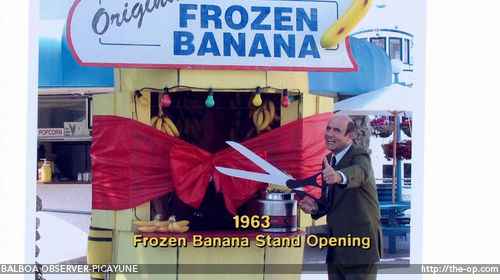
I learned a lot from watching Arrested Development, like the importance of always leaving a note, the existence of a dessert known as a frozen banana (which, in the show's universe, was created by a Korean banana stand owner and known as "Cold Banana in Delicious Brown Taste" before the Bluths stole the idea from him) and George Bluth Sr.'s adage that "there's always money in the banana stand." I had never heard of a frozen banana before Bluth's Original Frozen Banana Stand (a.k.a. "the Big Yellow Joint," the subject of Arrested Development composer David Schwartz's amusing fake '70s stoner anthem "Big Yellow Joint"). I thought a frozen banana was Asian American slang for a McCain-supporting Asian guy who lives under the Uncle Ruckus-style delusion that he's as white as Edward from Twilight while suffering from hypothermia.
I didn't realize a frozen banana is a banana covered in chocolate until recently, when I became curious about fictional foods that were integral to episodes of sitcoms like 30 Rock, The Boondocks and It's Always Sunny in Philadelphia (which gave us "milksteak" and "the grilled Charlie"), and I stumbled upon online recipes for the not-so-fictional dessert.
Yeah, it kind of looks like a chocolate-covered dick, and when peanuts are added to the coating, it starts to resemble poop on a stick, but it's also a delicious snack that's alright for any season. It's essentially a banana Popsicle in a chocolate coating.
In 2009, a couple of Arrested Development fans in Austin opened their own Bluth-style banana stand called Bananarchy, where they offer toppings like cinnamon and coconut. They even named an item after Arnett's breakout character. "The Gob" is two bananas double-dipped in chocolate and covered in peanuts.
Meanwhile, I attempted a few times to make for myself a frozen banana because I always wanted to recreate a snack that came from a show I admire (and occasionally revisit on DVD or IFC). I failed the first time with the chocolate coating, which is the trickiest component to master while making this otherwise simple snack. The coating shouldn't be Oreo cookie-esque, which was how my coating turned out the first time I made the dessert. It should be as smooth as Tobias Fünke's shiny blue pate.
So while we wait for word on the Arrested Development movie (or mull over getting the Arrested Development complete series DVDs for someone who--like everyone else during this recession--could use a laugh or two), here's the first-ever homemade recipe I've posted on this blog:
Ingredients 1 ripe and peeled banana 1 cup (6 oz.) of Nestle Toll House Milk Chocolate Morsels 1 tbsp. vegetable shortening 1 Popsicle stick
(Photo source: JJA)
1. Unpeel a banana. Cut an inch off one end of the banana. Push a Popsicle stick into that end of the banana.
2. Put the banana in a Ziploc bag and freeze it overnight.
3. The next day, place the chocolate morsels and the vegetable shortening together in an uncovered microwave-safe bowl. The shortening will thin out the chocolate and make it easier to work with. Heat the bowl on medium-high (70%) power for one minute. If there are still some morsel shapes in the melted chocolate, heat it again for a few more seconds. Stir.
4. Unroll a sheet of wax paper and pour the melted chocolate onto the sheet. Take the banana out of the freezer. If there are ice crystals on the banana, scrape them off. Roll the banana around in the chocolate until it's completely coated in it.
(Photo source: JJA)
(Photo source: JJA)
5. Seal the chocolate-covered banana in an airtight container and place it in the freezer. Keep the banana inside the freezer overnight or longer or until you're secure enough in your sexuality to stick a chocolate penis in your mouth.
Airing next Wednesday at 10am and 3pm on A Fistful of Soundtracks is the Fistful of Soundtracks: The Series episode "Zero Churn" (WEB69) from November 28-December 4, 2005.
All the tracks during "Zero Churn" come from soundtracks to movies that aired on L.A.'s beloved Z Channel in the '70s and '80s (examples include Nashville, The Harder They Come and the much-maligned Heaven's Gate). The ep's title refers to the Z Channel's "zero churn rate," a fancy business term that means subscribers never cancelled the service.
I never heard of the Z Channel--which was a really interesting and ahead-of-its-time cable channel--until I Netflixed the critically acclaimed Z Channel: A Magnificent Obsession documentary by both IFC and director Xan Cassavetes, the daughter of John Cassavetes and Gena Rowlands. My favorite parts of A Magnificent Obsession are the segments about Z Channel fare like Le Magnifique, Laura Antonelli's Mogliamante and Something of Value (interviewee F.X. Feeney, who wrote movie reviews for the listings guide that the channel mailed to its subscribers, does a funny impression of Winston Churchill's appearance in the prologue for Something of Value). And though Quentin Tarantino should really consider switching to decaf, he tells an amusing story in the middle of the doc about watching a tape of a Z Channel presentation of Mogliamante.
In 2005, I thought an AFOS: The Series ep based on A Magnificent Obsession would be a cool idea because the playlist would be eclectic, just like the channel itself was back in the day.
1. Nino Rota, "La Strada," Fellini & Rota: I Film, Le Musiche--Movies & Music, CAM 2. Jean Constantin, "Générique et Car de Police" (from The 400 Blows), Cannes Film Festival: 50th Anniversary Album, Milan 3. Giovanni Fusco, "Titoli" (from L'Avventura), I Film di Antonioni, Le Musiche di Fusco, CAM 4. The City of Prague Philharmonic, "The Bomb Run" (from Dr. Strangelove), Dr. Strangelove... Music from the Films of Stanley Kubrick, Silva Screen 5. The City of Prague Philharmonic, "Train Montage" (from The Wild Bunch), Cinema Century: A Musical Celebration of 100 Years of Cinema, Silva Screen 6. Bob Dylan, "Knockin' on Heaven's Door" (from Pat Garrett & Billy the Kid), Movie Music: The Definitive Performances, Columbia/Epic/Legacy 7. Jerry Fielding, "On the Road" (from Bring Me the Head of Alfredo Garcia), Bring Me the Head of Alfredo Garcia/The Killer Elite, Intrada 8. Pino Donaggio, "Tema di Clayton" (from Amore piombo e furore, a.k.a. China 9, Liberty 37), Spaghetti Westerns, Volume One, DRG 9. Jimmy Cliff, "The Harder They Come," The Harder They Come, Island 10. Henry Gibson, "200 Years," Nashville, MCA Nashville 11. David Mansfield, "Overture," Heaven's Gate, Rykodisc 12. Ennio Morricone with Gheorghe Zamfir & Edda Dell'Orso, "Cockeye's Song" (from Once Upon a Time in America), The Ennio Morricone Anthology: A Fistful of Film Music, Rhino 13. Piero Piccioni, "La Bella Signora" (from Tutto a posto e niente in ordine, a.k.a. All Screwed Up), (Italian Girls Like) Ear-Catching Melodies, Dagored 14. Gene Wilder and Peter Boyle, "Introduction/Puttin' on the Ritz," Young Frankenstein, One Way 15. Jerry Goldsmith, "Love Theme from Chinatown (End Title)," Chinatown, Varèse Sarabande
Count me as a Heaven's Gate hater, but God, the overture by Mansfield is such a beautiful piece of music.
Reruns of AFOS: The Series air Wednesdays at 10am and 3pm. To listen to the station during either of those time slots (or right now), press the play icon on the blue widget below the "About me" mini-bio on this blog.
The last time I saw The Limey was on an Artisan Entertainment screener tape during its art-house run 10 years ago. Steven Soderbergh's superb follow-up to the beloved Out of Sight was one of many highlights of a great and still-unsurpassed movie year (1999), and after stumbling into the film on IFC the other night and stopping whatever I was writing on my computer to watch it for the second time, it still is a highlight of '99.
I noticed a few things in this second viewing. The hot gangster's moll (played by a pre-daytime TV Amelia Heinle) spends a lot of time getting wet during the movie; Lesley Ann Warren is one of the finest-looking untouched-by-plastic-surgery sixtysomething actresses; Bill Duke must have been hired to play the marshals' disabled boss in the Out of Sight spinoffKaren Sisco based on his now-classic reaction to Terence Stamp's long speech from his DEA office desk ("There's one thing I don't understand. The thing I don't understand is every motherfuckin' word you're saying."); and some of the themes in Cliff Martinez's eerie score appear to have been an homage to equally eerie scores from late '60s/early '70s thrillers like Klute and Point Blank (which The Limey is often compared to, and Soderbergh is such a fan of the John Boorman classic that he recorded a commentrak for it).
I've read about the Limey DVD's infamous Soderbergh/Lem Dobbs commentrak--in which Dobbs argued with Soderbergh about the changes the director made to his script--but never listened to it. Now I'm itching to hear the commentrak.
My year-long postings of past or long-buried writing continue with a piece I wrote about The Limey at the time of its release.
The Limey Artisan Starring Terence Stamp, Peter Fonda, Lesley Ann Warren, Luis Guzman, Barry Newman, Joe Dallesandro, Nicky Katt, Amelia Heinle Music by Cliff Martinez Photographed by Ed Lachman Written by Lem Dobbs Directed by Steven Soderbergh
If Sarah Flack never gets an Oscar nomination for her ingenious editing of Steven Soderbergh's witty, melancholy revenge thriller/character study The Limey, then the members of the Academy ought to be taken out. The story of a British ex-con named Wilson (Terence Stamp) who tries to reconnect with his murdered daughter while searching the streets of L.A. for her killer, The Limey is told in a jigsaw-puzzle narrative style that shuffles past and present events. For instance, whenever Wilson discovers an important clue about his daughter's whereabouts before she was killed, the film cuts to a shot of a pensive, brooding Wilson, alone in a motel room or on an airplane. Are we watching him before he embarks on his journey through L.A. or are we seeing him on his way home to England, reflecting on his trip?
The nonlinear technique will befuddle some viewers, especially those expecting to see a "TBS Movie for Guys Who Like Movies." But it's a crucial--and inspired--device because it underscores how time makes very little sense to Stamp's title character, who, when the film opens, has just been released from a nine-year prison sentence that has messed with his concept of time, like it would do to any long-term inmate.
Wilson isn't the only character in The Limey who's disconnected from time. Terry Valentine (Peter Fonda) is a faded Hollywood record producer who never got over the end of the free-spirited '60s. This uneasy rider has gone to seed and turned to the drug trade to stay wealthy as he lures young starlets half his age with his hedonistic lifestyle and with stories about the '60s. One of these aspiring actresses is Wilson's daughter Jenny (Melissa George), who dated Valentine and lived with him before her death. Wilson's trail leads him to Valentine, but is Jenny's former lover really responsible for her tragic fate?
Stamp and Fonda are compelling as older, wearier versions of their '60s screen personas. Luis Guzman has an amusing and poignant supporting turn as a friend of Jenny's who assists Wilson on his manhunt, despite the language barrier between the two (the Angelenos' inability to understand Wilson's cockney slang is a running joke that fortunately isn't overused). Soderbergh calls The Limey "a very simple revenge film with a lot of '60s baggage." Although the plot may be a bit on the thin side, The Limey is anything but a simple revenge film. The characters are hardly the automatons of Charles Bronson shoot-'em-ups. Soderbergh and screenwriter Lem Dobbs refuse to paint them in simplistic strokes. The seedy Valentine, sort of an underworld Humbert Humbert with his taste for younger women, may be the villain here, but like Humbert, he's more pathetic than malicious; the film empathizes with his yearning for his younger, less desperate days. It's Valentine's associates, volatile, snarky hitman Stacy (Nicky Katt) and his older partner Uncle John (Joe Dallesandro), who are more greedy and evil than Fonda's character. As for Wilson, he's a man of contradictions. He has regrets about the life he led before prison (cleverly depicted in flashbacks composed of footage taken from Stamp's 1967 film Poor Cow, in which he also played a criminal named Wilson), most of all because it severed his relationship with his daughter. Yet he finds himself reverting back to the criminal life that drove her away in order to find her killer, which leads to another explanation for the jigsaw-puzzle storytelling: it suits the story of a man who's a puzzle, even to himself.