Showing posts with label Netflix. Show all posts

Saturday, 26 June 2010

Party Down, "Constance Carmell Wedding": "The Holo-what?"

Blond and blonder
This weekend's second-season finale of one of my current favorite shows, the Starz single-camera comedy Party Down, is rumored to be the series finale. The show's chances of being renewed by Starz have dimmed because it was a project that was nurtured by higher-ups who are no longer part of the channel staff, and they've been made even more dim by sucky ratings, as well as Party Down star and co-producer Adam Scott's decision to not return for another season (he became a regular on Parks and Recreation) and the decreasing availability of some of Scott's co-stars due to more stable employment opportunities that have emerged from pilot season. If Friday's finale was the last we see of the losers at Party Down Catering, it was a nice way to go out.

If you've never seen the underwatched Party Down, it's an uproarious and cynical portrayal of dog-eat-dog Hollywood, told through the eyes of cater-waiters who moonlight as actors, stage moms or underemployed screenwriters when they're not serving hors d'oeuvres to douchey showbiz bigwigs or the "blonde-haired nobodies with perky tits and bad skin" that Patton Oswalt encountered in one of the greatest things he ever wrote, a blog post about his miserable experience at an L.A. gifting suite (which I luckily saved to my computer before it was deleted from his blog). In other words, Party Down is the anti-Entourage. It's the darkest and funniest sitcom about not making it since Taxi.

The You Offend Me You Offend My Family blog does a wonderful series of posts called "Movies That Should Have Starred Asians." Party Down isn't a movie, but it belongs on that list. It's about failure and underemployment in Hollywood, and nobody's had it harder in that town than Asian American male actors, who have been stuck with some of the most demeaning roles in the biz. The one question I've had about Party Down throughout its run has been "Why is this group of struggling actors and screenwriters missing an Asian guy?" Now that the regular cast is without Scott (who's been terrific as Henry the lost soul and disillusioned actor who can't escape being recognized for his beer commercial catchphrase "Are we having fun yet?") and possibly Ryan Hansen, I'd be pissed if Party Down's yet-to-be-determined third season doesn't fill one of those empty spots with an Asian guy. (John Cho's without a TV series again. He'd be perfect on this show.)

Viewers who hate inside-showbiz sitcoms like Entourage or are tired of them will be relieved to know that not every episode of Party Down is about Hollywood (when HBO was initially interested in picking up Party Down, they pushed the creators, who include Paul Rudd--yes, that Paul Rudd--and Veronica Mars mastermind Rob Thomas, to make the project more of an inside-showbiz sitcom like so many other HBO shows, and the creators balked at having to recycle that exhausted genre, so Party Down ended up at Starz instead). In some eps, bumbling team leader Ron (Ken Marino, who along with Hansen, is one of many Veronica Mars alums who reteamed with their old boss on the new show) and his cater-waiters have found themselves working non-Hollywood functions like a young Republican club meeting or a college football star's NFL draft day party.

The show's versatile settings (and the rich material that arises from the waiters' reactions to each different setting and their encounters with the strangers they would mingle with) are among my favorite aspects of Party Down. The fact that the changing settings are really the soul of Party Down also means the show can never go stale, and it can survive the departure of a regular like Scott or Jane Lynch, who was an invaluable part of Party Down until she had to leave to join the cast of the surprise hit Glee. (Lynch's shoes have been ably filled this season by Megan Mullally as Lydia, an always cheery stage mom from outside of Hollywood whose lack of knowledge about the industry, pop culture or sexual slang like "cougars" and "bears" have resulted in some great reactions from her youngest co-workers, Martin Starr's self-described "hard sci-fi" screenwriter Roman and stand-up comic Casey, played by Lizzy Caplan, whose unexpected farewell to clothing in True Blood is the only reason to watch that show.)

Roger Meyers Jr., Coach Sue and Megan Mullally. Sorry, I didn't watch Will & Grace too often and can't remember the Mullally character's name on that show.
In "Constance Carmell Wedding," Lynch reprises her role as Constance--a '70s/'80s starlet whom you might barely remember from such Skinemax mainstays as Scream Weaver, Walnuts and Dingleberries--and who's now a client instead of one of the waiters of Party Down Catering, which she hires to cater her wedding to an elderly movie producer (an initially unrecognizable and sickly-looking Alex Rocco from The Godfather and The Friends of Eddie Coyle). The inevitable meeting between Constance and her replacement Lydia does not disappoint. Seeing Lynch and Mullally share the screen while their characters compete for attention from the Party Downers is like watching one of those Doctor Who eps that unite the current actor who stars as the Doctor with a previous actor who played him, except the Doctor now has a vagina.

The element I missed the most during season two due to Lynch's absence was the dynamic between Constance and Hansen's not-too-bright actor/supermodel/skirt-chaser/wannabe emo rocker character Kyle, whom Constance was often seen giving muddled showbiz advice to. Constance's interaction with this male version of her younger self--they look alike, and at times, they even think alike!--made Kyle the seemingly douchey pretty boy an even more likable character than bitter nerd Roman, whom we were tricked into sympathizing with early on in the series until we realized, "Damn, Roman is a worse asshole than the assholes he snarks about." (In a couple of nicely underplayed dramatic moments during a first-season ep, Kyle saw a group of potential drinking buddies ridicule Constance behind her back, and then he ditched them to hang out with Constance, an applause-worthy move that's a great example of the show's unpredictable and nuanced writing and must have won over viewers who thought Kyle would be a rehash of Hansen's douchey Veronica Mars character Dick Casablancas.) The finale revisits this dynamic in a hilarious wedding reception scene where Kyle and his emo band perform a song about struggle that could have been the perfect Party Down opening theme if it weren't for certain lyrics. Kyle doesn't realize his lyrics are repulsing Constance's older Jewish guests ("Yeah, they brand you a star/Put you on the midnight train/Going very far/Line you up and give you a number/Shoot you down/Throw you away/We will not surrender!") until Constance has to interrupt him to point out the questionable imagery, to which Kyle replies, "The Holo-what?"


The finale also reaches a pivotal point in the arc of a duo that's even more interesting to watch than Yoda and Luke Runwaywalker, mostly because of the chemistry between Scott and Caplan: Henry and his equally sharp-witted, on-again/off-again girlfriend Casey, who landed a bit part in a Judd Apatow movie and has been attempting to pull Henry out of his disillusionment with acting. Since it's Scott's final ep as a regular (or if the show gets axed, it's the final ep for everybody), this often downbeat show ends with a rarely seen ray of hope when Casey becomes so distraught over getting deleted from the final cut of the Apatow flick that she... nah, if you have a PC and a Netflix account, you have to go stream the finale now to see for yourself.

Wednesday, 9 June 2010

The Palace: So This Is Where the Asians Hang Out? begins June 14 and concludes June 20 at afistfulofsoundtracks.blogspot.com

The Palace: So This Is Where the Asians Hang Out?, Chapter 2 by Jimmy J. Aquino
I hate inking my own webcomic. It takes forever to do. Instead of adding ink directly onto each original sketch that I did in blue pencil, I place a tracing pad sheet over the sketch and redraw it in ink. (Even though the time-consuming process drives me crazy, I prefer to do it this way because when I scan the tracing pad sheet, the redrawn strip looks more dirt-free and clean than the version that's in pencil, so I don't have to do too much digital editing.) If one of my knuckles brushes up against a newly inked line or letter, it can smudge, so I have to wait a few minutes for the ink to dry before I resume inking. I bet this is what shooting a makeout scene with a temperamental actress who hates being touched by you must be like: a lot of stopping and starting and having to make sure your knuckle doesn't brush up against her boob because if it does, she'll throw a fit and refuse to come out of her trailer, and everything's ruined.

While scripting most of The Palace's STIWTAHO? arc a couple of months ago, I Netflixed DVDs of the surreal early '00s Britcom Black Books. A former colleague once blogged about his enjoyment of the show, and he mentioned that one of its running gags was the lead character's hatred of cell phones--something I really identify with--so I always wanted to check out Black Books, but I kept putting it off. I finally got around to Netflixing the show and enjoyed the hell out of it.

I was surprised to find that Black Books covered some of the same ground I've covered in my webcomic. The Dark Knight watercooler talk ban that Connor--an Irishman like Bernard Black--enforced at his business in The Palace's In the Shadow of the Bat arc is like any one of Bernard's various rules at his bookshop ("No mobiles, no walkmans, none of that or any of the others...").

When I came up with the concept for The Palace, I set it at an independently run art house/repertory theater that's barely scraping by instead of a successful multiplex that shows current blockbusters because struggling or failing always makes for more interesting material than being at the top (a reason why I got bored with Entourage). Black Books star/co-creator Dylan Moran must have been aware of that too. He said he set his show in an indie bookshop because he was fascinated by the theme of doomed enterprise. "Running a second-hand bookshop is a guaranteed commercial failure. It's a whole philosophy," said Moran in a 2000 Guardian article. "There were bookshops that I frequented and I was always struck by the loneliness and doggedness of these men who piloted this death ship."

Separated at birth?
Is it me, or is Bernard a dead ringer for Spike Spiegel?

Wednesday, 2 December 2009

AFOS: "Zero Churn" playlist

An ancient Z Channel graphic
Airing next Wednesday at 10am and 3pm on A Fistful of Soundtracks is the Fistful of Soundtracks: The Series episode "Zero Churn" (WEB69) from November 28-December 4, 2005.

All the tracks during "Zero Churn" come from soundtracks to movies that aired on L.A.'s beloved Z Channel in the '70s and '80s (examples include Nashville, The Harder They Come and the much-maligned Heaven's Gate). The ep's title refers to the Z Channel's "zero churn rate," a fancy business term that means subscribers never cancelled the service.

I never heard of the Z Channel--which was a really interesting and ahead-of-its-time cable channel--until I Netflixed the critically acclaimed Z Channel: A Magnificent Obsession documentary by both IFC and director Xan Cassavetes, the daughter of John Cassavetes and Gena Rowlands. My favorite parts of A Magnificent Obsession are the segments about Z Channel fare like Le Magnifique, Laura Antonelli's Mogliamante and Something of Value (interviewee F.X. Feeney, who wrote movie reviews for the listings guide that the channel mailed to its subscribers, does a funny impression of Winston Churchill's appearance in the prologue for Something of Value). And though Quentin Tarantino should really consider switching to decaf, he tells an amusing story in the middle of the doc about watching a tape of a Z Channel presentation of Mogliamante.

In 2005, I thought an AFOS: The Series ep based on A Magnificent Obsession would be a cool idea because the playlist would be eclectic, just like the channel itself was back in the day.

'A poem, by Henry Gibson.'
1. Nino Rota, "La Strada," Fellini & Rota: I Film, Le Musiche--Movies & Music, CAM
2. Jean Constantin, "Générique et Car de Police" (from The 400 Blows), Cannes Film Festival: 50th Anniversary Album, Milan
3. Giovanni Fusco, "Titoli" (from L'Avventura), I Film di Antonioni, Le Musiche di Fusco, CAM
4. The City of Prague Philharmonic, "The Bomb Run" (from Dr. Strangelove), Dr. Strangelove... Music from the Films of Stanley Kubrick, Silva Screen
5. The City of Prague Philharmonic, "Train Montage" (from The Wild Bunch), Cinema Century: A Musical Celebration of 100 Years of Cinema, Silva Screen
6. Bob Dylan, "Knockin' on Heaven's Door" (from Pat Garrett & Billy the Kid), Movie Music: The Definitive Performances, Columbia/Epic/Legacy
7. Jerry Fielding, "On the Road" (from Bring Me the Head of Alfredo Garcia), Bring Me the Head of Alfredo Garcia/The Killer Elite, Intrada
8. Pino Donaggio, "Tema di Clayton" (from Amore piombo e furore, a.k.a. China 9, Liberty 37), Spaghetti Westerns, Volume One, DRG
9. Jimmy Cliff, "The Harder They Come," The Harder They Come, Island
10. Henry Gibson, "200 Years," Nashville, MCA Nashville
11. David Mansfield, "Overture," Heaven's Gate, Rykodisc
12. Ennio Morricone with Gheorghe Zamfir & Edda Dell'Orso, "Cockeye's Song" (from Once Upon a Time in America), The Ennio Morricone Anthology: A Fistful of Film Music, Rhino
13. Piero Piccioni, "La Bella Signora" (from Tutto a posto e niente in ordine, a.k.a. All Screwed Up), (Italian Girls Like) Ear-Catching Melodies, Dagored
14. Gene Wilder and Peter Boyle, "Introduction/Puttin' on the Ritz," Young Frankenstein, One Way
15. Jerry Goldsmith, "Love Theme from Chinatown (End Title)," Chinatown, Varèse Sarabande

Count me as a Heaven's Gate hater, but God, the overture by Mansfield is such a beautiful piece of music.

Reruns of AFOS: The Series air Wednesdays at 10am and 3pm. To listen to the station during either of those time slots (or right now), press the play icon on the blue widget below the "About me" mini-bio on this blog.

Thursday, 9 July 2009

Chocolate city

Shoo, flies, don't bother me.
I wasn't aware of the existence of Thai director Prachya Pinkaew's 2008 martial arts flick Chocolate until a few weeks ago, when Netflix placed the movie on a list of rentals I might enjoy.

After I read Netflix's synopsis of their recommendation--"a young autistic woman who discovers that she has the uncanny ability to absorb precision fighting skills just by watching martial arts movies"--I immediately added it to my queue and placed it at the #1 spot because "Sampler," the Secret Identities: The Asian American Superhero Anthology short story I created, has a similar premise. In my story (the very reason why this weekend, I'll be making my first appearance at a comic book convention as a guest talent, even though it's at one of the smaller conventions, the new Asian American ComiCon), a dry cleaning store worker named June temporarily acquires the powers of her superhero customers by touching their costumes.

Monica (Dana Davis), Heroes' quickly-forgotten-because-the-showrunners-have-ADD supporting character, and another 'photographic reflexes' character, the Marvel Comics villain Taskmaster.
On the other hand, what Taskmaster can't do is find a costume that doesn't make bystanders laugh.
The autistic, candy-craving Chocolate heroine's superpower is actually more about "photographic reflexes"--like forgotten Heroes supermimic Monica Dawson and the Marvel Comics supervillain Taskmaster, whom Alan Sepinwall said must have been the inspiration for Monica--than power-absorption-by-touch. (In one of millions of lines that were deleted from "Sampler" by Secret Identities editor-in-chief Jeff Yang, June explains that she's able to sample superpowers because she's a mutant, or a "superior," a term I created for mutants in earlier drafts. In order to sample a mutant's power, June has to touch that mutant's fingerprint residue or any other traces of DNA left behind anywhere, whether it's on an item they touched or a garment they wore. I know--you're probably thinking, "Ewwww, so does that mean she would have to come into contact with the love stains inside Cyclops' unitard in order to shoot lasers from her eyes?" In the R-rated or TV-MA-rated version of "Sampler," unfortunately, yes.)

Below Sepinwall's recap of Heroes' introduction of Monica, a commenter joked, "Jeez, a hero whose superpower is that she's really, really good at watching TV?" In Chocolate, Zen (Jija Yanin) acquires her fighting moves in a similar fashion by viewing TV broadcasts of Muay Thai flicks like Pinkaew's own previous work, the Tony Jaa vehicle Ong-Bak, or in my favorite sequence, observing the movements of a henchman who has Tourette's. Yep, it's a South Park "Cripple Fight"-esque duel that pits mentally challenged fighter against physically challenged fighter (and though it's my favorite showdown in Chocolate, it's too quickly resolved).

No gang would accept physically challenged thugs--or transvestites--into its fold like the evil Thai crime family in Chocolate does. Gangsters aren't exactly known for being open-minded and tolerant. That's how much of a martial arts fantasy Chocolate is. It's like the multiracial Street Thunder gang in the original Assault on Precinct 13. You immediately knew John Carpenter's film was more of a hyperrealistic crime flick than a realistic one because in real life, no gang would be that racially mixed.

This move was copped from Tony Jaa...
... while this move was copped from Jean-Claude Van Damme in Gymkata 2: You Can Take the Kata Out of the Gym, But You Can't Take the Gym Out of the Kata.
I've previously said I'm not much of a fan of the martial arts genre. Even the fight sequences in some of the martial arts actioners I've enjoyed, like the first two Once Upon a Time in China installments, can get boring after a while. Chocolate's otherwise decent climax gets tedious at one point--I kept thinking, "C'mon, when's the main villain gonna finally lose consciousness? What is he? The Thai Energizer Bunny?"

Despite the tedious climax, a cancer-patient-mother subplot that's a bit too melodramatic for my tastes, and a crew of transvestite assassins who would fit right in with The Celluloid Closet's montage of evil gays from Freebie and the Bean and The Silence of the Lambs(*), the otherwise inventive Chocolate won me over, which is something of a miracle because I'm one of the few guys in America who actually didn't cry during Rudy. The premise of an undersized underdog overcoming adversity or physical limitations through combat is always appealing, whether it's in Rudy, Chocolate or even "Sampler."

(*) If I ever have to defend Chocolate to gay critics, I'd probably say, "Well, I agree, but in fairness, at least Chocolate doesn't ignore the tranny population in Thailand." I'd also say, "And the big bad's tranny second-in-command wasn't a weakling like in Freebie and the Bean. He was a badass with a gun."

Zen could use some Neosporin on her knee like soon-to-be-ex-Governor Sarah Palin could use a thick piece of electrical tape over her mouth.

A recent TCM Movie Morlocks blog post praises the coherently shot, Fred Astaire-style ass-whupping Donnie Yen gives to Sammo Hung in Hong Kong action maestro Wilson Yip's Kill Zone and explains why American action films pale in comparison to Asian actioners:
One excuse given as to why films like Taken or the Bourne series don't have this same kind of coherence is that the actors aren't as physically trained as martial arts pros like Hung and Yen, and necessarily need stunt doubles, necessitating even faster cuts and less spatial coherence. However, American action films don't necessarily have to have nuanced fighting styles – just watch the series of haymakers Gregory Peck and Charlton Heston unload on each other in The Big Country (which can be seen in the video slideshow of Dennis Lim's excellent history of fight choreography at Slate). It's a stylistic choice, and right now Hollywood filmmakers are making the wrong one. I was initially thrilled by the Bourne series' propulsive energy, but the more time that passes, the more its fractured editing seems like a dodge.
Fortunately, the fight sequences in Chocolate are as coherently shot as the Kill Zone sequence. That means each of Yanin's graceful moves aren't disrupted by a choppy edit. The sequences look like they must have been genuinely grueling to perform, and Chocolate's closing credits outtakes of Yanin and the stuntmen badly injuring themselves prove it. Adding to the coherence and credibility of Chocolate's sequences is the fact that like Hung and Yen, the charismatic, twentysomething Yanin is a pro, although she wasn't at first. She received two years' worth of intensive martial arts training after Pinkaew cast her as Zen, which means Chocolate took four years to make.

The comic book version of Chocolate

Jija Yanin's Raging Phoenix teaser poster

Yanin is a martial arts star to watch. A box-office hit in Thailand, Chocolate was popular enough to spawn a comic book and another high-concept martial arts flick for Yanin. Her next vehicle, Raging Phoenix, will involve another new-to-the-genre gimmick like Chocolate's introduction of an autistic heroine: hip-hop dancing. I take it Raging Phoenix will be like Ong-Bak meets You Got Served.

Saturday, 4 July 2009

The Anderson Tapes: "America, man! You know, it's so beautiful I wanna eat it!"

'America, man! You know, it's so beautiful I wanna eat it!'
I can't think of a more fitting quote to put at the top of this Fourth of July Weekend blog post. It's a standout line uttered early on by Christopher Walken in his big-studio debut, the 1971 Columbia Pictures heist flick The Anderson Tapes.

I finally got around to watching The Anderson Tapes the other day. Before Sidney Lumet's nifty little caper made its debut on DVD in September as part of Sony's "Martini Movies" imprint (uh, Sony, I think you missed the lounge movement by about 10 years), it was on my list of films I--a fan of '70s heist flicks like the original Taking of Pelham One Two Three and The Hot Rock--wanted to watch but wasn't able to because they weren't available on disc.

I always dug the Smackwater Jack version of Quincy Jones' Anderson Tapes theme, which features the late Freddie Hubbard on flugelhorn and a nice harmonica solo by Toots Thielemans. That version of the theme actually never turns up during Jones' unreleased, love-it-or-hate-it score, which is filled with early synthesizer bloops and squeals due to the paranoid film's subject of pre-Watergate (and pre-Conversation) surveillance.

The Randomatic sits in storage somewhere with other hilariously now-outdated '70s and '80s gadgets like that Etch-a-Sketch-ish police sketch machine from For Your Eyes Only and the Daggit from the old Battlestar Galactica.
Some viewers find the bloops and squeals to be grating and distracting, while I don't mind them at all. Jones' bloops and squeals--along with the now-goofy-looking Randomatic computer that's used by the film's NYPD officer characters to pull up criminal records--lend The Anderson Tapes a certain analog charm. The groovetastic sound effects remind me of the electronic noises during Roman Coppola's amusing 2001 film about the making of a low-budget French sci-fi flick, CQ, which takes place in the same era.

'Isch that a Lakers jersey under your skirt? Take the bloody thing off! You know I'm all aboat the Knicks.'
Sean Connery ditched the 007 hairpiece--or rather, chose a more revealing hairpiece--to star as Duke Anderson, a newly freed, unrepentant ex-con who plots an elaborate Labor Day heist at the ritzy Fifth Avenue apartment building of his high-priced hooker girlfriend Ingrid (Dyan Cannon). In other Connery/Lumet collabos, particularly The Hill and The Offence (when's that film going to hit DVD?), Lumet clearly loved giving Connery speeches that were long and fiery (yet not overwrought). Eager to move past his rather limited 007 persona, Connery excelled at those speeches, and he pulled off another juicy one here, an anti-authority screed that's more Cool Hand Luke than 007, courtesy of Cool Hand Luke screenwriter Frank Pierson ("What's advertising but a legalized con game? And what the hell's marriage? Extortion, prostitution, soliciting with a government stamp on it.").

Duke Anderson failed to deprive people of their money on Labor Day Weekend without getting caught. He should have just started his own Labor Day telethon for broke ex-cons who can't hack it outside prison.
Anderson's crew includes a younger safecracker known simply as "the Kid" (Walken, whose eccentric line delivery is made even weirder by the fact that he really does look like a kid here), unflappable getaway driver Spencer (Dick Anthony Williams) and gay antiques dealer Tommy (if acting styles were KFC recipes, Martin Balsam's would be Extra Swishy). They'd be the tightest crew in the history of caper movies, if they weren't so oblivious to then-recent advances in surveillance technology, which have allowed government agents or cops to illegally monitor the activities of everyone Anderson comes into contact with, from his associates to his girlfriend. Those lawmen aren't even interested in Anderson's next score. They've been spying on everyone in Anderson's circle because of unrelated improprieties, whether past or alleged. Black Panther-hating Feds are profiling Spencer, who lives near a Panther Party chapter, the IRS is keeping tabs on Anderson's Mafioso benefactor (Alan King), and Ingrid's jealous sugar daddy (Richard B. Schull) has hired a private detective to listen in on her trysts with her clients.

'We're gonna rob every single copy of 'Zardoz,' 'The League of Extraordinary Gentlemen,' 'The Country Bears' and 'Gigli' we can find and then lock them away in a vault, never to be found again. Are you in, kid?'In The Anderson Tapes (which the creatively bankrupt Sony has been attempting to remake, and I hope the box-office failure of their Pelham remake discourages them), it's interesting to see narrative devices and character types Lumet would revisit in later, better-known works. Lumet jumbled the Labor Day heist's time frame--a gimmick the director would re-use in The Offence and Before the Devil Knows You're Dead. The flashbacks to the heist are less distracting here than in Before the Devil. The crooked cops of Serpico, Prince of the City and Night Falls on Manhattan are cut from the same cloth as the lawmen who illegally bug or wiretap Anderson's cohorts (the only likable cop in The Anderson Tapes is a resourceful SWAT team leader played by a pre-SNL Garrett Morris). The victims of Anderson's heist get some standout lines and are as fleshed out as Al Pacino's hostages from my favorite Lumet film, 1975's Dog Day Afternoon. The heist sequence's tension is offset by some welcome comic relief from Judith Lowry as an elderly resident who doesn't seem to mind being robbed (Lowry was the same ornery old lady who stole scenes in Norman Lear's not-yet-on-DVD satire Cold Turkey, also released in 1971).

If you can find Walken's obscure 2000 indie movie The Opportunists, in which he plays a world-weary safecracker whose mentorship of a younger crook carries echoes of the Connery character's mentorship of Walken's upstart safecracker, it would make for an intriguing double feature with The Anderson Tapes. Walken's performance in The Opportunists--it's Walken in not-so-weird Catch Me If You Can mode--is one of his most underrated. Too bad The Opportunists is rather listless for a caper flick. Compared to the fun and nail-biting Anderson Tapes, The Opportunists is--to borrow a line from one of Walken's many quotable SNL sketches--a Stiffly Stifferson.

Friday, 16 January 2009

Watch The Rockford Files and call to see if Paul can score some weed

'This is Jim Rockford. At the tone, leave your name and message. I'll get back to you...'
Your friends do it and you've probably done it too: catch up on a show your lazy ass has put off watching by setting aside an entire weekend to view the DVD box set in one marathon sitting. Back when 24 first hit the DVD market, various writers who missed the first season chose to catch up with the show on DVD and recapped in real time what it was like to watch the first-season discs in one sitting, while a writer I used to work with picked the '80s version of The Twilight Zone for his weekend DVD marathon. A couple of years ago, those writers inspired me to do a similar marathon thing with the box sets of another cult show: The Rockford Files, Stephen J. Cannell's clever reinvention of the private eye genre, which starred James Garner in his signature role as rugged everyman gumshoe Jim Rockford.

Alright, so it's not quite a marathon. I haven't even viewed all 123 episodes yet, but my goal is to eventually see them all on DVD or via Netflix's media player for PC users. As of this writing, I haven't reached season five yet. On Inauguration Day Tuesday, Universal Studios Home Entertainment will release Rockford's sixth and final season.

I picked Rockford because I was a fan of Veronica Mars (which starred one of the world's hottest-looking Star Wars geeks, Forgetting Sarah Marshall's Kristen Bell, who should have Jedi mind-tricked the CW assclowns into bringing back her show). Before I started renting the Rockford DVDs from Netflix, I had only caught Veronica's spiritual granddaddy once or twice on cable, so I wanted to better acquaint myself with Rockford on DVD, where it's uncut and commercial-free (on Hulu, it's not commercial-free). The older the series, the more it gets chopped up by syndicators to accommodate commercial breaks, which grow annoyingly longer with each passing year. So that must mean Adventures of Superman reruns will eventually be edited down to 10 minutes, and George Reeves' flying sequences will be sped up so badly it'll look like the Metropolis underworld slipped some crank into the Daily Planet watercooler.

Rockford still draws a cult that's pretty rabid, though not quite as huge as Veronica's online fanbase. Slackers like the main character's pal in Ben Folds Five's "Battle of Who Could Care Less" (the source of the title of this post) dig Rockford reruns because Jim is one of them. They identify with a hero who'd rather go fishing with his father Rocky (Noah Beery) than do his job. The fans who still visit the alt.tv.rockford-files newsgroup continue to exchange favorite Garner wisecracks, and a couple of fan sites list every wacky message Jim received on his answering machine during the opening credits.

On disc, Rockford has aged better than most '70s shows, thanks to quirky, sharp and timeless scripts penned by staff writers like Cannell, future Sopranos creator David Chase and Juanita Bartlett. Seventies TV comes in three modes: schlocky (the Krofft variety shows, anything with Glen A. Larson's name on it), sanctimonious (M*A*S*H, Norman Lear's shrill shoutcoms) or a hideous mash-up of both (Hawaii Five-0, the "Fonzie gets a library card" era of Happy Days). Rockford is one of the few '70s shows I've seen that's neither of the above, and whenever the series did address a serious issue--like the flaws of the grand jury system in its most celebrated ep, the Bartlett-scripted "So Help Me God"--it did it with class and zero preachiness.

If Rockford were made today, it would be a perfect fit for USA's Thursday or Friday night lineup, alongside equally easygoing, character-driven detective shows like Burn Notice, Monk and Psych. But when Rockford first aired in 1974 on NBC, a comedic detective drama was considered an oddity and a huge risk. Part of Rockford's charm was how it subverted hard-boiled gumshoe genre clichés (Rockford would always hurt his fist after punching somebody, he had an answering machine instead of a sexy secretary, he worked out of a rundown mobile home on the Malibu beach instead of an Art Deco-ish office in downtown L.A., etc.).

However, NBC found the tongue-in-cheek humor to be off-putting and wanted Rockford to be dead-serious like its ratings competition at the time, the CSI: Miami of the '70s, the stiff and banal Hawaii Five-0, so they tried to interfere with the show's tone, resulting in an uneven first season (although season one has a few winners, like the "Profit and Loss" two-parter that pits Rockford against corporate fraud).

Network interference ruined the second half of Veronica's third and final season (Veronica worked better as a serialized whodunit than as the case-of-the-week procedural it seemed to be morphing into in its last few eps). Decades before, that same predicament could have destroyed Rockford, if it weren't for its defiant lead actor and his fierce protectiveness of the show's crew (Cannell once told an interviewer that Garner was one of the most polite and gracious actors he ever worked with, which made the Rockford set a more pleasant workplace for Cannell than the Baretta set, where Robert Blake behaved like a douchey little anti-Garner). In season two, Garner stood up for the showrunners--just as Rockford would valiantly do for his beleaguered clients, even if they stiffed him--and threatened to walk if NBC continued to tinker with the scripts. The network wisely realized you don't piss off Jim Rockford (something that eluded Universal, which later got itself embroiled in endless legal disputes with Garner), so it left the showrunners alone, and the Malibu P.I. who famously charged "$200 a day, plus expenses" stayed in business for four more years.

Here are five reasons why The Rockford Files are always worth reopening, despite the lack of substantial DVD extras (c'mon Universal, step your game up).

1. The Rockford Reverse 180 is one of the coolest car chase maneuvers ever. Plus, Garner--star of Grand Prix and a car-racing enthusiast--did his own stunt driving, and he never filmed his Pontiac Firebird sequences in front of a blue screen, unlike other '70s shows with car chases (I'm looking at you, Dukes of Hazzard). If you forgot how to execute a Reverse 180 (also known as the J-turn, or as it's more commonly called today, "the Rockford"), which would come in handy whenever goons would corner Rockford in his Firebird, Jim would put his car in reverse, make a sweet 180 degree turn, and then drive off into the opposite direction--and the Car Chase Hall of Fame.

Here's a list of eps in which Rockford does the Reverse 180 (and when to skip to it on your DVD player). You could start a drinking game with this.

"Gearjammers (Part 1)" (season two): 00:22:19.
"The No-Cut Contract" (season two): 00:09:50.
"Foul on the First Play" (season two): 00:40:07.
"Return to the 38th Parallel" (season two): 00:28:02.
"Sticks and Stones May Break Your Bones, But Waterbury Will Bury You" (season three): 00:20:12. What makes this Reverse 180 particularly amusing is that Rockford smiles and waves at the bad guys before reversing.
"To Protect and Serve (Part 1)" (season three): 00:43:08.
"Second Chance" (season four): 00:22:16. Rockford drives into a dead-end alley, does the Reverse 180 and then cleverly pushes the Firebird into a trash bin so that he can crash the bin into the goons' car. There's also a blooper. The close-up shot of the right front tire as he drives in reverse is incorrect. It shows the Firebird going forward instead of in reverse. Aw, don't you just love rushed-into-broadcast '70s TV and its continuity errors?
"White on White and Nearly Perfect" (season five): 00:37:03. Instead of doing the Reverse 180 in the middle of a chase, Rockford does it while stealing a car to stake out the bad guys.

2. Trace how Rockford evolved in its first three seasons. Most of our favorite shows start off strongly and then gradually decline in quality, but Rockford was the opposite. It got better as it went along. Season one tended to meander--you could tell the writers ran out of material if the car chase that week went on for an eternity. Season two was a slight improvement, but it lost points with viewers because they got sick of seeing clients take advantage of Rockford week after week, and they preferred it when their hero was the smartest guy in the room, not the dumbest.

Season three saw less of the pacing problems and repetitive Rockford-gets-played-again eps that plagued the first two years. For most fans, this is the season when Rockford hit its stride. It's also the year when David Chase joined the writing staff. Chase, who previously wrote for Kolchak: The Night Stalker, contributed exceptional eps like "Quickie Nirvana," "To Protect and Serve" and "Sticks and Stones May Break Your Bones, But Waterbury Will Bury You."

If you're a Sopranos fan who's unfamiliar with Chase's earlier work on Rockford, his eps are especially worth checking out because they hint at the brilliant melding of humor and angst he would later perfect on the mob opera. My favorite Chase-penned Rockford ep is "Waterbury Will Bury You," a riff on Watergate. The "Waterbury" of the title is a corporate P.I. firm that eliminates the competition--smaller P.I. businesses like Rockford's--by causing the detectives to lose their licenses. The playful references to political scandal is a Chase trademark that seeped into The Sopranos, most memorably during its final season, when Uncle Junior, institutionalized after shooting Tony, writes a letter to Dick Cheney: "Like yourself, I was involved in an unfortunate incident when a gun I was handling misfired..."

3. A great cast of supporting players backed up the superb Garner. Occasionally, Rockford's case of the week would be on the mundane side, but one particular element of the show was never dull: the character interplay. The core of the series was Rockford's richly drawn relationships with Rocky; Sgt. Dennis Becker (Joe Santos), his only friend on the police force; Angel (Stuart Margolin), a weaselly, love-him-or-hate-him ex-cellmate; and lawyer and on-and-off girlfriend Beth Davenport (Gretchen Corbett, the thinking man's '70s hottie, like Jan Smithers on WKRP).

The Rockford staffers also clearly had fun writing for characters of color, who rarely got to shine in the crime show genre in those days (Huggy Bear doesn't count). Cannell created memorable, nuanced characters who were the opposite of "scared brother on a police show," that hilarious category from In Living Color's classic "Black People's Awards" bit. Rockford crossed paths with the likes of parole officer-turned-P.I. Marcus "Gabby" Hayes (Garner's Skin Game co-star Louis Gossett Jr.), whose affinity for lavish expenses irritated Rockford the Jack Benny-esque cheapskate, and ex-felon Gandolph "Gandy" Fitch (the late Isaac Hayes), whose signature quirk was to still call Rockford by what must have been his prison nickname, "Rockfish." If you only know Hayes for his Chef character on South Park, then the second-season fan favorite "The Hammer of C Block," in which Gandy searches for the person who framed him 20 years before for the murder of Gandy's girlfriend, will be a revelation because of Hayes' dramatic turn.

Cannell even tried using Rockford as a launching pad for a show concept that was considered more outlandish than a comedic detective drama: an action drama anchored by two African American leads. The concept is still deemed a risky venture by the networks, which appear to be more comfortable with having all-black casts in sitcoms rather than dramas. Whenever a drama with a predominantly ethnic cast does make it to the schedule, the network either fails to promote it or tinkers with it so much that it ends up being unappealing to viewers of any race (exhibit A: the heavily watered-down Shaft TV series). But the failures of the small-screen Shaft and two other '70s detective shows with black leads, Get Christie Love! and Tenafly, didn't stop Cannell from pairing up Gabby the sharp-dressed smoothie with Gandy the hotheaded ex-thug in 1977's "Just Another Polish Wedding," which served as a backdoor pilot for a Gabby and Gandy spinoff that, of course, never got off the ground. It's a shame we never got to see Gossett and Hayes together again because they played well off each other, like during a raucous sequence in which Gabby and Gandy stumble into a neo-Nazi bar. Five years later, Eddie Murphy found himself in a similar jam in 48 Hrs. and trash-talked his way into movie history. But Gossett and Hayes did the intimidate-a-dive-full-of-racists thing first on Rockford.

4. See where Keith Mars and his daughter Veronica inherited their sense of humor and disdain for upper-class arrogance. We never knew if Keith's parents were still alive, but his unseen dad must have been Rockford himself or a Rockford type. Veronica has often been compared to Nancy Drew, which is silly because snarky Veronica has more in common with the equally sardonic, ramshackle Rockford than with Nancy the earnest preppie chick.

- Rockford adored his trucker dad; Veronica adored her dad, a P.I. and former sheriff of Santa Cruz-like Neptune, California.

- Rockford worked hard to restore his reputation after doing a five-year bid in San Quentin for a robbery he didn't commit. Veronica worked hard to restore her reputation (and help Keith pay the bills) after being ostracized and humiliated by the 09ers--the wealthy douchebags in Neptune--because Keith accused an 09er of murder.

- Rockford often found himself protecting his clients from rich bullies like the "Fiscal Dynamics" CEO played by Ned Beatty in "Profit and Loss," an interesting precursor to the corporate bigwig Beatty would portray in Network two years later. Veronica had to put up with her 09er classmates almost every week.

- Rockford didn't get along with the cops, except for Sgt. Becker; Veronica didn't get along with the self-centered, incompetent Sheriff Lamb.

- Rockford was jealous of suave, sharp-dressed rival sleuth Lance White, played by a pre-Magnum Tom Selleck. Mars Investigations' main rival was lowlife detective Vinnie Van Lowe (Ken Marino, in a scene-stealing role originally written for Marino's Wet Hot American Summer co-star Paul Rudd), who craved publicity like White but was hardly as refined--his collection of Members Only jackets rivaled Richie Aprile's.

- Rockford concocted undercover identities like the folksy oilman "Jimmy Joe Meeker;" so did Veronica. (Kristen Bell has a knack for goofy voices and accents. Also peep her killer Russell Brand impression in Forgetting Sarah Marshall. Bell has a future as a cartoon voiceover actor.)

- Rockford hated violence. He carried an unlicensed gun but rarely used it ("I don't shoot it, I just point it"). Veronica also didn't have the stomach for fighting. She relied on either a taser or her pitbull Backup to fend off thugs and frat-boy douches. (One of the reasons why I love Veronica Mars is because creator Rob Thomas resisted making his heroine a clichéd butt-kicking babe, unlike all the other producers who have tried to clone Buffy and suck at it.)
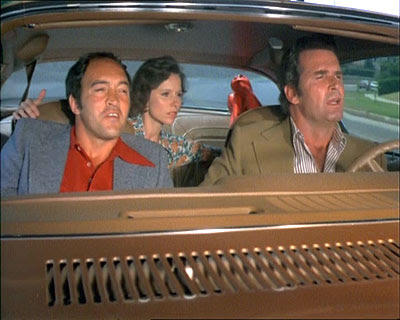
Rockford prepares to show off his Reverse 180 skills to Sgt. Becker and his wife.
5. Rockford is also the spiritual granddaddy to the grifter heroes of the BBC/AMC hit Hustle. Plus, who can resist an unlikely hero helping the downtrodden? Before Hustle and its clones (like NBC's short-lived Heist) came along, TV rarely allowed con artists to be heroes. The networks used to be run by puritanical killjoys who wanted prime-time protagonists to always be good, upstanding citizens who "drink their school, stay in drugs and don't do milk," as the Robert Smigel version of Mr. T would put it. Though Rockford did drink his milk and was often seen enjoying a glass with the Oreos that shared cookie jar space with his gun, he was a unique TV detective hero because of his ex-con past and reliance on conman tricks like fake aliases and phony business cards he made from a mini-printing press he kept in the back of his Firebird. Rockford's roguish nature flew in the face of the straight-arrow Jack Webb/Jack Lord vision of crime show heroism. (Garner's lovable outsider was a modern-day variation on the actor's Wild West conman persona Bret Maverick, who was also conceived by Rockford co-creator Roy Huggins.)

The Hustle characters must be fans of the second-season ep "The Farnsworth Stratagem," in which Sgt. Becker and his wife seek Rockford's help after they're tricked by condo developers into buying outrageously overpriced property. Posing as oil magnate "J.W. Farnsworth," Rockford turns the tables on the mob-connected developers by having an oil-drilling rig constructed right in the middle of their property.

Speaking of Southern California scams involving real estate, a couple of years before the foreclosure crisis hit the rest of America, several Orange County homeowners wound up homeless or broke due to "foreclosure rescue" scams.

If only those former homeowners had Rockford by their side.