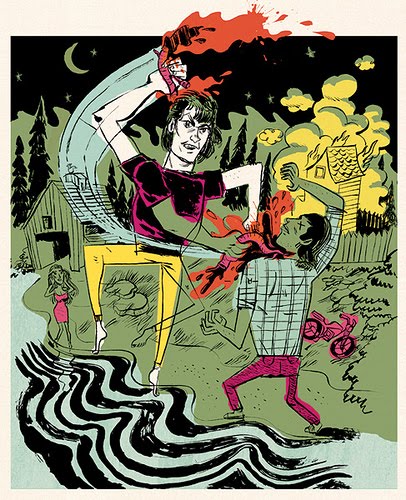
All this week, everyone has been chiming in with their Patrick Swayze memories, from their love of
Dirty Dancing and
Ghost to the night they laughed their asses off during the classic
SNL episode when Swayze spoofed both his sex-symbol image and his appeal to gay viewers and then played generous straight man to Chris Farley in the then-newcomer's breakout sketch,
the Chippendales audition. Because I'm a guy who has zero tolerance for chick flicks, I'll always remember Swayze not for
Dirty Dancing and
Ghost, but for his creepy
Donnie Darko supporting turn as a child-molesting motivational speaker and action films like
Road House, where the mulleted star's dance background and willingness to do many of his own stunts played a huge part in making the fight sequences the best element of that Joel Silver camp classic.
Since 1989,
Road House has been a source of great comedy, from Dana Gould's bit about Dalton's Zen bouncer thing-as-U.S. foreign policy to Michael J. Nelson's
MST3K "(Let's Have) A Patrick Swayze Christmas" musical number and
RiffTrax audio commentary (a more enjoyable commentrak than the
Road House DVD's Kevin Smith/Scott Mosier one, which is a funny commentrak when Smith isn't tediously reading off pages and pages of Internet jokes about Dalton's superpowers because he ran out of things to say).
Road House is the white
Dolemite. Like the
Rudy Ray Moore camp classic, the Swayze vehicle is a bad movie, but extremely fun to watch and endlessly quotable.
Over at big WOWO, Byron Wong calls the modern-day western
one of the best American martial arts flicks ever made. He raises a good point about how "Swayze didn't have to otherize us. Unlike Chuck, Steve, Jean-Claude, and just about every other White martial artist out there, he didn't have to hire a crew of Asians, blacks, or Latinos to beat up."
I agree with Byron that
Road House's martial arts sequences are terrific--the complete opposite of
Dolemite's fight sequences--and the movie surpasses anything Van Damme and Seagal have done (with directors who aren't Peter Hyams and Andrew Davis, that is). But outside of the convincing fight sequences and Swayze's charismatic star turn as the world's only NYU philosophy major-turned-internationally famous bouncer,
Road House is
pretty incompetent for a glossy '80s big-studio movie.
Keith David (
They Live,
There's Something About Mary), one of my favorite actors-turned-announcers, shows up halfway through
Road House, and then the movie leaves him stranded with nothing to do.
Road House is loaded with almost everything I don't like about '80s big-studio filmmaking--the only '80s Hollywood touch that's missing is the John Hughes-style racism. The movie outdoes the first season of
NewsRadio in the crappy clothes department. Swayze wears a weird-looking wraparound
gi thing as a shirt, which, combined with the mullet, makes him look like Luke Skywalker's soap opera actor cousin from below the Mason-Dixon Line on Tatooine.
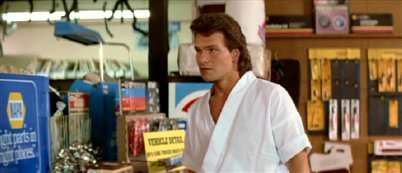 Road House
 is like a bad '60s Elvis flick, but with a pubes-flashing Sam Elliott as second fiddle instead of Bill Bixby--and Jeff Healey doing all the singing instead of the Big E. Healey has a painfully awkward "musician appears as himself and gives us his endorsement that the hero's a cool guy" scene, which was a staple of '80s movies, although that kind of cameo existed long before the '80s (Duke Ellington's scene with Jimmy Stewart in 1959's
Anatomy of a Murder is the earliest example of a "musician cameoing as himself and helping to up the star's street cred" moment I can think of). The Healey tracks, which include a pretty good cover of Bob Dylan's "When the Night Comes Falling from the Sky," overshadow a Michael Kamen score that sounds exactly like all the other drab scores Kamen wrote for the Silver action factory. There are attempts at wit that fall flat and make little sense, like the vague and homoerotic-sounding "I thought you'd be bigger" running gag, which seems to be a jab at Dalton's height--or not. I assume this botched attempt at a Silver catchphrase refers to how his height is below average for someone who's a cooler. So why didn't the script have the characters say "I thought you'd be taller" instead of "I thought you'd be bigger"? Oh, '80s Hollywood.
I never saw
Point Break, Swayze's other signature action film, until shortly after his death was all over the news. I happened to have a long-unwatched Netflix copy of the 1991 bankrobbing surfer flick lying around my apartment, so as I watched the film for the first time, I was surprised by how well-made it was. The foot chase sequence, which concludes with the angsty emptying-of-the-gun moment that
Hot Fuzz memorably mocked, is the best foot chase I've seen since the one in
Raising Arizona. (During the DVD, I also constantly cringed over how
Point Break's superbly shot surfing and skydiving sequences would have looked if the film were made in this current age of CGI instead of pre-CGI 1990.)
Point Break is a better Swayze actioner than
Road House, thanks to the skilled direction of underrated
Hurt Locker helmer Kathryn Bigelow, but if I want a campy and unintentionally funny good time, I'll turn to
Road House. Gay guys have their
Valley of the Dolls,
The Apple and
Showgirls, while us straight guys have
Dolemite,
Color of Night,
Riki-Oh: The Story of Ricky,
Death Bed: The Bed That Eats and
Road House.
Ever since Swayze went Swayze, I've been looking all over the file folders in my computer for Dana Gould's
Road House bit. I finally found it. During an August 28, 2004 performance at the Largo in L.A., the stand-up and former
Simpsons staff writer amusingly observes how America is "the world's bouncer." I like how Gould couldn't remember the Ben Gazzara character's name, so he gave him the name of the main villain from
Rocky IV.


