Showing posts with label R.I.P.. Show all posts

Friday, 15 July 2011

Jamie Foxx covers the Brady Bunch theme as Babyface, Luther Vandross and Prince

While giving her former boss a peck on the cheek, Dawn Wells sneaks a bag of weed into his coat pocket as a gift.
Thanks, Sherwood Schwartz, for making sitcoms that were so often devoid of logic that they led to many fun hours of dissection during tipsy or stoned conversations ("If Mike's supposed to be an architect, then why would he build a house for nine people that has only two bathrooms?"). The tuneful and surreal Schwartzverse in The Brady Bunch and Gilligan's Island has also served as fodder for countless stand-up routines--mostly bad, some good.

Because the Brady Bunch and Gilligan creator died earlier this week, here are the four best versions of the Schwartz-penned Brady Bunch theme ever, all performed in 2002 by Jamie Foxx (who, by the way, is very funny in this summer's Horrible Bosses, as a "murder consultant" who doesn't quite live up to his intimidating-looking appearance):


Because I watched a lot of Comedy Central during the '90s, I was subjected to tons of hacky stand-up clips from the '80s and early '90s. The hackiest ones always involved either of the following topics: "Asians talk funny," airline food, "White people drive like this, while bruthas drive like this," the differences between men and women and "Here's what the Brady Bunch theme would sound like if a rapper did it." Foxx's R&B-ified Brady Bunch is funnier--and much more accurate about the musicians he's imitating--than those '80s routines that basically said, "Hey everybody, watch me do the Brady Bunch intro as I demonstrate that I've listened to only one rap song in my life, that one by Aerosmith and Rum-DMZ."

Friday, 10 June 2011

Stefon Mad Libs is the hot and (adjective) meme that answers the question: "(John Cassavetes movie title)?"

In honor of Leonard B. Stern, the recently deceased Honeymooners and Get Smart writer who created the never-not-boring parlor game and childhood staple Mad Libs, here's a highly addictive new version of Mad Libs that I spotted on Crushable.

I can't come up with a humorous alt tag for this snapshot of Stefon Mad Libs. (expletive ending in -ing) hell!

It's inspired by the most consistently funny character during the 36th and most recent season of SNL, Weekend Update nightlife correspondent Stefon. (The Ed Hardy shirt-clad expert on New York clubbing is played by Bill Hader. He's always "corpsing," or erupting into uncontrollable laughter and breaking character, whenever he appears as Stefon because the SNL writers throw away the Stefon lines Hader rehearsed with and then replace them on the cue cards with completely new lines during the live broadcast, hence Hader's surprised and giggly reactions.)

Here are the results from one of the holiday-themed Stefon Mad Libs I played around with.

I still can't come up with any humorous alt tags. I feel like such a (pervy politician with a last name that's spawned a billion dick jokes and whose junk has been all over the news way too much lately).

Wednesday, 23 February 2011

Dwayne McDuffie (1962-2011)

A shot from 'Divided We Fall,' one of many Justice League Unlimited episodes written by Dwayne McDuffie.
Dead at 49, Dwayne McDuffie was an incredibly prolific comics and TV animation writer who, as a story editor and frequent scriptwriter for Justice League Unlimited, helped make that cartoon the most satisfyingly written DC Animated Universe show since Batman: The Animated Series. But McDuffie's greatest contribution remains Milestone Media, the indie comics company he co-founded in the '90s to make the way-too-white superhero genre more diverse and to give comics writers and artists of color more opportunities behind the scenes.

"It showed that there could be actual black people in comics," wrote comics reviewer David Brothers in a Black History Month tribute to McDuffie and Milestone that he posted a couple of weeks before McDuffie's death yesterday. "The company was full of people who looked, acted, and talked like people I knew. This is a big deal, believe it or not."

It was also a big deal for Asian American readers like myself who grew up in a multiracial world that wasn't being reflected enough in superhero comics (sadly, it still isn't) and were looking for comics that featured Asian characters who were raised in America like we were and weren't foreigners in corny dragon-themed or martial arts-themed costumes that were the Asian equivalent of the "headband and yellow disco shirt" that The Boondocks once joked about in regards to Luke Cage's costume. Milestone responded to the lack of Asian American characters in superhero comics by creating the immortal hero Xombi and Third Rail, a Korean member of the Blood Syndicate, a superhero team comprised of gangbangers who were mutated by radioactive tear gas during a police crackdown on gangs. Latino and gay characters also inhabited the Milestone universe.

He's X-static about whupping some ass.
The most popular and enduring Milestone creation is McDuffie's Static character, a.k.a. Virgil Hawkins, a constantly bullied inner-city high-schooler who gains the ability to manipulate electricity after being exposed to the aforementioned radioactive tear gas. When the original Static comic debuted in 1993, I was glad to finally come across a comic about teens where the high school setting was hardly as clean-cut as Riverdale High or whatever campus subjected Peter Parker's Spider-Can to frequent wedgies. In other words, Ernest Hemingway High resembled the school I went to. Virgil's campus was beset by gang violence and racial conflict, elements that were watered down but still addressed in Static Shock, a more kid-friendly animated version that McDuffie was also involved in.

Static, sans that Malcolm X baseball cap that used to scream out '1992!'
There had been previous attempts by other publishers to target readers of color, but the characters of color in those titles weren't as fully realized or three-dimensional as Virgil and the other Milestone characters were.

I got to meet McDuffie at a 2009 San Diego Comic-Con panel about diversity in comics where one of the projects that were discussed was Secret Identities: The Asian American Superhero Anthology, a graphic novel that followed in Milestone's footsteps and featured a short story I created, "Sampler." As a teen, I enjoyed Static, Blood Syndicate and Icon, so I was thrilled to meet McDuffie, who praised our GN and called it long-overdue.

Jimmy J. Aquino and Dwayne McDuffie, 2009
I also enjoyed McDuffie's work on Justice League Unlimited. He came up with the premise for "The Great Brain Robbery," an amusing episode in which The Flash and Lex Luthor switched bodies and Michael Rosenbaum, who played Lex on Smallville when he wasn't providing the voice of The Flash on JLU, got to voice both his live-action and animated alter egos. McDuffie also crafted the show's Cadmus arc, which gave ample screen time to characters who were not so well-known to viewers who were unfamiliar with most of the DC books--like The Question, Green Arrow and The Huntress--and followed those heroes as they uncovered a government conspiracy to dismantle the Justice League due to fears that the team would become as corrupt as its parallel universe counterpart, the fascist Justice Lords. A high point of the series, the Cadmus arc dared to question (no pun intended) and critique the superhero genre's right-wing tendencies.

All-Star Superman features the voices of James Denton as Superman and Christina Hendricks as Lois Lane, although we all know the DC character Christina Hendricks was born to play isn't Lois but Giganta--preferably a naked version of Giganta like in The All-New Atom.
Although McDuffie's working relationship with DC, which distributed the Milestone books, had soured in recent years (some have viewed DC's mistreatment of McDuffie as racist), he continued to work on the company's animated projects. He scripted the feature-length adaptation of Grant Morrison and Frank Quitely's excellent All-Star Superman comic, which dropped on Blu-ray and DVD the same day he died.

McDuffie may be gone, but his fight to bring more diversity to comics rages on, whether it's in the form of Secret Identities or David Brothers' writing.

"You don't even see that these days," said Brothers in a tweet referring to how the diversity in the Milestone titles ventured to include not just black characters. "They weren't black comics. They were comics."

Monday, 31 January 2011

John Barry (1933-2011)

John Barry (1933-2011)
My favorite element of the 007 movies--besides the women--is the score music. John Barry, who died earlier this morning at the age of 77, wrote 11 of those 007 scores and made them so enjoyable and listenable outside the context of those movies. It's hard to listen to Barry's rousing and cool On Her Majesty's Secret Service main title theme without going up to a mirror and kneeling and pretending to aim a gun--just like what Danny once did on Hustle when he rehearsed a heist to the tune of Lalo Schifrin's Mission: Impossible theme blaring from a stereo.

I'm sure Barry would have rather been remembered for more than just Bond, so I'll mention that my two favorite non-Bond pieces of score music by Barry are the entire score from 1965's The Knack... And How to Get It and the theme from the Roger Moore/Tony Curtis buddy detective show The Persuaders!


"Another of the great composers has left us," tweeted Bear McCreary, who's currently scoring NBC's The Cape. "I'm cranking up The Black Hole in your honor."

Besides The Black Hole (an example of great opening title theme, schizophrenic and uneven movie--when I was a kid, I thought the Black Hole coloring book was more fun), I'm also fond of Barry's themes from The Ipcress File, The Lion in Winter, Midnight Cowboy and Game of Death.

Barry also appeared on-screen as orchestra conductors in a couple of movies he scored. He cameoed in the 1968 Michael Caine heist flick Deadfall, which Fox Movie Channel aired last week, and The Living Daylights, his final 007 project (the above photo is from his Living Daylights cameo). Barry's musical output dried up in the late '90s (his last screen credit was the 2001 WWII codebreaking thriller Enigma), but British musicians kept alive his work by sampling some of his film themes. Mono sampled an Ipcress File cue in 1996's "Life in Mono," Fatboy Slim crafted a memorable hook out of the guitar riffs of Barry's first major film theme, the 007-esque Beat Girl theme from 1960, in 1998's ubiquitous "Rockafeller Skank," and Robbie Williams introduced the You Only Live Twice theme to a new generation in 1998's "Millennium" (seven years later, another of Barry's Bond themes got a similar introduction to a new generation when Kanye West sampled "Diamonds Are Forever" in "Diamonds from Sierra Leone").

Vanity Fair's intriguing profile of Barry from two years ago offers great insight into what made Barry tick and why everyone from his Out of Africa boss Sydney Pollack to Michael Caine thought of him as a man with the Midas touch, especially when it came to music.

Monday, 24 May 2010

Lost (2004-2010)

Ben Linus is the new Number Two. So that means when I'm taking a shit, I can say I'm taking a Ben Linus.
After watching the Lost series finale, I thought to myself, "Ooh, I bet Roman from Party Down is not a happy man right now."

I'm sure the finale pissed off viewers who are into "hard sci-fi" like Martin Starr's Roman character. As for myself, I'm still not sure what to make of the finale--so the sideways universe was essentially the Nexus from that lame seventh Star Trek movie?--but one thing's for sure: the post-finale wrap-up show hosted by Jimmy Kimmel and scored by special guest bandleader Michael Giacchino was hilarious.

Tuesday, 20 April 2010

Guru (1961-2010)

Guru (1966-2010)"Lemonade was a popular drink and it still is/I get more props and stunts than Bruce Willis."
--Guru, "Dwyck"


The Gang Starr MC with the love-it-or-hate-it monotone delivery and a preference for "an alternative to James Brown samples" has died way too young from cancer. Guru's star-studded Jazzmatazz albums were among my favorite CDs during my university years--I remember trying to finish writing a term paper or two to the sounds of Volume II: The New Reality. Jazzmatazz introduced my ears to cats like Donald Byrd and Roy Ayers, who performed alongside the Brooklyn rapper, an admirer of their jazz albums since his childhood in Boston.

Together with DJ Premier, Guru (birth name: Keith Elam) recorded such hip-hop classics as "Manifest," "Just to Get a Rep," "Take It Personal," "Mass Appeal" and my favorite Gang Starr track, "Dwyck," an endlessly quotable collabo with Nice & Smooth ("I left my Philly at home/Do you have another?/I wanna get blunted, my brother").

Gang Starr's sole original contribution to movie soundtracks was the Mo' Better Blues end title theme "Jazz Thing."

Thursday, 1 April 2010

David Mills (1961-2010)

David Mills (1961-2010) by Rhonda Birndorf/AP
I enjoyed Mills' work on Homicide: Life on the Street and The Wire (his contributions to The Wire were the episodes "Soft Eyes" and "React Quotes"), and I regularly read his blog Undercover Black Man (I was jazzed when he added me to his huge blogroll), so his passing, which I learned from a G4 news ticker last night, is unfortunately not a joke and is a shock to me. As one can see from his UBM posts, Mills had incredible taste in music, so it was no surprise that he was a P-Funk expert who co-wrote a book about the Funk Mob and named one of his Homicide episodes after "Bop Gun (Endangered Species)."

The former Washington Post reporter researched a different kind of mob when he created the 2003 drug trade drama Kingpin. Mills' final TV series Treme (pronounced trih-MAY) reunited him with several Wire staffers, including his college friend David Simon, who co-created the new series and also collaborated with Mills on an Emmy-winning HBO adaptation of his own book The Corner: A Year in the Life of an Inner-City Neighborhood. Treme--not the first scripted TV series to use post-Katrina New Orleans as a backdrop but most likely to be the best--drops on HBO in 11 days.

A New York Times photo of David Mills on location with David Simon for the New Orleans filming of Treme.
Your funk was the best, UBM.

Thursday, 25 March 2010

Robert Culp (1930-2010)

I was surprised to learn a monkey wasn't involved in Robert Culp's death.
Learning about the I Spy and Greatest American Hero star's death yesterday was a bit of a shock because Culp was a terrific (and Emmy-nominated) action show lead and such an underrated comic actor, even though he was also responsible for this:

That's no Asian. He looks like Cornelius from Planet of the Apes if he suddenly felt the urge to cheat on Zira and pick up some human chicks by passing as human.
That's why watching most older TV shows can be such a pain in the ass for me. I have to put up with lame bits of yellowface and brownface in everything from Bewitched to I Spy, where Culp, who was once married to half-Vietnamese actress and frequent I Spy guest star France Nuyen, played both his regular role of Kelly Robinson and a Chinese warlord in an episode he scripted (Culp also wrote frequently for TV, a little-known fact pointed out by Film Score Monthly label head Lukas Kendall in his excellent liner notes for FSM's I Spy CD).

Earle Hagen and Robert Culp
Yellowface aside, the understated I Spy was groundbreaking TV: it envisioned itself as more like a feature film than a TV show (the title sequence even began with the rather cocky "Sheldon Leonard Presents"--Nick the Bartender wants to conquer the spy fiction business!); instead of recycled library music, it featured completely original score music every week (courtesy of the late Earle Hagen, whose I Spy theme is one of my favorite TV themes of all time); it favored location shooting in foreign countries(*) over studio backlots; it took a chance on a stand-up with no acting experience named Bill Cosby and made him the first black lead in a prime-time drama; and it gave birth to the buddy action comedy, years before Butch and Sundance. Even The Greatest American Hero--Culp's other classic buddy comedy series and the show where I and countless others from my generation first saw Culp the snarky, over-the-hill action hero--is a descendant of I Spy.

Robert Culp enjoys what I assume is another embarrassing story about Russell Cosby.
(*) I doubt any of the five major networks would allow the Culp/Cosby show--which once had to pay the Yakuza a ransom for a show crew member they kidnapped while the crew was shooting in Japan--to be filmed all over the world today like it was in the '60s, because of inflated network TV budgets and certain other obstacles. Instead, 24 tries to pass off L.A. as Washington D.C. and New York (rather miserably), and Alias (which was slightly more convincing) dressed up the Disney backlot to look like Madrid or Casablanca, among other cities. I assume the latest episode of Lost, which flashed back to Richard Alpert's original home on the Canary Islands, never even left Hawaii.

Culp had great taste in sci-fi and horror scripts. His guest shots on the original Outer Limits were among the highlights of that series ("The Architects of Fear," "Demon with a Glass Hand"), and his hard-to-find-but-YouTube-able 1973 TV-movie A Cold Night's Death--one of those thrillers where the twist ending isn't as shocking as the film thinks it is, but the journey to that ending is still entertaining--would make for a great double bill with John Carpenter's The Thing (it features an unsettling synthesizer score by Gil Melle of The Andromeda Strain fame). On a similar note, who can forget Culp's creepy performance when Bill Maxwell got possessed by an evil ghost chick in "The Beast in the Black," the Greatest American Hero ep I remember most fondly?

Wednesday, 10 February 2010

Sir John Dankworth (1927-2010)

Sir John Dankworth (1927-2010)
Whenever I try to finish drawing an arc of The Palace, like during last week and this week, I avoid logging on to the Web for a few days because I find it to be such a distraction. When I did allow myself to log on earlier today, I learned about the Saturday death of British jazz artist John Dankworth, whom I know best for his theme from the rarely rebroadcast first few seasons of The Avengers (back when the show was shot on videotape and was more serious in tone--Dankworth's theme reflected that harder-edged tone--and Emma Peel wasn't around yet to sex up the joint) and his catchy Modesty Blaise theme...


... which I was first exposed to via the Gorillaz/Del tha Funkee Homosapien collab "Rock the House."


In England, Dankworth is better known for his theme from Tomorrow's World--the show that was spoofed by Peter Serafinowicz's Look Around You--and his jazz albums. A Guardian obit gives a good overview of the career of Dankworth, whose death was announced by his singer wife Cleo Laine onstage at the end of an all-star jazz concert that took place only a few hours after he passed.

One of the greatest compliments a musician can receive is being frequently sampled. Dankworth has been the source of many excellent samples (and what I'm sure are hours of giggles from stoners because of his last name).

Dankworth's 1974 cover of his own theme from the 1965 thriller Return from the Ashes is pretty gangster.


The 1974 re-recording was sampled by Madlib a.k.a. Quasimoto for his 2002 joint "Astronaut"...


... and DJ Premier for Cee-Lo's 2004 cut "Evening News."

UPDATE: Y Society's "Never Off (On & On)" is another track that sampled the '74 recording. (Good looking out, wutangfan85.)

Tuesday, 20 October 2009

Vic Mizzy (1916-2009)

Vic Mizzy (1916-2009)Recently on the blog, I brought up how the old-fashioned TV theme is a dying art form, so I was surprised to learn from Film Score Click Track's Jim Lochner that one of the kings of the old-school TV theme, Addams Family and Green Acres theme composer Vic Mizzy, died Saturday at the age of 93. The last major piece of music from Mizzy that I heard was a novelty song about Spider-Man he recorded for the Spider-Man 2 DVD's bloopers montage.

Lochner's more of an expert on Mizzy's credits than I am (his obit contains a full audio clip of Mizzy's memorable main title theme from The Ghost and Mr. Chicken). However, as a child of the '80s, when baby boomers' nostalgia for the TV shows and rock music they grew up with was at its most overbearing, I heard the Addams Family theme everywhere, from Harry and the Hendersons to a local radio ad campaign for Winchester Mystery House that reworked the song's lyrics to focus on Sarah Winchester's not-exactly-scary crib. My inability to get sick of hearing that Mizzy ditty is a testament to his witty songwriting.

Making up new lyrics for the Addams Family theme was a playground pastime. A popular new version was "The Addams Family started/When Uncle Fester farted/That's how they got retarded/The Addams Family." The not-as-twisted-or-funny lyric that I came up with was "Their house is an exhibit/When people come to visit."


Attaboy, Victor!

Monday, 28 September 2009

Jerry van Rooyen (1928-2009)

Jerry van Rooyen (1928-2009)
"The Great Bank Robbery," a supercool big-band jazz instrumental I first heard on the soundtrack album for the 1998 Eric McCormack/William Shatner indie comedy Free Enterprise, is the epitome of sleazy listening, from the bouncy organ solo to the presence of my favorite '60s/'70s instrument, the fuzztone guitar. The funky tune, which popped up during a Taco Bell ad campaign this summer (the one that doesn't involve "The Piña Colada Song"), was originally written for the obscure 1970 German B-movie How Short Is the Time for Love. Its composer, Dutch bandleader and trumpeter Jerry van Rooyen, died on September 14 at the age of 80.

Though the bandleader wrote scores for only seven movies (the X-rated 1969 Jess Franco flick Succubus is the most well-known film he scored), those scores were sleazy listening at its best. In 1997, the Crippled Dick Hot Wax! label released At 250 Miles Per Hour, a collection of highlights from four of van Rooyen's previously unavailable scores. This CD was most likely where Free Enterprise screenwriters Mark A. Altman and Robert Meyer Burnett were first exposed to "The Great Bank Robbery" (mistakenly called "The Great Train Robbery" in the van Rooyen obit that was posted on Weirdomusic.com). No wonder Altman and Burnett adopted the swinging van Rooyen instrumental as the opening theme for their Swingers-inspired film and attempted to do for "The Great Bank Robbery" what Pulp Fiction did for "Misirlou."


Saturday, 19 September 2009

Roc Raida (1972-2009)

X-Ecutioners' Built from Scratch
I love how Roc Raida (real name: Anthony Williams), a legendary turntablist and member of the X-Ecutioners crew for those not in the know, cited Bruce Lee as an influence in the second video, a DJ tutorial he recorded for djvibe.com.


Friday, 18 September 2009

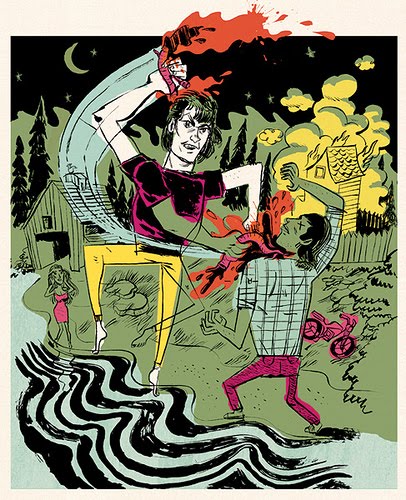
Pain don't hurt, whereas parts of Road House are pretty excruciating

Road House by Mike Reddy
All this week, everyone has been chiming in with their Patrick Swayze memories, from their love of Dirty Dancing and Ghost to the night they laughed their asses off during the classic SNL episode when Swayze spoofed both his sex-symbol image and his appeal to gay viewers and then played generous straight man to Chris Farley in the then-newcomer's breakout sketch, the Chippendales audition. Because I'm a guy who has zero tolerance for chick flicks, I'll always remember Swayze not for Dirty Dancing and Ghost, but for his creepy Donnie Darko supporting turn as a child-molesting motivational speaker and action films like Road House, where the mulleted star's dance background and willingness to do many of his own stunts played a huge part in making the fight sequences the best element of that Joel Silver camp classic.

Since 1989, Road House has been a source of great comedy, from Dana Gould's bit about Dalton's Zen bouncer thing-as-U.S. foreign policy to Michael J. Nelson's MST3K "(Let's Have) A Patrick Swayze Christmas" musical number and RiffTrax audio commentary (a more enjoyable commentrak than the Road House DVD's Kevin Smith/Scott Mosier one, which is a funny commentrak when Smith isn't tediously reading off pages and pages of Internet jokes about Dalton's superpowers because he ran out of things to say).

Road House is the white Dolemite. Like the Rudy Ray Moore camp classic, the Swayze vehicle is a bad movie, but extremely fun to watch and endlessly quotable.

Over at big WOWO, Byron Wong calls the modern-day western one of the best American martial arts flicks ever made. He raises a good point about how "Swayze didn't have to otherize us. Unlike Chuck, Steve, Jean-Claude, and just about every other White martial artist out there, he didn't have to hire a crew of Asians, blacks, or Latinos to beat up."

I agree with Byron that Road House's martial arts sequences are terrific--the complete opposite of Dolemite's fight sequences--and the movie surpasses anything Van Damme and Seagal have done (with directors who aren't Peter Hyams and Andrew Davis, that is). But outside of the convincing fight sequences and Swayze's charismatic star turn as the world's only NYU philosophy major-turned-internationally famous bouncer, Road House is pretty incompetent for a glossy '80s big-studio movie. Keith David (They Live, There's Something About Mary), one of my favorite actors-turned-announcers, shows up halfway through Road House, and then the movie leaves him stranded with nothing to do. Road House is loaded with almost everything I don't like about '80s big-studio filmmaking--the only '80s Hollywood touch that's missing is the John Hughes-style racism. The movie outdoes the first season of NewsRadio in the crappy clothes department. Swayze wears a weird-looking wraparound gi thing as a shirt, which, combined with the mullet, makes him look like Luke Skywalker's soap opera actor cousin from below the Mason-Dixon Line on Tatooine.
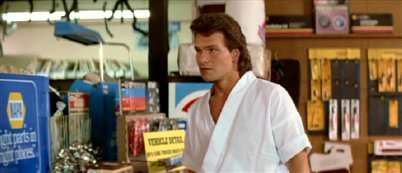
'But I was going to Toshi Station to pick up some power converters!'
Road House is like a bad '60s Elvis flick, but with a pubes-flashing Sam Elliott as second fiddle instead of Bill Bixby--and Jeff Healey doing all the singing instead of the Big E. Healey has a painfully awkward "musician appears as himself and gives us his endorsement that the hero's a cool guy" scene, which was a staple of '80s movies, although that kind of cameo existed long before the '80s (Duke Ellington's scene with Jimmy Stewart in 1959's Anatomy of a Murder is the earliest example of a "musician cameoing as himself and helping to up the star's street cred" moment I can think of). The Healey tracks, which include a pretty good cover of Bob Dylan's "When the Night Comes Falling from the Sky," overshadow a Michael Kamen score that sounds exactly like all the other drab scores Kamen wrote for the Silver action factory. There are attempts at wit that fall flat and make little sense, like the vague and homoerotic-sounding "I thought you'd be bigger" running gag, which seems to be a jab at Dalton's height--or not. I assume this botched attempt at a Silver catchphrase refers to how his height is below average for someone who's a cooler. So why didn't the script have the characters say "I thought you'd be taller" instead of "I thought you'd be bigger"? Oh, '80s Hollywood.

I never saw Point Break, Swayze's other signature action film, until shortly after his death was all over the news. I happened to have a long-unwatched Netflix copy of the 1991 bankrobbing surfer flick lying around my apartment, so as I watched the film for the first time, I was surprised by how well-made it was. The foot chase sequence, which concludes with the angsty emptying-of-the-gun moment that Hot Fuzz memorably mocked, is the best foot chase I've seen since the one in Raising Arizona. (During the DVD, I also constantly cringed over how Point Break's superbly shot surfing and skydiving sequences would have looked if the film were made in this current age of CGI instead of pre-CGI 1990.) Point Break is a better Swayze actioner than Road House, thanks to the skilled direction of underrated Hurt Locker helmer Kathryn Bigelow, but if I want a campy and unintentionally funny good time, I'll turn to Road House. Gay guys have their Valley of the Dolls, The Apple and Showgirls, while us straight guys have Dolemite, Color of Night, Riki-Oh: The Story of Ricky, Death Bed: The Bed That Eats and Road House.

Ever since Swayze went Swayze, I've been looking all over the file folders in my computer for Dana Gould's Road House bit. I finally found it. During an August 28, 2004 performance at the Largo in L.A., the stand-up and former Simpsons staff writer amusingly observes how America is "the world's bouncer." I like how Gould couldn't remember the Ben Gazzara character's name, so he gave him the name of the main villain from Rocky IV.

Sunday, 29 March 2009

Maurice Jarre (1924-2009)

Maurice Jarre (1924-2009)The composer of rich and powerful scores for epics like Lawrence of Arabia, Doctor Zhivago, Grand Prix(*), the Jesus of Nazareth miniseries and Mad Max Beyond Thunderdome has died. Jarre was 84. When he accepted an honorary Golden Bear for lifetime achievement at the Berlin Film Festival in February, he was confined to a wheelchair and looked very frail.

(*) Besides the awesome racing sequences and Jarre's energetic, if a bit repetitive, score, another highlight of Grand Prix is the eye candy--Françoise Hardy and Jessica Walter. Lucille Bluth was quite a hottie back then.

Though he dabbled in the small screen (Nazareth, Shogun), Jarre told interviewer James Fitzpatrick he didn't enjoy writing TV scores because "everything is too hurried with poor sound and nobody caring about wrong notes." Monsieur Jarre, if only you were still alive because I would have liked you to meet Michael Giacchino, Bear McCreary and Jeff Richmond.

Jarre's most lasting collaborations were with David Lean (Arabia, Zhivago), Peter Weir (Witness, Dead Poets Society) and John Frankenheimer (Grand Prix, The Train). The father of New Age musician Jean Michel Jarre and Glory screenwriter Kevin Jarre told Film Score Monthly he admired Mozart and his music because "The harmony is so perfect, and the orchestration is so simple and natural. You listen to Mozart and you get a great lesson in humility. To me his music is perfect."

So were many of Jarre's film scores.

Friday, 20 February 2009

Late Night with Conan O'Brien (1993-2009)

Clash of the titans
I remember first becoming a fan of Late Night with Conan O'Brien--despite its tired gags about docile Asian (or rather, gaysian) male hookers--back when Conan and Andy did a clever series of shows called "Time Travel Week," and during a reenactment of a Civil War battle on Civil War Night, they brought out ultra-frail Civil War veteran Carl "Oldy" Olsen (a character who was retired in 1998 after the actor who played him died). That's how old of a Conan viewer I am.

Everyone's chiming in with their favorite memories of Conan's Late Night run (the Masturbating Bear, Triumph at the Attack of the Clones line, the Walker, Texas Ranger Lever, the writers' strike shows), and sure, those are all amusing moments, but I'm more fond of the weirder, lesser-known bits that haven't been featured in any of the clip montages that Conan has shown during his final Late Night week, like "Time Travel Week" and the following:

- The Hunky Newcomer, an O.C.-ish intern who squints his eyes and pouts to the accompaniment of Simple Plan's "Welcome to My Life."

- Conan experiments with having an all-kid studio audience for an entire show. Whenever the testy six- to eight-year-olds express their boredom with guests Dave Foley and Myron Kandel from CNN, Conan either brings out the Boredom Monster to entertain the kids or gets the CNN financial expert to stand up and do the Chicken Dance.

- "Max on Max," a porno video of a naked Max Weinberg humping a naked Max Weinberg.

- A lengthy parody of Led Zeppelin's The Song Remains the Same and its dream sequences, in which the pale Late Night host proceeds to blind viewers' eyes by unbuttoning his shirt and imitating Robert Plant.

- Conan and Andy can barely keep their composure while a robot shits into a toilet during one of their "Staring Contests."

- Conan realizes the stupidity of his campaign for a 10th anniversary rerelease of Dirty Dancing after he plays back Jennifer Grey and Jerry Orbach's unintentionally funny crying scene (which Conan later reenacted with Orbach when he guested on the show).

- The search for Grady from Sanford & Son.

- Andy's little sister Stacy, who's obsessed with Conan. (She was played by a pre-SNL Amy Poehler.)

- The audience's horrified responses to Mick Jagger and Uma Thurman's "If They Mated" baby. The kid has such a disgusting-looking face it makes the V lizard baby look adorable.

That's also Conan's pud-pulling face.
- Years before Conan found comedy gold in the immensely popular Walker Lever, Polly the NBC Peacock shows Conan a clip of a badly aging Chuck Norris as part of a jab at craggy old CBS. The elderly Norris impersonator's fighting moves are priceless.

- Wrist Hulk.

- After a sketch in which Superman flies home to find Lois Lane in bed with her lesbian lover and he starts to masturbate, the camera cuts back to the actor who's playing Superman. He's still rubbing his chest long after the sketch ended, and a mock-disgusted Conan runs over to stop him.

- Conan and Andy watch a clip of the new Ninja Turtles ripoff Embryonic Rockabilly Polka-Dotted Fighter Pilots.


- Conan shows a blooper montage of Mr. T cracking up during the taping of a classic remote in which they went on an apple-picking field trip. T's pig-snort laugh is so bizarre and hilarious that viewers ask Conan to air the blooper montage again.

- The day after a fire chases Late Night out of Studio 6A, Conan tapes an entire show outside the building, near the Rockefeller Center skating rink. Left without a clip to plug guest Samuel L. Jackson's The Long Kiss Goodnight, Conan has to rely instead on a flipbook of the scene they were going to show. Then when people walk onto the makeshift set without realizing Conan and Andy are taping, Conan says, "It doesn't get any crappier than this."

- Though a 2003 New York blackout forces 30 Rock to turn to reserve power, Conan and announcer Joel Godard attempt to do the show with only flashlights to light the studio. But after about 15 minutes, they give up, turn off their flashlights and cut to a rerun.

- A forgotten uncomfortable moment, and it's not exactly funny or a favorite moment, but it's interesting because it shows how closely tied Conan is to SNL, which gave him his big break as a TV writer: in 1998, he asked Chris Rock about his upcoming projects, and Rock joked, "I'll be in Lethal Weapon 4, starring Brynn Hartman." Then the audience booed. (Brynn Hartman was Phil Hartman's wife. She killed her husband and then herself a few months before Rock made the joke.) Conan tried to defuse the situation by saying, "It's okay. We knew them. We can joke about it."

- "Clutch Cargo" Bob Dole (voiced by Robert Smigel) longs for his previous life as a pirate: "Oh, how I miss Squawky."

Oh, how I miss Late Night with Conan O'Brien already.

Friday, 16 January 2009

"Great Moments in Presidential Speeches" (2006-2009)

'Great Moments in Presidential Speeches' (2006-2009)
There's one downside to the eagerly awaited end of the Bush Administration: the retirement of David Letterman's nightly Bush-bashing segment. Called "the gift that kept on giving" by Letterman staff writer Eric Stangel, the segment is receiving a grand sendoff from the Late Show host, shortly before Obama's inauguration. "Great Moments in Presidential Speeches," you will be missed.

I'll also miss the running gag of Late Show staffers getting inserted into the clip of JFK's inaugural address:
The staffers include announcer Alan Kalter, "cue card boy" Tony "Inky" Mendez (who shows cue cards to President Kennedy), costume designer Susan Hum (whose actions include taking his picture with a disposable camera, removing lint from his shoulder, stealing his wallet, and eating a jumbo pretzel), associate producer Nancy Agostini, and stage manager Biff Henderson. All "cameos" end with the staffers clapping along in real-time response to Kennedy's speech.

Wednesday, 14 January 2009

Ricardo Montalban (1920-2009) and Patrick McGoohan (1928-2009)

Mr. Roarke and Steve Martin made the white suit look really pimp in 1978.
As I found out about Montalban's death, TCM happened to be airing the MGM: When the Lion Roars documentary, which features the former MGM contract player and Star Trek II: The Wrath of Khan star as an interviewee. The lengthy doc traces the rise and fall of "the Tiffany studio," and Montalban, in his smooth Latin playa voice, laments how "the lion stopped roaring."

Montalban was one of the few remaining survivors of the era of the studio system--a system that both helped and hurt his career. In an interesting 2002 Palm Beach Post article that unfortunately is no longer online, Montalban, who at the time was promoting TCM's Hispanic Heritage Month tribute to Hispanics in cinema, recalled his days as one of Hollywood's few Latino movie stars:
Montalban, a star in his native Mexico -- his parents were Castilian Spanish, but his physician father moved the family to Mexico before he was born -- had his troubles in Hollywood. When he was signed by MGM in 1946, there was a movement afoot to change his name to -- wait for it -- Ricky Martin.

"They couldn't pronounce my name," he says today. "Joe Pasternak, the producer, would introduce me to people as Richard Mandelbaum. Eight times out of 10, I was Richard Mandelbaum, but a couple of times I was Richard Mountbatten, and at least once he said Richard Musclebound. He had a hell of a time with it.

"So they thought my name was impossible, and they were going to change it, but then they consulted with the man who was in charge of the Latin America market, and he said, 'He has a following here, you can't change his name.' And that's the only reason I managed to retain my dignity."

The studios' strengths were in stereotyping -- the blond bombshell, the ultra-masculine leading man, etc. -- so the Hispanics they had under contract were no exception.

"I approached directors, producers, executives and tried to convince them to create other characters besides the Mexican bandit and the hot senorita. Call it ignorance, but they would tell me, 'We're trying to put as many colorful characters in the movies as we can.' They called these stereotypes 'colorful.' "

Not only that, but Montalban was aware of an even subtler prejudice. Montalban played Cubans, played Argentinians, played Brazilians, but it took years before he could play a Mexican.

"Mexico didn't sound quite right, even though we have the best muralists in the world, some of the best painters, the best heart specialists. Where were they on the screen, people of dignity, wealth and culture? Or even the very honorable middle-class man who struggles to give his kids a better education. 'An architect is not colorful,' they would tell me."

MGM didn't stint on Montalban; he worked opposite the studio's top leading ladies, from Lana Turner to Jane Powell, and was given several films in the early '50s as a stand-alone lead, though he points out that they were B films.

Even when Montalban resented the roles he was assigned, his options were limited. "When I would say, I don't want to do it, it's vapid, they would say, 'All right, you don't have to do it. But we'll put you on suspension for six months.' So that vapid role became a great role. I had a wife and four children; I never went on suspension because I couldn't afford it."

There was no cohesion within the Hispanic community in Hollywood -- everybody worked at different studios, and went home to their different houses. That would eventually lead Montalban to found Nosotros, an organization to promote Hispanic talent so that, as he puts it, "we could be judged on our ability or lack of ability, not by our names."
Because of the lack of substantial big-screen roles for Latinos and the decline of the studio system, Montalban made the jump to TV. But the small screen wasn't much of an improvement for Latinos (and everyone else who was a minority), because Montalban guest-starred as a '90s dictator from India (Khan Noonien Singh on Star Trek), a Frenchman (Combat!) and a Japanese gangster (Hawaii Five-0) and then ruled the '70s and '80s Saturday night airwaves as a mysterious island resort owner of indeterminate race (Fantasy Island).

Whether the role was inane (the taped-eyelidded act on Five-0) or not (Khaaaaaaaaaan!), Montalban the serial guest star--and serial Fakasian--brought to each of his live-action or animated performances a certain regal movie-star charisma that boosted the show. That same charisma helped add an edge to Wrath of Khan that was missing from the first Trek feature film. Returning to a character he played 15 years earlier, Montalban was pitch-perfect as the genetically engineered title villain, or as Robin Harris would have called him, "Test-tube baby!"

Montalban also played equally pivotal roles in the Planet of the Apes and Spy Kids franchises. Speaking of spies...

Another great actor has died: Patrick McGoohan, star and co-creator of both Danger Man, a.k.a. Secret Agent, and its unofficial sequel The Prisoner, which he memorably parodied on The Simpsons in one of his last bits of acting.

'I am not a number! I am a free man!'
The Danger Man creators used the Bond novels as a springboard to conceive a spy hero who was different from Ian Fleming's "blunt instrument." John Drake wasn't much of a skirtchaser and was less violent and glamorous than 007. McGoohan actually turned down the film version of Dr. No because the actor, a devout Catholic, wasn't comfortable with playing a womanizer. But he had no objections to playing the cerebral Drake, the antithesis of Bond.

Like Montalban, McGoohan excelled in villainous roles, from Silver Streak to Columbo. He played four different killers on both the NBC and ABC versions of the Peter Falk TV-movie franchise and won Emmys for two of those characters. By Dawn's Early Light is my favorite Columbo installment because McGoohan is so mesmerizing as an unflappable military school commandant.

Wired's Underwire blog has posted a detailed remembrance of McGoohan, who wanted individuality in everything he did. "It's not easy to find it always," he said as he channeled Number Six from The Prisoner. "I question everything. I don't accept anything on face value."

Here's the classic Prisoner opening title sequence, scored by Ron Grainer, who also composed the Doctor Who theme, and featuring guitar work by Vic Flick, who performed the guitar riffs during the Dr. No version of "The James Bond Theme":

Tuesday, 30 December 2008

Freddie Hubbard (1938-2008)

The first time I ever encountered 'Red Clay' was through a cover version by the Solsonics. Years later, I discovered the Freddie Hubbard original in my campus radio station library and dug that version even more.
The badass and slinky 12-minute jam "Red Clay" was the very first tune I played when I was a college radio DJ.

Undercover Black Man has posted some musical highlights from the veteran trumpeter's career.

Thursday, 25 December 2008

Eartha Kitt (1927-2008): She was an awful good girl

Eartha Kitt (1927-2008)
Sheldon: That poster of Halle Berry is a little unnerving.

Howard: So don't look at it.

Sheldon: She's like my fourth favorite Catwoman.

Howard: No kidding.

Sheldon: Yeah, Julie Newmar, Michelle Pfeiffer, Eartha Kitt and then her.

Howard: What about Lee Meriwether?

Sheldon: Oh, I forgot about Lee Meriwether.

Howard: Well I'm glad that is settled.

Sheldon: That makes Halle Berry my fifth favorite Catwoman. It's Julie Newmar, Michelle Pfeiffer, Eartha Kitt, Lee Meriwether...

Howard: Please, I'm begging you. Go to sleep.

Sheldon: I'm trying. I'm counting Catwomen.

--The Big Bang Theory

Sheldon also forgot about Adrienne Barbeau (the voice of Catwoman on Batman: The Animated Series) and Gina Gershon (she assumed the role in 2004 on the imaginatively titled animated series The Batman). Sheldon's third favorite Catwoman, legendary "Santa Baby" singer Eartha Kitt, has died at 81 from colon cancer on the holiday that was the subject of her signature song.

Without Eartha Kitt, there'd be no Conan O'Brien.
Kitt was the purrrrrfect replacement for Julie Newmar when the statuesque dancer/actress was unable to continue playing Batman's most formidable female foe on the '60s series because she was busy filming MacKenna's Gold. No other Catwoman could purrrrr or grrrrrowl like Kitt did. How fitting that the role was assumed by someone named Kitt.

Who can forget when Kitt purred one of the greatest lines in an Eddie Murphy movie that weren't spoken by Murphy ("Marcus, darling... I don't have any panties on...")?

Kitt led an amazing life. She was a civil rights activist who was blacklisted for criticizing the Vietnam War and its negative effect on minorities and more recently, she expressed her joy over Senator Obama's rise as a presidential candidate ("It's one of the most wonderful things that can happen to this country") and supported her countless gay fans on the issue of same-sex marriage.
She goes on to say that the gay marriage issue is similar to what African-Americans experienced during the time of the Civil-Rights Movement. "We were not allowed to go through certain doors because of our race, our color," she says intensely. "It was so stupid that we were not able to sit at the counter of a restaurant because it was only for Anglo-Saxons. It's stupid when this country says it was born on "freedom for all," but it's "freedom for some"!
This Christmas is a bittersweet one due to the news of her passing on the day when she suggestively invited Kringle to "come and trim my Christmas tree." I usually get creeped out by songs that try to sex up Santa like he's the hero of a Judd Apatow movie, but Kitt's rendition of the frequently covered "Santa Baby" is awesome. Her version was the first version and it's still the sultriest.

Monday, 22 December 2008

Misidentified White Person of the Week

Wow, I didn't know Richard Mulligan, a.k.a. Burt Campbell from Soap, died twice.

From the News tab on Yahoo!'s front page tonight:

Mulligan stew
It's Robert Mulligan, not his brother Richard, Yahoochies.

Confused? You won't be, after this acoustic performance of the theme from Soap.