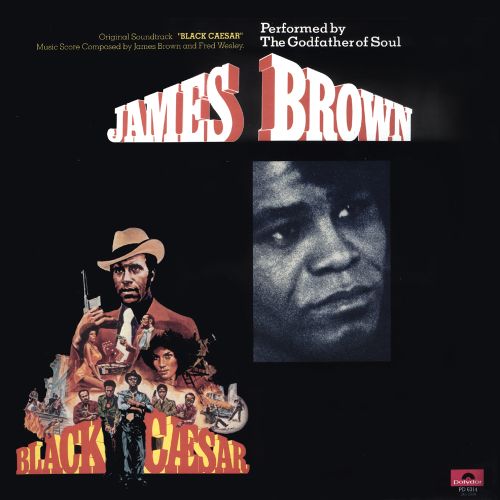
James Brown died three years ago today on the day when Santa Claus goes straight to the ghetto (as he once sang), so below is a very lengthy excerpt about the Hardest-Working Man in Show Business from writer/director Larry Cohen's highly entertaining commentrak for MGM's 2001 DVD release of
Black Caesar.
When
Public Enemies came out on DVD earlier this month, I arranged my Netflix queue so that I could be treated to a festival of gangster flicks I always wanted to watch but kept putting off watching:
Public Enemies,
Hoodlum,
American Gangster and
Black Caesar. During the
Black Caesar commentrak, Cohen told an interesting story I'd never heard or read before about the Godfather of Soul's short-lived side job as film scorer. Brown's stint resulted in a terrific soundtrack that's been frequently sampled by rappers like Ice-T, Das EFX, Nas and Jin and frequently streamed by me on the Fistful of Soundtracks channel.

"The first choice to do the music was Stevie Wonder, so I was told that we were going to run the movie for Stevie Wonder in the rough cut. I thought, 'Well, how was this guy gonna watch a movie?' But he came in with an entourage and sat in the projection room, and they ran the movie, and he listened to the movie, and then he asked some questions afterwards, and I thought we had a shot at getting Stevie Won... All he asked me was what my birth sign was. He was interested in what sign of the zodiac I was. I think he thought it was too violent for him. James Brown didn't have that trouble.
"But James had never scored a picture before, and it was interesting that this was his first job as a composer for a motion picture, and we went over the whole project with him and his manager Charles Bobbit, and I think Bobbit is with Michael Jackson today. So we gave him a 16mm or 35mm black-and-white dupe of the movie so they could have the movie. This was way before videocassettes. So he had a copy of the movie. We gave him the timing sheets of each scene, and James went off to do the music. Of course, motion picture makers are more at the mercy of composers than anybody because by the time you hear the music, it's already been recorded, it's done and the money's been spent, and if you don't like it, there really isn't too much you can do except go have the music done over again and spend your money twice.
"So James' music sounded great when he came in. He'd written some terrific songs like 'Pay the Cost to Be Boss' and 'Your Mama's Dead' and 'Down and Out in New York City,' which was actually written by Barry De Vorzon, but James recorded it. The only problem was that when James brought the music in, if it was a four-minute scene, James wrote seven minutes of music. Or if it was a three-minute scene, James wrote five minutes of music. Or if it was an eight-minute scene, he wrote 11 or 12 minutes of music. So I called Bobbit up. I said, 'Charles, this doesn't make any sense. It's too much music.' He says, 'Well, the man gave you more than enough.' They didn't have any cognizance that the songs, the music's supposed to fit the length of the sequence...
"I had to take all those long cues and cut them down to fit the scenes that they were in, and we cut the scenes pretty well and made them work. We had to slide the music forward, slide the music back, have some dissolves and segues, but we managed to make the music fit the picture, and American International was so delighted that they went and hired James Brown to do another picture for them. When he did
Slaughter's Rip-Off, they went into shock 'cause he delivered the same kind of music, only they weren't equipped to do what I did, which is make it work. They just got infuriated with James Brown and told him that they'd never work with him again, and then when I wanted to make the second
Black Caesar picture,
Hell Up in Harlem, AIP would not let me hire James Brown to do the music. They said, 'He screwed us on
Slaughter's Rip-Off, and we'll never work for him again.' I said, 'He screwed us on
Black Caesar, but I made it work, and there's no reason why we can't make it work again 'cause James will give us a great score.'
"So I went back to Bobbit, and I said, 'Mr. Bobbit, the only way American International would consider letting James do the music is if he did it on spec--if he went out, wrote the music and recorded it himself at his own expense and gave us the tapes--and if they like the music, they'll use the music. If they don't like the music, it belongs to you.' And a day later, I got a call from Bobbit. He said, 'The man accepts the challenge! James will write the music and record it as his own expense and bring it to you.' And he did. Unbelievable. Big name like him. And I played the music. It sounded pretty good to me. But I took it to AIP. They said, 'Oh no no no. We got a deal with Motown to do the music on this picture, and Motown's gonna supply us with some big-name artists, and we don't wanna work with James Brown again, and we don't care for the music anyway.' So I had to go back to Bobbit and say, 'Charles, I'm sorry, but AIP has rejected it, and there's nothing I can do about it. This is one area where they're insisting to have their way.' And he said, 'No hard feelings. We'll do what we can with this music.'

"And he put the music out as an album, and it was James Brown's most successful album. It was called
The Payback, and that music is used over and over again in movies today. It was in a movie called
Lock, Stock and Smoking Barrels. It was used as music on the TV series
New York Undercover. And it's some of James Brown's most famous cuts, and it should have been in
Hell Up in Harlem. Kinda breaks my heart. But that was my James Brown story."
--
Black Caesar writer/director
Larry CohenRelated links:-The Deuce's
Black Caesar soundtrack page-Cohen's recent
Trailers from Hell commentrak for the
Black Caesar trailer
-
World of Hurt webcomic creator Jay Potts'
witty Black Caesar liveblog ("The kid playing a young Tommy Gibbs... looks a bit too much like Chris Brown for me to root for him wholeheartedly.")


