Previously: The Middleman: The Doomsday Armageddon Apocalypse,
Adrenaline and Bumperboy and the Loud, Loud Mountain.
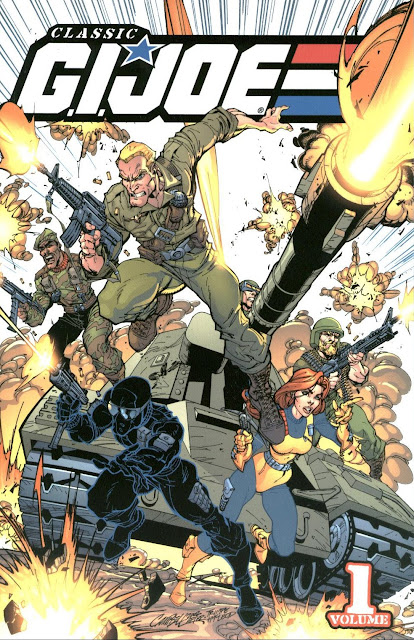
My rundown of the graphic novels and TPBs I bought at
Comic-Con concludes with two recent projects from IDW, which quickly became the comics publisher whose releases I've been looking forward to the most because of its ambitious reprints and high-quality revivals of properties like
Star Trek and
Doctor Who.
I picked up
Classic G.I. Joe Volume 1 at the IDW booth because I was looking for a comic that veteran Marvel and DC letterer (and friend and mentor to several of us
Secret Identities creators) Janice Chiang worked on and could sign for me at Comic-Con, and the TPB happened to contain an issue lettered by Janice. She then brought me over to another former Marvel letterer,
Rick Parker, to have him sign the TPB because his work appeared in the collection too.
I never was an avid reader of Marvel's
G.I. Joe comics, although
I bought some issues of the mothership and a couple of its spinoffs when I was a kid. I was more familiar with the Sunbow animated series, which hasn't exactly aged well. Even when I watched
G.I. Joe and
Transformers back-to-back after school, I thought the animation on both those Sunbow shows sucked. The constantly choppy character movements made
the crappy made-for-TV Popeye shorts from the '60s look like Richard Williams cartoons. Because the Sunbow series was essentially a 29-minute toy commercial (subtract one minute for the "Knowing is half the battle" PSA, which was devoted to giving safety tips or warnings about creepy guys in white vans instead of selling toys), most of
G.I. Joe's episodes were forgettable and silly, except for one: the Steve Gerber-penned "There's No Place Like Springfield," an eerie two-part ep about
Jack Nicholson's Shipwreck's awakening from a seven-year coma that was inspired by
The Prisoner (Shipwreck's home address at "Number Six Village Drive" was a shout-out to that famously surreal show). The downbeat tone of the ep and the images of Shipwreck's wife, daughter and friends melting into grey goo blew my mind when I was a kid and
scarred other kid viewers for life.

The Marvel comics were intended to sell toys too, but the writing in those comics tended to be much better than the writing on the cartoon, thanks to regular scripter and G.I. Joe action figure dossier writer Larry Hama, a real American hero, especially to
Secret Identities contributors who dug that an Asian American was at the helm of Marvel's finest-written toy-based title (also
the first comic ever advertised on TV). The Vietnam vet-turned-comics scripter's military expertise added authenticity and grit to the comics and kept them more grounded than the cartoon, where nobody died,
Star Wars-style lasers replaced bullets and Cobra was about as dangerous and menacing as Colonel Klink and Sergeant Schultz. That's why the late Gerber's despair-filled "Springfield" was such a stunner back in 1985--the cartoon ditched its usually campy tone for once, added some much-needed menace to Cobra and incorporated a storyline from the comics, the Joes' discovery of a Cobra base disguised as an idyllic, all-American suburb called Springfield.
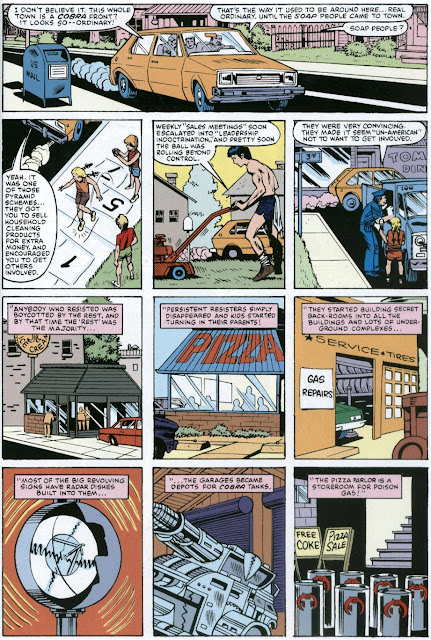 The standout 1983 G.I. Joe issue
 that introduced Hama's Springfield--a town that's as rotten-at-the-core as Matt Groening's Springfield--is included in
Classic G.I. Joe Volume 1, which collects the first 10 issues of the original 1982-1994 Marvel comic, most of them drawn by '70s
Incredible Hulk artist
Herb Trimpe in the classic '60s/'70s Marvel style. My tastes in espionage comics lean towards the more adult
Queen & Country and
Sleeper, so I found the dialogue in these early '80s
G.I. Joe issues to be on the hokey side. Despite the hokey one-liners, as the Topless Robot blog noted last year,
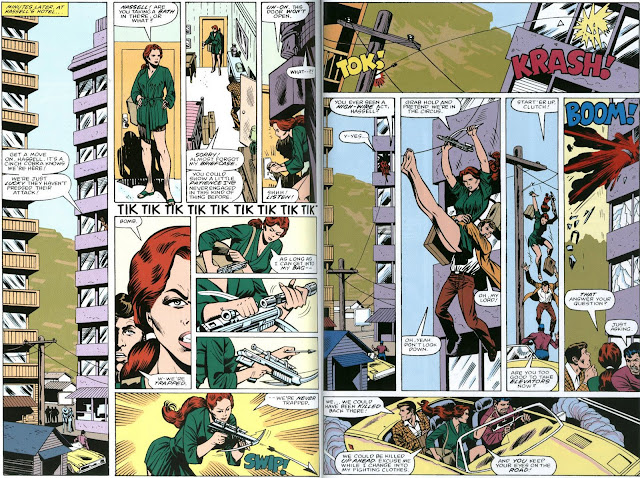
the original comic still kicks its cartoon counterpart's ass. Scarlett--the lone female Joe in these earlier issues, before Hasbro added Cover Girl and Lady Jaye to the cast--gets a bunch of thrilling take-charge moments in the 1983 issue that Janice lettered, a
Mike Vosburg-drawn story in which Scarlett is assigned to protect a diplomat who's being targeted by Cobra (another highlight of the TPB, as well as one of the few issues in the collection that didn't involve either Hama or Trimpe).
I bet the old issues I read in
Volume 1 even wallop the ass of
G.I. Joe: The Rise of Cobra, which hired Hama as a creative consultant. I have no plans to watch the movie because it looks terrible and overly CGI'd in the TV ads (this was a much more expensive Paramount movie than
Star Trek, yet they couldn't afford to get some decent-looking CGI that looks like 2009 CGI instead of 2002 CGI?). Director Stephen Sommers seems to have gotten the '80s toy lines-turned-cartoons mixed up. Exosuits?! (Or as the movie calls them, "accelerator suits"?!) That's
Centurions, not
G.I. Joe.
The Funny or Die parody was better cast than the movie itself. Henry Rollins would have been a more charismatic Duke than Channing Tatum, whose acting coach was apparently a 3 3/4-inch Duke action figure. And what the hell is the very blond Sienna Miller doing playing the very dark-featured Baroness (who's portrayed in the Funny or Die spoof by
a far more convincing-looking Olivia Wilde), and why was Miller directed to give the Russian villainess an American accent? To me, Miller will always be
Eddie Arlette's prissy and spoiled British flatmate.
Judging from the ads, the only performer in
The Rise of Cobra who's perfectly cast is
Star Trek's scene-stealing Orion babe Rachel Nichols as Scarlett. She looks like she walked straight out of the issue that Janice lettered, which at one point has a shorty robe-clad Scarlett making a daring high-wire escape from an upper-story hotel window with her crossbow. The statuesque ex-
Alias season 5 regular appears as if she were born to perform a sequence like that.
Speaking of destiny, artist Darwyn Cooke--
a fan of the artwork on the '60s/'70s G.I. Joe action figure packaging--was born to bring his minimalist style to the late Donald E. Westlake's equally minimalist 1962 crime novel
The Hunter, a book so nice moviemakers have filmed it thrice, as the badass Lee Marvin revenge flick
Point Blank, the Chow Yun-Fat actioner
Full Contact and the Mel Gibson vehicle
Payback (the only one of the three loose screen adaptations of
The Hunter I haven't watched, and that's partly because
composer Chris Boardman's ripoff of David Shire's Taking of Pelham One Two Three main title theme indicates how tired and derivative
Payback must be).

For those who have never read Westlake's original novel or watched either
Point Blank,
Full Contact or
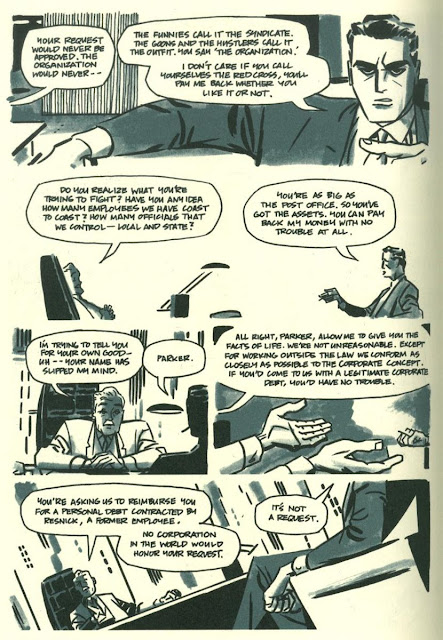
Payback, the brutal tale follows a ruthless career thief's vendetta against his former partners-in-crime, who left him for dead and screwed him out of his share of a successful heist. The vendetta escalates into a one-man battle against the mob, a.k.a. the Organization ("The funnies call it the Syndicate. The goons and the hustlers call it the Outfit."), as the crook, known simply as Parker, kills his way through the Organization's hierarchy to get back his skrilla.
Under his Richard Stark pseudonym, Westlake wrote
24 novels featuring Parker--the original cold-blooded, unrepentant thief. Westlake's creation has clearly influenced so many similar thief characters in film and TV, particularly the protagonists in Michael Mann caper flicks like
Thief. The climactic retribution that James Caan's self-made small businessman character unleashed against the control-freak boss who "owns the paper on his life" echoed Parker the similarly independent freelancer's confrontations with big business. Linda Fiorentino's
Last Seduction antiheroine Bridget Gregory seemed to have inherited the Westlake character's amorality and relentlessness. Michael Westen, the blacklisted ex-spy and occasional safecracker in
Burn Notice, inherited Parker's icy demeanor, professionalism and stubborn refusal to let a faceless, elusive corporation screw him over (in Michael's case, the shady character known only as "Management" and the nameless black ops organization that arranged to have Michael "burned").
Leverage co-creator
John Rogers named Parker the possibly Asperger's-afflicted cat burglar chick after Westlake's equally antisocial thief. Parker has basically begat more offspring than Anthony Quinn.
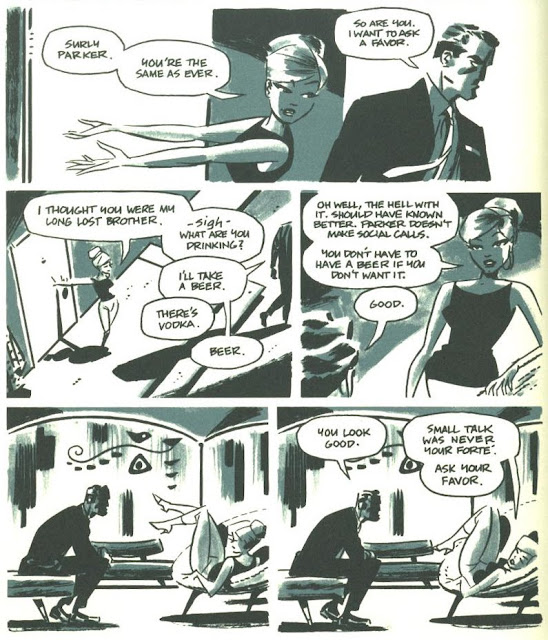
Some readers have complained that Cooke's IDW adaptation of Westlake's first Parker story is overhyped. On what planet is this graphic novel overhyped? As
a commenter on the Robot 6 blog noted, "In a world where
Blackest Night is consuming 90% of the comics blogosphere's attention, this is overhyped?," but both Westlake's writing and Cooke's work have loyal cult followings, as evidenced by the slightly long line for Cooke's
Hunter signing at the IDW booth--the only Comic-Con line I had the patience to stand in. I was lucky to nab a first-printing copy of
The Hunter (wrapped in an exclusive Comic-Con dust jacket that I prefer over
the regular white version of the jacket) before the hardcover novel
sold out at its distribution level.
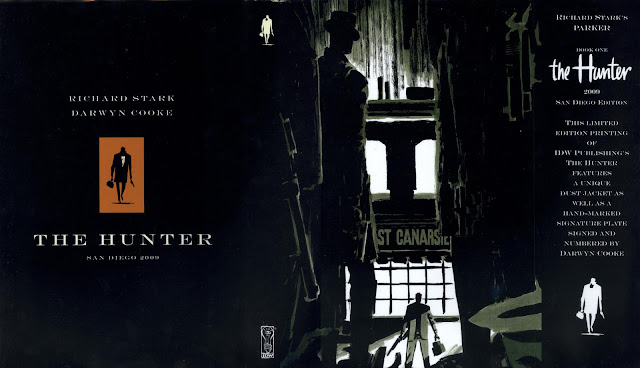
It's easy to see why
The Hunter attracted a lengthy line that Friday, skyrocketed to #3 on the
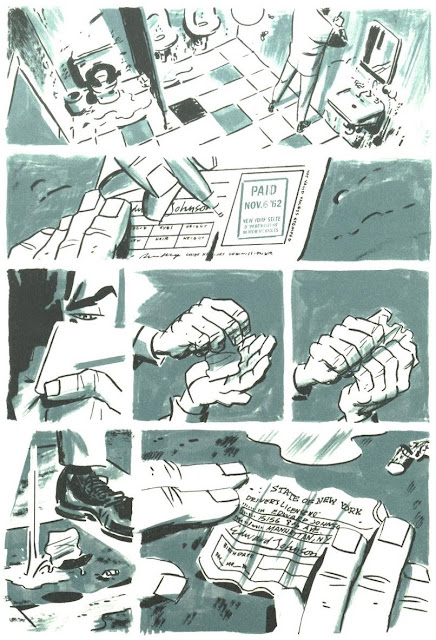
New York Times Graphic Books Best Seller List in its first week and is already on its way to a second printing. Cooke's spare, monochromatic and beautifully shaded artwork is extraordinary, whether it's visuals of sexy women or 1962 New York streetscapes. The
DC: The New Frontier writer/illustrator told the
L.A. Times that he intended his art in
The Hunter to be as stripped-down as Westlake's prose, which was the crime author's experiment to see if he could tell a story without any emotional content and with an antihero who internalizes his emotions. The Cooke adaptation's first 16 pages are as coldly efficient as Parker himself. Cooke superbly establishes Parker's criminal skills and single-minded, amoral character without any dialogue. It's as ballsy an opening as the disorienting first few minutes of
Point Blank.
I never read the original source material, but the 1967 John Boorman film wowed me when I first saw it in university a decade ago, despite a puzzling ending that was initially frustrating (SPOILER: Patrick Duffy emerges from a shower and says "it was all a dream").
The Hunter doesn't quite do for crime comics what
Point Blank did for '60s American crime flicks, which was revolutionize that genre with its
fractured narrative and
Euro art film-inspired sensibility. The Cooke version is just solid storytelling that makes the most of the strengths of comics as a visual medium, and like any good adaptation of a work from a different medium, it honors the source material without being overly reverential (for instance, Parker's resemblance to bodybuilder-turned-actor
Edson Stroll, who played the leader of the exiled beautiful people in
Twilight Zone's "Eye of the Beholder" ep, is quite a departure from
Westlake's vision of Parker as a more rugged-looking Jack Palance type).

I'm more acquainted with Cooke's animation and cover illustration work than his
Catwoman and
Spirit comics.
The Hunter has made me want to check out more of Cooke's comics. These storyboards Cooke pencilled for
Batman: The Animated Series' "Legends of the Dark Knight" homage to
The Dark Knight Returns, which I've taken from Paul Dini and Chip Kidd's 1998
Batman: Animated coffeetable book, are
Hunter-like in their intensity:
 Westlake never granted Hollywood producers permission to use Parker's name
 in their adaptations of his novels because he would only allow them to retain the name if they agreed to do a series of Parker movies, and none of them had sequels on their minds (hence the name "Walker" in
Point Blank, "McClain" in 1969's
The Split and "Porter" in
Payback). Cooke's novel is the first Parker adaptation in which Westlake gave the okay to use the name, possibly because Cooke planned on writing and drawing a four-volume series. Scheduled for summer 2010, Cooke's next Parker comic will adapt both
The Man with the Getaway Face and
The Outfit, which director John Flynn made into
a solid 1973 Robert Duvall vehicle of the same title that's more straightforward than the stylized
Point Blank, so it's blander in comparison, but it deserves as much notice as Boorman's movie (
The Outfit isn't on DVD yet, although TCM occasionally broadcasts it).
Screw
Avatar: The Next Whitewasher,
The Twilight Saga: Emotards and the other unpromising blockbusters that are slated so far to hit theaters next summer. The one true blockbuster of summer 2010 will be found not in a multiplex, but in comic shops and bookstores.
 The New York Times said blogging is passé, so I'm not going to blog anymore.


