Showing posts with label Marvel. Show all posts

Wednesday, 6 January 2010

Mighty love: A look back at Ralph Bakshi's adventurous and long-lost Terrytoons reboot, now on DVD

The flower-sniffing scene is included on the DVD. All you right-wingers who hated on the show because of the flower scene can suck it.
This is a revised version of a June 5, 2009 post--updated to include mentions of the Mighty Mouse: The New Adventures complete series DVD that came out yesterday.

I never thought I'd see the day. Ralph Bakshi and John Kricfalusi's hilarious late '80s Mighty Mouse: The New Adventures reboot of Terrytoons' opera-singing rodent superhero finally got an extras-filled DVD release from CBS/Paramount, delighting animation fans and '80s kids like me who, back in '87 or '88, thought, "There's gotta be a better cartoon than Transformers, G.I. Joe and all the other lamer ones starring toys," and then caught Mighty Mouse: TNA one Saturday morning and said, "Hey man, we just found it."

Bat-Bat and Tick the Bug Wonder by Jeffrey Pidgeon
The amusingly over-the-top and off-kilter Bakshi Animation fanfare that opened every 11-minute Mighty Mouse: TNA story signaled this was not another saccharine and sanctimonious cartoon kingdom like the ones inhabited by the Care Bears, Teddy Ruxpin, My Little Pony and the Little Clowns of Happytown. The Bakshi/John K. Mighty Mouse brought back some characters from the Terrytoons shorts (Pearl Pureheart, a less prominent Oil Can Harry) and introduced several new ones, like MM's lonely orphan buddy Scrappy Mouse, a bald villain named Petey Pate, the Batman spoof Bat-Bat--a precursor to both the Tick and Die Fledermaus--and the Cow, Bat-Bat's bovine nemesis.

The Cow by Jim Smith
The show also ditched the obnoxious opera singing from the old shorts and gave MM a secret identity for the first time. When MM wasn't busy rescuing Pearl, Scrappy or the other citizens of Mouseville, he disguised himself as a plain-voiced construction worker named Mike the Mouse, a new conceit that actually made MM a more relatable character. In the show's much more anarchic and absurdist second season, the writers apparently lost interest in the Mike persona and had MM appear as his caped self all the time, even when he got married to Pearl at a ceremony that was attended by all the other Terrytoons characters.

'You've got me? Who's got you?'Nineties cartoons like Tiny Toon Adventures and Animaniacs jumpstarted the whole meta-toon trend of poking fun at rival cartoons. But Mighty Mouse: TNA actually went meta years before--and with funnier and wilder results--in the classic "Don't Touch That Dial" episode, which launched an unprecedented attack on cookie-cutter '80s cartoons and viewers' short attention spans. The show's writers and animators admired the '40s and '50s Looney Tunes shorts (the Termite Terrace crew was in their comedic prime during those decades, but several of their shorts were also pretty racist-ass, to borrow a word from a recent tweet by Geo of Blue Scholars about Looney Tunes marathons). Throughout the series run, the Mighty Mouse: TNA staff succeeded in recapturing the irreverent spirit of those '40s and '50s cartoons, and in "Don't Touch That Dial" and an earlier ep, "Mighty's Benefit Plan," they couldn't resist expressing their hatred for the shabby state of mainstream animation at the time.

In the first-season ep "Mighty's Benefit Plan," the writers skewered one particular '80s cartoon, NBC's Alvin and the Chipmunks revival. They reimagined the Chipmunks as "Elwy and the Tree Weasels" (the band's biggest hit was called "Twitch and Writhe"), and in a series of gags they somehow Jedi mind-tricked CBS censors into ignoring, they turned David Seville into a disgusting-looking, Cheerios-craving pseudo-pedophile--an eerie foretelling of creepy teen pop Svengalis like Lou Pearlman and Joe Simpson.

Mr. E from Mighty Mouse: TNA's 'Don't Touch That Dial' ep
Mr. E (Photo source: Jeffrey Pidgeon)
In season two, instead of targeting just one show, the writers decided to go after a whole bunch of shows with "Don't Touch That Dial." The ep follows a Sgt. Bilko's Cereal-eating, diaper-clad kid viewer as he channel-surfs after MM's latest adventure bores him. Evicted from his own show by the impatient kid's remote, MM gets zapped into lame cartoons that resemble The Flintstones, The Jetsons, The Real Ghostbusters, Rocky and Bullwinkle (with Rocky Balboa instead of Rocky the Flying Squirrel) and Scooby-Doo (complete with canned laughter and a Scrappy-Doo-esque sidekick named "Mr. E," a mash-up of Mr. T and Ed Sullivan who tells MM to get away from his "really big shoe" and stop taunting his "ethnically mixed buddies"). Long before the writers of The Simpsons, Futurama, Arrested Development and 30 Rock were inserting gags that viewers have to freeze-frame, "Don't Touch That Dial" snuck in a great split-second shot of MM getting zapped into a nameless cartoon starring a mash-up of Popeye and a Smurf ("Popeye Smurf").

Not everything in Mighty Mouse: TNA worked. Scrappy, voiced by the late Dana Hill, the Patrick Troughton of Audrey Griswolds, was an annoying audience surrogate who became even more annoying when a cost-cutting Bakshi would string together clips of old Terrytoons shorts and have an offscreen Scrappy snark at the footage for the entire 11-minute segment. Mighty Mouse invented MST3King about a year before MST3K did! (When he was asked in a 1988 interview about the 11-minute montages of old Terrytoons clips, John K. said, "Why waste money on those things? Nobody's going to watch them anyway.") Though these segments weren't very funny--and listening to Scrappy's voice for 11 minutes straight is like being treated to a concerto by the Nails on Chalkboards Philharmonic Orchestra--they showed how much of an improvement the Bakshi/John K. reboot was over the original MM cartoons, which were rather sucky. No wonder the show's writers and animators turned to Looney Tunes instead of Terrytoons for comedic inspiration.

Marvel Comics' Mighty Mouse #1It's a shame this little-seen show has been remembered mostly for the uproar caused by the religious right--they thought they saw MM snort coke from a flower--and not often enough for moments like the ep that pitted MM against a giant, evil and nameless parade balloon that was clearly Pee-wee Herman (a funny reference to another CBS Saturday morning show at the time), the Elwy show and "Don't Touch That Dial," the most entertaining 11 minutes of small-screen animation from the '80s. Though it lasted only two seasons, Mighty Mouse: TNA was popular enough to spawn an early '90s Marvel comic that brought Bat-Bat, his sidekick Tick the Bug Wonder, the Cow and the show's other new characters to the funny pages.

For a while, a Mighty Mouse: TNA DVD seemed unlikely because according to Jeffrey Pidgeon, an artist who worked on the show, "the rights are owned by five different people who don't exactly like each other." I don't know who sorted out the legal mess, but I like to think a mouse in yellow tights was somehow involved.

Wednesday, 2 September 2009

The long Khan: AFOS September 2009 segment playlists

Starting today at 8am, these September '09 playlists (intro'd by yours truly, of course) will air all through the month on the Fistful of Soundtracks channel. Until September 29, they'll be repeated every Tuesday and Thursday at 4am, 10am, 3pm, 7pm and 11pm and every Saturday and Sunday at 7am, 9am, 1pm, 3pm and 5pm.

The constantly screaming Chekov secures his position as the Jennifer Love Hewitt of Star Trek.
"Eelmatic":
1. James Horner, "The Eels of Ceti Alpha V/Kirk in Space Shuttle," Star Trek II: The Wrath of Khan, Retrograde/Film Score Monthly
2. James Horner, "Captain Terrell's Death," Star Trek II: The Wrath of Khan, Retrograde/Film Score Monthly

"Promises, Promises":
3. Tom Jones, "Promise Her Anything" (from Promise Her Anything), Their Greatest Hits: Tom Jones and Engelbert Humperdinck, Rebound
4. Klaus Badelt, "The Promise," The Promise, Superb

"Chase Those Crazy Beatheads Out of Town":
5. Barry De Vorzon, "Baseball Furies Chase," The Warriors, Spectrum
6. J.J. Johnson, "Willie Chase," Willie Dynamite, Hip-O Select/Geffen

"Harkness, Everybody, Harkness":
7. Ben Foster, "Here Comes Torchwood," Torchwood: Children of Earth, Silva Screen
8. Ben Foster, "Judgement Day," Torchwood: Children of Earth, Silva Screen

"Tarantino Raided My Soundtrack Cabinets":
9. Ennio Morricone, "Algiers November 1, 1954" (from Battle of Algiers), The Ennio Morricone Anthology: A Fistful of Film Music, Rhino
10. Giorgio Moroder & David Bowie, "Cat People (Putting Out Fire)," Cat People, MCA
11. Lalo Schifrin, "Tiger Tank," Kelly's Heroes, Film Score Monthly

"The Hottie and the Ostinati":
12. The Paramount Studio Orchestra, "Prelude and Rooftop," Vertigo, Varèse Sarabande
13. The Paramount Studio Orchestra, "The Streets," Vertigo, Varèse Sarabande

"Schnapps for Breakfast":
14. Bernard Herrmann, "Thank God for the Rain," Taxi Driver, Arista
15. Bernard Herrmann, "Getting Into Shape/Listen You Screwheads/Gun Play/Dear Father & Mother/The Card/Soap Opera," Taxi Driver, Arista

"R.I.P. Erich Kunzel":
16. Cincinnati Pops Orchestra, "Overture" (from The Seventh Voyage of Sinbad), The Great Fantasy Adventure Album, Telarc

"I Guess This Means That Alias/Alias Crossover's a Possibility Now":
17. Michael Giacchino, "On the Train," Alias: Season Two, Varèse Sarabande
18. Eric Rogers, "Spider-Woman," Sci-Fi's Greatest Hits Vol. 4: Defenders of Justice, TVT

"English as Language Second":
19. Ennio Morricone with Maurizio Graf, "Il Ritorno Di Ringo" (from The Return of Ringo), The Ennio Morricone Anthology: A Fistful of Film Music, Rhino
20. Guido & Maurizio De Angelis featuring Susi & Guy, "Driving All Around" (from Il Cittadino Si Rebella), Beretta 70: Roaring Themes from Thrilling Italian Policefilms 1971-80, Crippled Dick Hot Wax!
21. Seatbelts featuring Masayoshi Furukawa, "You Make Me Cool" (from the "Mushroom Samba" episode), Cowboy Bebop: No Disc, Victor
22. Seatbelts featuring Mai Yamane, "Want It All Back" (from the "Asteroid Blues," "Stray Dog Strut" and "Speak Like a Child" episodes), Cowboy Bebop: No Disc, Victor

"Westlake Ho":
23. Johnny Mandel, "Trackdown" (from Point Blank), Point Blank/The Outfit, Film Score Monthly
24. Quincy Jones, "Kifka Car Caper," The Split, Film Score Monthly
25. Quincy Jones, "Main Title," The Hot Rock, Prophecy
26. Jerry Fielding, "Office Scuffle/Kenilworth Heist/Casino Heist" (from The Outfit), Point Blank/The Outfit, Film Score Monthly

The Shots in the Dark cover featuring Rose McGowan"Say Si, Not Oui":
27. La-33, "La Pantera Mambo," La-33, Walboomers
28. The Wondermints, "The Party," Shots in the Dark, Donna

"Alley OOP":
29. Elliot Goldenthal, "Obligatory Car Chase," Demolition Man: The Original Orchestral Score, Varèse Sarabande
30. Hans Zimmer, "Show Me Your Firetruck" (from Backdraft), Passions & Achievements, Milan
31. Royal Scottish National Orchestra, "End Credits" (from First Knight), Hollywood '95, Varèse Sarabande

"There Are Never Possibilities":
32. James Horner, "Epilogue (original version)/End Title," Star Trek II: The Wrath of Khan, Retrograde/Film Score Monthly

Friday, 21 August 2009

The Hunter gets captured by the geeks: The books I picked up at Comic-Con, part 2

Previously: The Middleman: The Doomsday Armageddon Apocalypse, Adrenaline and Bumperboy and the Loud, Loud Mountain.
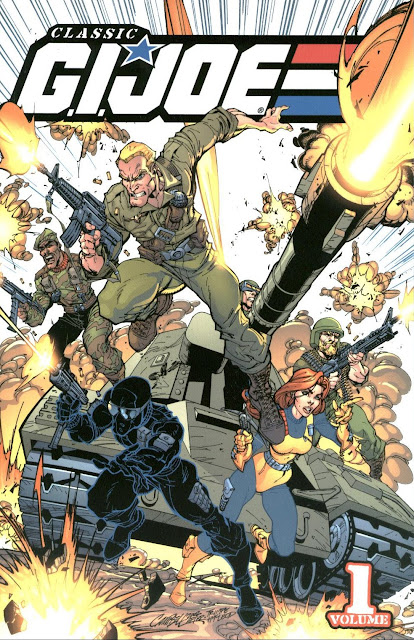
Classic G.I. Joe Volume 1 cover by J. Scott Campbell
My rundown of the graphic novels and TPBs I bought at Comic-Con concludes with two recent projects from IDW, which quickly became the comics publisher whose releases I've been looking forward to the most because of its ambitious reprints and high-quality revivals of properties like Star Trek and Doctor Who.

I picked up Classic G.I. Joe Volume 1 at the IDW booth because I was looking for a comic that veteran Marvel and DC letterer (and friend and mentor to several of us Secret Identities creators) Janice Chiang worked on and could sign for me at Comic-Con, and the TPB happened to contain an issue lettered by Janice. She then brought me over to another former Marvel letterer, Rick Parker, to have him sign the TPB because his work appeared in the collection too.

I never was an avid reader of Marvel's G.I. Joe comics, although I bought some issues of the mothership and a couple of its spinoffs when I was a kid. I was more familiar with the Sunbow animated series, which hasn't exactly aged well. Even when I watched G.I. Joe and Transformers back-to-back after school, I thought the animation on both those Sunbow shows sucked. The constantly choppy character movements made the crappy made-for-TV Popeye shorts from the '60s look like Richard Williams cartoons. Because the Sunbow series was essentially a 29-minute toy commercial (subtract one minute for the "Knowing is half the battle" PSA, which was devoted to giving safety tips or warnings about creepy guys in white vans instead of selling toys), most of G.I. Joe's episodes were forgettable and silly, except for one: the Steve Gerber-penned "There's No Place Like Springfield," an eerie two-part ep about Jack Nicholson's Shipwreck's awakening from a seven-year coma that was inspired by The Prisoner (Shipwreck's home address at "Number Six Village Drive" was a shout-out to that famously surreal show). The downbeat tone of the ep and the images of Shipwreck's wife, daughter and friends melting into grey goo blew my mind when I was a kid and scarred other kid viewers for life.

G.I. Joe #5 is essentially a 21-page ad for the toy line's MOBAT vehicle.
The Marvel comics were intended to sell toys too, but the writing in those comics tended to be much better than the writing on the cartoon, thanks to regular scripter and G.I. Joe action figure dossier writer Larry Hama, a real American hero, especially to Secret Identities contributors who dug that an Asian American was at the helm of Marvel's finest-written toy-based title (also the first comic ever advertised on TV). The Vietnam vet-turned-comics scripter's military expertise added authenticity and grit to the comics and kept them more grounded than the cartoon, where nobody died, Star Wars-style lasers replaced bullets and Cobra was about as dangerous and menacing as Colonel Klink and Sergeant Schultz. That's why the late Gerber's despair-filled "Springfield" was such a stunner back in 1985--the cartoon ditched its usually campy tone for once, added some much-needed menace to Cobra and incorporated a storyline from the comics, the Joes' discovery of a Cobra base disguised as an idyllic, all-American suburb called Springfield.
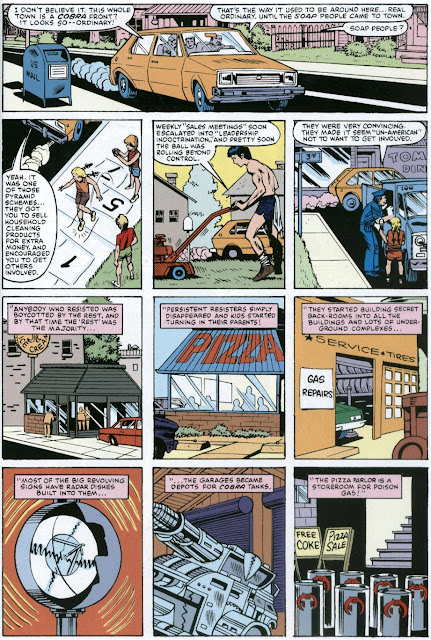
Larry Hama's deceptively nice suburb of Springfield beats David Lynch's equally deceptive Blue Velvet town of Lumberton to the punch by three years in G.I. Joe #10 by Hama, Mike Vosburg and Chic Stone.
The standout 1983 G.I. Joe issue that introduced Hama's Springfield--a town that's as rotten-at-the-core as Matt Groening's Springfield--is included in Classic G.I. Joe Volume 1, which collects the first 10 issues of the original 1982-1994 Marvel comic, most of them drawn by '70s Incredible Hulk artist Herb Trimpe in the classic '60s/'70s Marvel style. My tastes in espionage comics lean towards the more adult Queen & Country and Sleeper, so I found the dialogue in these early '80s G.I. Joe issues to be on the hokey side. Despite the hokey one-liners, as the Topless Robot blog noted last year, the original comic still kicks its cartoon counterpart's ass. Scarlett--the lone female Joe in these earlier issues, before Hasbro added Cover Girl and Lady Jaye to the cast--gets a bunch of thrilling take-charge moments in the 1983 issue that Janice lettered, a Mike Vosburg-drawn story in which Scarlett is assigned to protect a diplomat who's being targeted by Cobra (another highlight of the TPB, as well as one of the few issues in the collection that didn't involve either Hama or Trimpe).

I bet the old issues I read in Volume 1 even wallop the ass of G.I. Joe: The Rise of Cobra, which hired Hama as a creative consultant. I have no plans to watch the movie because it looks terrible and overly CGI'd in the TV ads (this was a much more expensive Paramount movie than Star Trek, yet they couldn't afford to get some decent-looking CGI that looks like 2009 CGI instead of 2002 CGI?). Director Stephen Sommers seems to have gotten the '80s toy lines-turned-cartoons mixed up. Exosuits?! (Or as the movie calls them, "accelerator suits"?!) That's Centurions, not G.I. Joe. The Funny or Die parody was better cast than the movie itself. Henry Rollins would have been a more charismatic Duke than Channing Tatum, whose acting coach was apparently a 3 3/4-inch Duke action figure. And what the hell is the very blond Sienna Miller doing playing the very dark-featured Baroness (who's portrayed in the Funny or Die spoof by a far more convincing-looking Olivia Wilde), and why was Miller directed to give the Russian villainess an American accent? To me, Miller will always be Eddie Arlette's prissy and spoiled British flatmate.

Judging from the ads, the only performer in The Rise of Cobra who's perfectly cast is Star Trek's scene-stealing Orion babe Rachel Nichols as Scarlett. She looks like she walked straight out of the issue that Janice lettered, which at one point has a shorty robe-clad Scarlett making a daring high-wire escape from an upper-story hotel window with her crossbow. The statuesque ex-Alias season 5 regular appears as if she were born to perform a sequence like that.
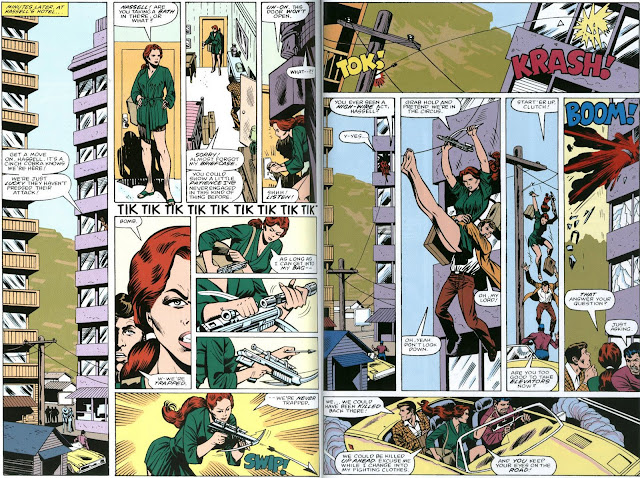
Nice stems, Scarlett. The crossbow-wielding hottie takes center stage in G.I. Joe #9 by Steven Grant and Mike Vosburg, with letters by Janice Chiang.
Speaking of destiny, artist Darwyn Cooke--a fan of the artwork on the '60s/'70s G.I. Joe action figure packaging--was born to bring his minimalist style to the late Donald E. Westlake's equally minimalist 1962 crime novel The Hunter, a book so nice moviemakers have filmed it thrice, as the badass Lee Marvin revenge flick Point Blank, the Chow Yun-Fat actioner Full Contact and the Mel Gibson vehicle Payback (the only one of the three loose screen adaptations of The Hunter I haven't watched, and that's partly because composer Chris Boardman's ripoff of David Shire's Taking of Pelham One Two Three main title theme indicates how tired and derivative Payback must be).

Mal Reese flashes back to the night he forced Lynn Parker to betray her husband in Darwyn Cooke's adaptation of The Hunter.
For those who have never read Westlake's original novel or watched either Point Blank, Full Contact or Payback, the brutal tale follows a ruthless career thief's vendetta against his former partners-in-crime, who left him for dead and screwed him out of his share of a successful heist. The vendetta escalates into a one-man battle against the mob, a.k.a. the Organization ("The funnies call it the Syndicate. The goons and the hustlers call it the Outfit."), as the crook, known simply as Parker, kills his way through the Organization's hierarchy to get back his skrilla.
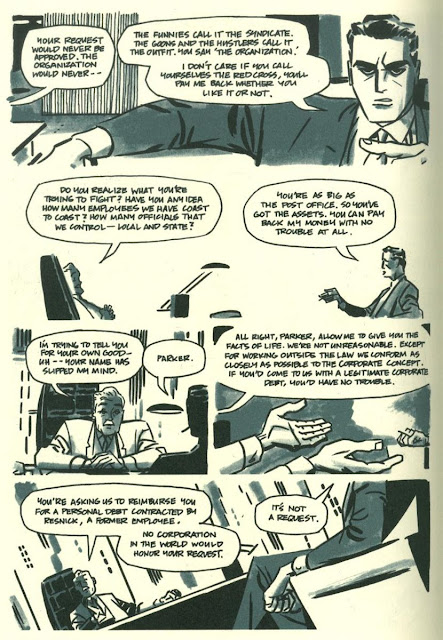
Parker strong-arms the Organization into handing over his money in The Hunter.
Under his Richard Stark pseudonym, Westlake wrote 24 novels featuring Parker--the original cold-blooded, unrepentant thief. Westlake's creation has clearly influenced so many similar thief characters in film and TV, particularly the protagonists in Michael Mann caper flicks like Thief. The climactic retribution that James Caan's self-made small businessman character unleashed against the control-freak boss who "owns the paper on his life" echoed Parker the similarly independent freelancer's confrontations with big business. Linda Fiorentino's Last Seduction antiheroine Bridget Gregory seemed to have inherited the Westlake character's amorality and relentlessness. Michael Westen, the blacklisted ex-spy and occasional safecracker in Burn Notice, inherited Parker's icy demeanor, professionalism and stubborn refusal to let a faceless, elusive corporation screw him over (in Michael's case, the shady character known only as "Management" and the nameless black ops organization that arranged to have Michael "burned"). Leverage co-creator John Rogers named Parker the possibly Asperger's-afflicted cat burglar chick after Westlake's equally antisocial thief. Parker has basically begat more offspring than Anthony Quinn.
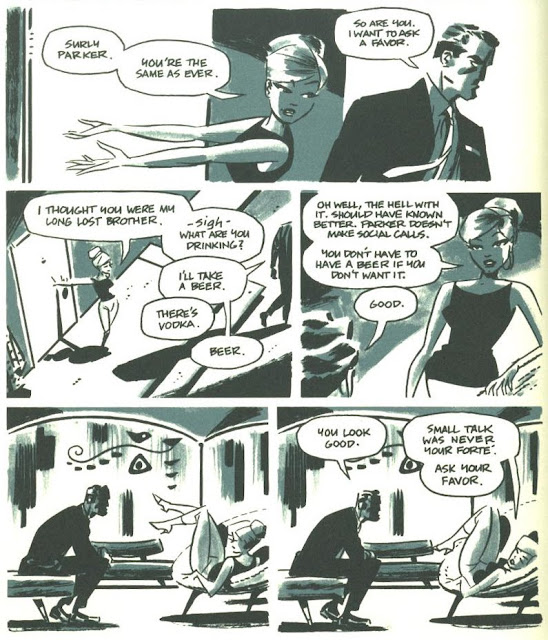
'Parker, you haven't changed a bit. You're just as warm and sociable as ever.'
Some readers have complained that Cooke's IDW adaptation of Westlake's first Parker story is overhyped. On what planet is this graphic novel overhyped? As a commenter on the Robot 6 blog noted, "In a world where Blackest Night is consuming 90% of the comics blogosphere's attention, this is overhyped?," but both Westlake's writing and Cooke's work have loyal cult followings, as evidenced by the slightly long line for Cooke's Hunter signing at the IDW booth--the only Comic-Con line I had the patience to stand in. I was lucky to nab a first-printing copy of The Hunter (wrapped in an exclusive Comic-Con dust jacket that I prefer over the regular white version of the jacket) before the hardcover novel sold out at its distribution level.
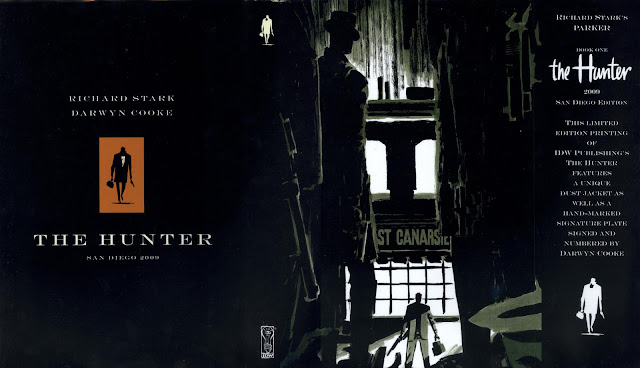
The Hunter's Comic-Con-only dust jacket is cooler than the jacket that's in bookstores now.
It's easy to see why The Hunter attracted a lengthy line that Friday, skyrocketed to #3 on the New York Times Graphic Books Best Seller List in its first week and is already on its way to a second printing. Cooke's spare, monochromatic and beautifully shaded artwork is extraordinary, whether it's visuals of sexy women or 1962 New York streetscapes. The DC: The New Frontier writer/illustrator told the L.A. Times that he intended his art in The Hunter to be as stripped-down as Westlake's prose, which was the crime author's experiment to see if he could tell a story without any emotional content and with an antihero who internalizes his emotions. The Cooke adaptation's first 16 pages are as coldly efficient as Parker himself. Cooke superbly establishes Parker's criminal skills and single-minded, amoral character without any dialogue. It's as ballsy an opening as the disorienting first few minutes of Point Blank.
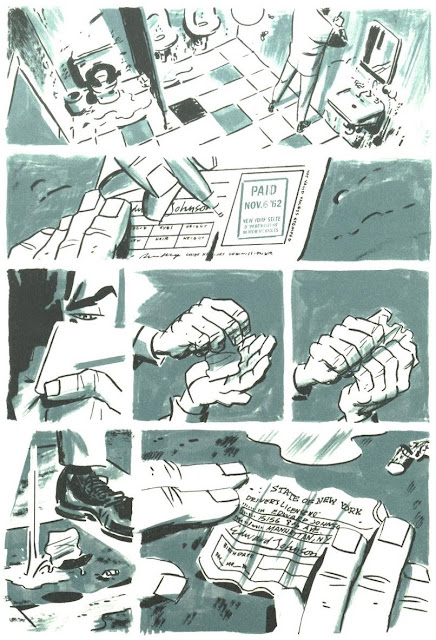
How to Forge a '60s Driver's License in Four Uneasy Pages
I never read the original source material, but the 1967 John Boorman film wowed me when I first saw it in university a decade ago, despite a puzzling ending that was initially frustrating (SPOILER: Patrick Duffy emerges from a shower and says "it was all a dream"). The Hunter doesn't quite do for crime comics what Point Blank did for '60s American crime flicks, which was revolutionize that genre with its fractured narrative and Euro art film-inspired sensibility. The Cooke version is just solid storytelling that makes the most of the strengths of comics as a visual medium, and like any good adaptation of a work from a different medium, it honors the source material without being overly reverential (for instance, Parker's resemblance to bodybuilder-turned-actor Edson Stroll, who played the leader of the exiled beautiful people in Twilight Zone's "Eye of the Beholder" ep, is quite a departure from Westlake's vision of Parker as a more rugged-looking Jack Palance type).

What does Parker want with Oprah's boyfriend?
I'm more acquainted with Cooke's animation and cover illustration work than his Catwoman and Spirit comics. The Hunter has made me want to check out more of Cooke's comics. These storyboards Cooke pencilled for Batman: The Animated Series' "Legends of the Dark Knight" homage to The Dark Knight Returns, which I've taken from Paul Dini and Chip Kidd's 1998 Batman: Animated coffeetable book, are Hunter-like in their intensity:

Batman: The Animated Series' 'Legends of the Dark Knight' storyboards by Darwyn Cooke and Glen Murakami
Westlake never granted Hollywood producers permission to use Parker's name in their adaptations of his novels because he would only allow them to retain the name if they agreed to do a series of Parker movies, and none of them had sequels on their minds (hence the name "Walker" in Point Blank, "McClain" in 1969's The Split and "Porter" in Payback). Cooke's novel is the first Parker adaptation in which Westlake gave the okay to use the name, possibly because Cooke planned on writing and drawing a four-volume series. Scheduled for summer 2010, Cooke's next Parker comic will adapt both The Man with the Getaway Face and The Outfit, which director John Flynn made into a solid 1973 Robert Duvall vehicle of the same title that's more straightforward than the stylized Point Blank, so it's blander in comparison, but it deserves as much notice as Boorman's movie (The Outfit isn't on DVD yet, although TCM occasionally broadcasts it).

Screw Avatar: The Next Whitewasher, The Twilight Saga: Emotards and the other unpromising blockbusters that are slated so far to hit theaters next summer. The one true blockbuster of summer 2010 will be found not in a multiplex, but in comic shops and bookstores.

Thursday, 9 July 2009

Chocolate city

Shoo, flies, don't bother me.
I wasn't aware of the existence of Thai director Prachya Pinkaew's 2008 martial arts flick Chocolate until a few weeks ago, when Netflix placed the movie on a list of rentals I might enjoy.

After I read Netflix's synopsis of their recommendation--"a young autistic woman who discovers that she has the uncanny ability to absorb precision fighting skills just by watching martial arts movies"--I immediately added it to my queue and placed it at the #1 spot because "Sampler," the Secret Identities: The Asian American Superhero Anthology short story I created, has a similar premise. In my story (the very reason why this weekend, I'll be making my first appearance at a comic book convention as a guest talent, even though it's at one of the smaller conventions, the new Asian American ComiCon), a dry cleaning store worker named June temporarily acquires the powers of her superhero customers by touching their costumes.

Monica (Dana Davis), Heroes' quickly-forgotten-because-the-showrunners-have-ADD supporting character, and another 'photographic reflexes' character, the Marvel Comics villain Taskmaster.
On the other hand, what Taskmaster can't do is find a costume that doesn't make bystanders laugh.
The autistic, candy-craving Chocolate heroine's superpower is actually more about "photographic reflexes"--like forgotten Heroes supermimic Monica Dawson and the Marvel Comics supervillain Taskmaster, whom Alan Sepinwall said must have been the inspiration for Monica--than power-absorption-by-touch. (In one of millions of lines that were deleted from "Sampler" by Secret Identities editor-in-chief Jeff Yang, June explains that she's able to sample superpowers because she's a mutant, or a "superior," a term I created for mutants in earlier drafts. In order to sample a mutant's power, June has to touch that mutant's fingerprint residue or any other traces of DNA left behind anywhere, whether it's on an item they touched or a garment they wore. I know--you're probably thinking, "Ewwww, so does that mean she would have to come into contact with the love stains inside Cyclops' unitard in order to shoot lasers from her eyes?" In the R-rated or TV-MA-rated version of "Sampler," unfortunately, yes.)

Below Sepinwall's recap of Heroes' introduction of Monica, a commenter joked, "Jeez, a hero whose superpower is that she's really, really good at watching TV?" In Chocolate, Zen (Jija Yanin) acquires her fighting moves in a similar fashion by viewing TV broadcasts of Muay Thai flicks like Pinkaew's own previous work, the Tony Jaa vehicle Ong-Bak, or in my favorite sequence, observing the movements of a henchman who has Tourette's. Yep, it's a South Park "Cripple Fight"-esque duel that pits mentally challenged fighter against physically challenged fighter (and though it's my favorite showdown in Chocolate, it's too quickly resolved).

No gang would accept physically challenged thugs--or transvestites--into its fold like the evil Thai crime family in Chocolate does. Gangsters aren't exactly known for being open-minded and tolerant. That's how much of a martial arts fantasy Chocolate is. It's like the multiracial Street Thunder gang in the original Assault on Precinct 13. You immediately knew John Carpenter's film was more of a hyperrealistic crime flick than a realistic one because in real life, no gang would be that racially mixed.

This move was copped from Tony Jaa...
... while this move was copped from Jean-Claude Van Damme in Gymkata 2: You Can Take the Kata Out of the Gym, But You Can't Take the Gym Out of the Kata.
I've previously said I'm not much of a fan of the martial arts genre. Even the fight sequences in some of the martial arts actioners I've enjoyed, like the first two Once Upon a Time in China installments, can get boring after a while. Chocolate's otherwise decent climax gets tedious at one point--I kept thinking, "C'mon, when's the main villain gonna finally lose consciousness? What is he? The Thai Energizer Bunny?"

Despite the tedious climax, a cancer-patient-mother subplot that's a bit too melodramatic for my tastes, and a crew of transvestite assassins who would fit right in with The Celluloid Closet's montage of evil gays from Freebie and the Bean and The Silence of the Lambs(*), the otherwise inventive Chocolate won me over, which is something of a miracle because I'm one of the few guys in America who actually didn't cry during Rudy. The premise of an undersized underdog overcoming adversity or physical limitations through combat is always appealing, whether it's in Rudy, Chocolate or even "Sampler."

(*) If I ever have to defend Chocolate to gay critics, I'd probably say, "Well, I agree, but in fairness, at least Chocolate doesn't ignore the tranny population in Thailand." I'd also say, "And the big bad's tranny second-in-command wasn't a weakling like in Freebie and the Bean. He was a badass with a gun."

Zen could use some Neosporin on her knee like soon-to-be-ex-Governor Sarah Palin could use a thick piece of electrical tape over her mouth.

A recent TCM Movie Morlocks blog post praises the coherently shot, Fred Astaire-style ass-whupping Donnie Yen gives to Sammo Hung in Hong Kong action maestro Wilson Yip's Kill Zone and explains why American action films pale in comparison to Asian actioners:
One excuse given as to why films like Taken or the Bourne series don't have this same kind of coherence is that the actors aren't as physically trained as martial arts pros like Hung and Yen, and necessarily need stunt doubles, necessitating even faster cuts and less spatial coherence. However, American action films don't necessarily have to have nuanced fighting styles – just watch the series of haymakers Gregory Peck and Charlton Heston unload on each other in The Big Country (which can be seen in the video slideshow of Dennis Lim's excellent history of fight choreography at Slate). It's a stylistic choice, and right now Hollywood filmmakers are making the wrong one. I was initially thrilled by the Bourne series' propulsive energy, but the more time that passes, the more its fractured editing seems like a dodge.
Fortunately, the fight sequences in Chocolate are as coherently shot as the Kill Zone sequence. That means each of Yanin's graceful moves aren't disrupted by a choppy edit. The sequences look like they must have been genuinely grueling to perform, and Chocolate's closing credits outtakes of Yanin and the stuntmen badly injuring themselves prove it. Adding to the coherence and credibility of Chocolate's sequences is the fact that like Hung and Yen, the charismatic, twentysomething Yanin is a pro, although she wasn't at first. She received two years' worth of intensive martial arts training after Pinkaew cast her as Zen, which means Chocolate took four years to make.

The comic book version of Chocolate

Jija Yanin's Raging Phoenix teaser poster

Yanin is a martial arts star to watch. A box-office hit in Thailand, Chocolate was popular enough to spawn a comic book and another high-concept martial arts flick for Yanin. Her next vehicle, Raging Phoenix, will involve another new-to-the-genre gimmick like Chocolate's introduction of an autistic heroine: hip-hop dancing. I take it Raging Phoenix will be like Ong-Bak meets You Got Served.

Wednesday, 24 June 2009

Song for Nico: Marvel's Runaways gets a theme tune

I like Runaways, but Nico doesn't exactly look Asian. It's a common problem with Marvel's heroines of color. Storm is apparently a member of the only tribe in Kenya that's blue-eyed and stringy-haired.
In a post about songs I would have chosen for the Watchmen movie if I were its music supervisor, I mentioned a comic book that came with its own original soundtrack: the Devil's Due series Spooks, a Ryan Schifrin/Larry Hama collabo that spawned a score album co-composed by Schifrin's father, legendary Enter the Dragon and Mission: Impossible composer Lalo Schifrin.

Witchblade is another comic with a soundtrack. Megadeth and Cibo Matto's Miho Hatori were among the artists who contributed original songs that readers could rock out to while following the adventures of their favorite scantily clad NYPD detective-turned-warrior woman.

Spooks and Witchblade are comics I've never read, so I was kind of excited to learn a comic I do read is joining the list of comics with original theme songs: Runaways (no, not The Mark Sanford and Maria Story, but the witty Marvel teenage superhero series created by one of my favorite comic scriptwriters, Brian K. Vaughan, and featuring an Asian American Goth chick, Nico, as the team leader).

Runaways editor Nick Lowe--not to be confused with Nick Lowe of "Cruel to Be Kind" and "I Love the Sound of Breaking Glass" fame--has written and recorded theme music for his own series. This isn't the first time Lowe and his brother Matt, a member of the Down Lowe, created a theme for a comic Lowe edited. The brothers also recorded a theme for Nextwave.

MTV's Splash Page debuted a music video of Lowe's Runaways theme, which can be downloaded in mp3 form from Marvel's site, and interviewed Lowe about his recording:
"'Runaways' has always hit me like the best of the teen TV shows," said Lowe of the inspiration for his musical contribution to the series. "It's got it all: making out, poor decisions, and angst. Sure, they have super powers, but that's not what it's all about. So I tried to write a song that felt like something that would be played on 'Gossip Girl' or 'Ugly Betty.'"...

Marvel's Senior Art Director, Jeff Suter, said he didn't know what to expect from Lowe when the theme song was first pitched around the publisher’s office. Charged with putting the song to video, he said the finished musical element was quite a bit different than he anticipated.

"He came to us with the concept of an opening montage of a sitcom or Saturday morning kids show," said Suter. "I knew he's come back to us with something clever, but I really had no idea he'd bring such a catchy pop tune, something reminiscent of some of the great 1990s TV themes."
How does the Runaways theme fare? It's alright--it breaks down the comic's premise in a tuneful way that makes me miss old-school TV themes like the ones that opened the '60s Spider-Man cartoon, The Greatest American Hero, Jack of All Trades and The Knights of Prosperity--but it's not exactly the theme I had in mind while reading Runaways.

The theme I would have gone with is "I Love Playin' with Fire" by... the Runaways.

What's up with Kristen Stewart's femullet? It's for her role as Joan Jett in the Runaways biopic. What's up with Kristen Stewart's dead eyes? If you had to work with a script like Twilight's, you'd look that dead-eyed too.
[Via Robot 6]

Friday, 5 June 2009

Mighty Mouse: The New Adventures: Jimmy J. Aquino's Lacuna Matata, Part 2

It's the Mighty Mouse remake of Michael Bay's Armageddon: Armageddon Outta Here!
"Lacuna Matata" continues with another attempt to preserve the fading memory of TV shows no one except me remembers watching because the networks somehow Lacuna'd these things from everyone's heads.

In the case of Ralph Bakshi and John Kricfalusi's Mighty Mouse: The New Adventures, a hilarious late '80s reboot of Terrytoons' opera-singing rodent superhero, some people still actually remember watching it--particularly artists who worked on the show, animation fans and '80s kids like me who thought, "There's gotta be a better cartoon than Transformers, G.I. Joe and all the other lamer ones starring toys" and then caught Mighty Mouse: TNA and said, "Hey man, we just found it."

Bat-Bat and Tick the Bug Wonder by Jeffrey Pidgeon
The amusingly over-the-top and off-kilter Bakshi Animation fanfare that opened every 11-minute Mighty Mouse: TNA story signaled this was not another saccharine and sanctimonious cartoon kingdom like the ones inhabited by the Care Bears, Teddy Ruxpin, My Little Pony and the Little Clowns of Happytown. The Bakshi/John K. Mighty Mouse brought back some characters from the Terrytoons shorts (Pearl Pureheart, a less prominent Oil Can Harry) and introduced several new ones, like MM's lonely orphan buddy Scrappy Mouse, a bald villain named Petey Pate, the Batman spoof Bat-Bat--a precursor to both the Tick and Die Fledermaus--and Bat-Bat's bovine archenemy, the Cow.

The Cow by Jim Smith
The show also ditched the obnoxious opera singing from the old shorts and gave MM a secret identity for the first time. When MM wasn't busy rescuing Pearl, Scrappy or the other citizens of Mouseville, he disguised himself as a plain-voiced construction worker named Mike the Mouse, a new conceit that actually made MM a more relatable character. In the show's much more anarchic and absurdist second season, the writers apparently lost interest in the Mike persona and had MM appear as his caped self all the time, even when he got married to Pearl at a ceremony that was attended by all the other Terrytoons characters.

Nineties cartoons like Tiny Toon Adventures and Animaniacs jumpstarted the whole meta-toon trend of poking fun at rival cartoons. But Mighty Mouse: TNA actually went meta years before--and with funnier and wilder results--in the classic "Don't Touch That Dial" episode, which launched an unprecedented attack on cookie-cutter '80s cartoons and viewers' short attention spans. The show's writers and animators, who admired the '40s and '50s Looney Tunes shorts and succeeded in recapturing the irreverent spirit of those cartoons, couldn't resist expressing their hatred for the shabby state of mainstream animation at the time.

'You've got me? Who's got you?'During Mighty Mouse: TNA's first season, the writers skewered one particular '80s cartoon, NBC's Alvin and the Chipmunks revival, in "Mighty's Benefit Plan." They reimagined the Chipmunks as "Elwy and the Tree Weasels" (the band's biggest hit was called "Twitch and Writhe"), and in a series of gags they somehow Jedi mind-tricked CBS censors into ignoring, they turned David Seville into a disgusting-looking, Cheerios-craving pseudo-pedophile--an eerie foretelling of creepy teen pop Svengalis like Lou Pearlman and Joe Simpson.

In season two, instead of targeting just one show, the writers decided to go after a whole bunch of shows with "Don't Touch That Dial." The episode follows a Sgt. Bilko's Cereal-eating, diaper-clad kid viewer as he channel-surfs after MM's latest adventure bores him. Evicted from his own show by the impatient kid's remote, MM gets zapped into lame cartoons that resemble The Flintstones, The Jetsons, The Real Ghostbusters, Rocky and Bullwinkle (with Rocky Balboa instead of Rocky the Flying Squirrel) and Scooby-Doo (complete with canned laughter). Long before the writers of The Simpsons, Futurama, Arrested Development and 30 Rock were inserting gags that viewers have to freeze-frame, "Don't Touch That Dial" snuck in a great split-second shot of MM getting zapped into a nameless cartoon starring a mash-up of Popeye and a Smurf ("Popeye Smurf").

Tick the Bug Wonder and Bat-Bat by Ralph Bakshi
Not everything in Mighty Mouse: TNA worked. Scrappy, voiced by the late Dana Hill, the Patrick Troughton of Audrey Griswolds, was an annoying audience surrogate who became even more annoying when a cost-cutting Bakshi would string together clips of old Terrytoons shorts and have an offscreen Scrappy snark at the footage for the entire 11-minute segment. Mighty Mouse invented MST3King about a year before MST3K did! (When he was asked in a 1988 interview about the 11-minute montages of old Terrytoons clips, John K. said, "Why waste money on those things? Nobody's going to watch them anyway.") Though these segments weren't very funny--and listening to Scrappy's voice for 11 minutes straight is like being treated to a concerto by the Nails on Chalkboards Philharmonic Orchestra--they showed how much of an improvement the Bakshi/John K. reboot was over the original MM cartoons, which were rather sucky. No wonder the show's writers and animators turned to Looney Tunes instead of Terrytoons for comedic inspiration.

Marvel Comics' Mighty Mouse #1It's a shame this little-seen show is remembered mostly for the uproar caused by the religious right--they thought they saw MM snort coke from a flower--and not often enough for moments like Elwy, the episode that pitted MM against a giant, evil and nameless parade balloon that was clearly Pee-wee Herman (a funny reference to another CBS Saturday morning show at the time) and "Don't Touch That Dial," the most entertaining 11 minutes of small-screen animation from the '80s. Though it lasted only two seasons, Mighty Mouse: TNA was popular enough to spawn an early '90s Marvel comic that brought Bat-Bat, his sidekick Tick the Bug Wonder, the Cow and the show's other new characters to the funny pages. A DVD box set of Mighty Mouse: TNA is unlikely because according to Jeffrey Pidgeon, an artist who worked on the show, "the rights are owned by five different people who don't exactly like each other."

Fans who are too lazy to hunt down bootleg copies of Mighty Mouse: TNA should go to YouTube, where clips of it are constantly posted and then immediately removed, perhaps due to pressure from the rights holders. Just type the words "mighty," "mouse" and "adventures" in your YouTube search and voila, here he comes to save the day.

Friday, 15 May 2009

An old G.I. Joe comic has eerie parallels to Laura Ling's ordeal

G.I. Joe #61 cover by Mike Zeck
I posted about this recently on my Twitter page. While searching my storage boxes in my parents' dusty garage for some old Starlog issues because I wanted to look at a couple of Starlog articles about Gerald Fried and the making of The Rocketeer, I stumbled into a stack of '80s Marvel G.I. Joe comics written by Asian American comics author Larry Hama, whose work is admired by all of us creators from Secret Identities: The Asian American Superhero Anthology. (Quick Kick--one of the few Asian American heroes in '80s comics and voiced on the original G.I. Joe animated show by none other than Dr. Pierre Chang--was Hama's creation. A chat between Hama and Secret Asian Man creator Tak Toyoshima appears in Secret Identities as an interstitial feature drawn by Tak.)

'S.A.M. Meets Larry Hama' by Tak Toyoshima
At the top of the stack of G.I. Joe comics I unearthed from the garage was one of the first comics I bought for myself, G.I. Joe #61 from July 1987, which is notable for two things: a badass Mike Zeck cover depicting Snow Job, a wounded Quick Kick and a mad-as-hell Stalker in the middle of a shootout (one of my all-time favorite comics covers) and some early Todd McFarlane artwork that Marvel rejected because it didn't meet their standards. Marvel replaced the future Amazing Spider-Man and Spawn illustrator with Marshall Rogers, whose late '70s Batman comics I've always dug (one of Rogers' Batman stories was later adapted by Batman: The Animated Series into "The Laughing Fish").

But McFarlane's scrapped art actually isn't the most interesting thing about issue #61, which, like many of Hama's other G.I. Joe comics, is grittier than the bloodless, Star Wars-like '80s animated series and Paramount's upcoming G.I. Joe: The Rise of Cobra. (Uh, Stephen Sommers, I think you've gotten your '80s cartoons mixed up. The shiny skintight power suits aren't G.I. Joe. That's Silverhawks, pal. And that long-winded Rise of Cobra title is terrible. It's not going to attract non-fans who think it's a documentary about health insurance for the unemployed.)

Hama's story in #61 centers on the Joe unit's attempted rescue of an American reporter who's arrested on trumped-up espionage charges in the fictional country of Borovia.

G.I. Joe #61 page 1 by Larry Hama and Marshall Rogers
While re-reading #61, I couldn't help but think of recent headlines involving captured journalists, like the North Korean detainment of Current TV staffers Laura Ling--a correspondent for Current's Vanguard and the younger sister of reporter and ex-View co-host Lisa Ling--and Euna Lee.

G.I. Joe #61 page 2 by Larry Hama and Marshall Rogers
Hama's comic makes me wish that a special ops unit would sneak into North Korea and bust them the hell out of there.

Those of us former or current journos who are worried about Ling and Lee's impending trial (and hope they are released like captured Iranian American journo Roxana Saberi recently was) should read the LiberateLaura Twitter page, which has been posting both updates on Ling and Lee's case and links to candlelight vigil announcements and press coverage. I first learned about the page when its tweeter replied to my tweets about the 1987 G.I. Joe issue.

Laura LingA lot of bloggers are blasting the Al Gore-owned channel for not publicly acknowledging the ordeal. Current continues to air Ling's past Vanguard segments as if nothing awful has happened to her. For instance, the channel has lately put Ling's segment about Vietnamese bird flu into heavy rotation because of its relevance to the swine flu problem, but Current Tonight host Rawley Valverde didn't mention his colleague's present situation at all during a recently recorded intro that preceded the bird flu segment. The channel's silence must be due to legal reasons--as angry asian man notes, not even Ling's family members can publicly "go into detail regarding her ordeal due to the sensitive nature of the case"--and what I assume is the Current staff's discomfort with having two of its reporters become the story.

By the way, when will newspapers and blogs stop posting the same two blurry DMV driver's license photo-quality pictures of Ling and Lee? Are these papers and blogs lazy or what? Ling wasn't exactly reclusive in her line of work, so how can that be the only picture these papers and blogs have of her?

Friday, 13 March 2009

About a Pinoy (Part 2)

Previously: Part 1.

Note: This is the second half of a bio I wrote about myself for my user profile at a Secret Identities: The Asian American Superhero Anthology creators' wiki on Wetpaint.com. I wrote this list a few weeks before I saw The Dark Knight, which would have wound up on the list had I seen the movie beforehand. Watchmen wouldn't have made the list though. I have mixed feelings about that film.(*)

---------------

5 FAVORITE SCREEN ADAPTATIONS OF SUPERHERO COMICS

'Harley and Ivy'
1. Batman: The Animated Series

Highlights: The revamped origins for Mr. Freeze and Two-Face, the early conflict between Batman and the police, the spectacular animation and Shirley Walker score during "Feat of Clay, Part 2," the Gray Ghost, "Harley and Ivy," Batman's hatred of It's a Wonderful Life, Kevin Conroy's performances in "Robin's Reckoning, Part 1," "Perchance to Dream" and "I Am the Night," the "death" of Batgirl, the Dark Knight Returns segment (and Joel Schumacher-bashing) in "Legends of the Dark Knight."

Worst moments: "I've Got Batman in My Basement," most of the episodes that were animated by AKOM (the worst of the many overseas studios that collaboed with Warner Bros. on B:TAS), Nightwing's mullet.

2. Batman Begins

Highlights: Wally Pfister's awesome cinematography, the realization during the Iceland-posing-as-Tibet sequences that this Batman wasn't going to be stagebound like the other films, Christian Bale's acting during the "party's over" speech, the excellent supporting cast, Jonathan Crane/Scarecrow's minimal dialogue, the lack of puns, "Do I look like a cop?!"

Worst moments: Why another love interest? Batman/Bruce has fuckbuddies, not soulmates. His one true love is his work.

3. Iron Man

Highlights: Robert Downey Jr.'s ad-libs, the Altman-esque dialogue, the performances by everyone in the cast, the character interplay, the evolution of the armor, Pepper saving Tony rather than the other way around, the final line before the closing credits.

Worst moments: Yinsen is essentially a rehash of the Magic Negro, despite a good performance by Shaun Toub.

Atom, you lucky motherfucker.
4. Justice League Unlimited

Highlights: The Cadmus arc, the sight of Batman trying to buy a cup of joe inside a coffeehouse to stay awake, the Justice Lords, the jabs at Bill O'Reilly, Green Arrow's evolution from skeptical outsider to team booster/conscience, the guest shots by Joss Whedon alumni, the Question's secret love for teenybopper music, the Ultimen, the sight of Wonder Woman tucking the Atom into her cleavage, the Superman/Captain Marvel battle, the writers' clever way of getting Michael Rosenbaum to temporarily play his own character from Smallville.

Worst moments: The Batman Beyond retcon, the mostly forgettable pre-Unlimited first season, the wonky CGI in the opening titles during the pre-Unlimited seasons, the absence of a B:TAS-style full orchestra.

5. Spider-Man 2

Highlights: Ock's hospital massacre, the fact that Peter has a crappy apartment, the J. Jonah Jameson scenes, the "Raindrops Keep Falling on My Head" montage, the el train sequence, Tobey Maguire doesn't cry too much in this one.

Worst moments: The Ock character was better fleshed out in Michael Chabon's early draft before it was script-doctored.

---------------

(*) During the sequence in which Dan Dreiberg gets a visit from the beans-craving Rorschach in his kitchen, the IMAX theater where I saw Watchmen experienced technical problems, and the projectionist had to stop running the film for about 15 minutes. The audience went apeshit, but they calmed down when the theater staff apologized and announced that they would offer re-admit passes to everyone at the end of the Watchmen screening. Luckily, the 15-minute interruption didn't ruin my enjoyment of the film.

Here are the things I love about Zack Snyder's adaptation of Alan Moore and Dave Gibbons' anti-superhero comic: the brilliant opening title sequence--the lesbian twist on the "V-J Day in Times Square" photo was the coolest and funniest part--and Jackie Earle Haley's fierce performance as the crazed Rorschach. I also think the film's modified climax works better than the rather screwy psychic squid master plan in the comic.


'Say hurm!'
But the film has pacing problems--it feels rushed, resulting in a film that plays like a two-hour-and-40-minute theatrical cut of a 12-hour network TV miniseries. For instance, you don't get enough of a sense of the impact of Veidt's actions, which Gibbons hauntingly captured in the final chapter of the comic. (Will the extended cut that Snyder has planned for DVD and Blu-ray rectify the pacing problems?) I also don't like the wonky CGI for Veidt's genetically engineered lynx Bubastis and some of the hackneyed music choices, like "Ride of the Valkyries" during Dr. Manhattan's attack on the Vietcong. The lack of Elvis Costello on the film's soundtrack--the comic quoted Costello's "The Comedians"--kind of bums me out.

I like what AICN's Alexandra DuPont says about the Laurie Juspeczyk character. DuPont always thought of Laurie as "Karen Allen feisty--you could see how she was the sort of fiery woman who would attract powerful men despite her '80s-coke-queen exterior." Had Allen been a couple of decades younger, she would have been a better Laurie/Silk Spectre than Malin Akerman, who's too young to be playing a world-weary ex-"costumed adventurer." Also, I would have preferred
Heroes' Jack Coleman as Dan/Nite Owl--he's the right age for Dan, plus Hollywood ought to hire Coleman, the best actor on Heroes, more often. But Patrick Wilson did a fine job and was more subtle than I expected as the washed-up, nerdy Dan.

God, I let this footnote go on too long. The end is nigh.