Showing posts with label Batman: The Animated Series. Show all posts

Friday, 21 August 2009

The Hunter gets captured by the geeks: The books I picked up at Comic-Con, part 2

Previously: The Middleman: The Doomsday Armageddon Apocalypse, Adrenaline and Bumperboy and the Loud, Loud Mountain.
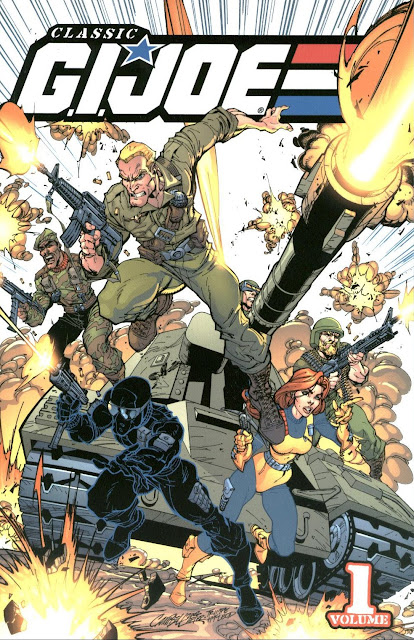
Classic G.I. Joe Volume 1 cover by J. Scott Campbell
My rundown of the graphic novels and TPBs I bought at Comic-Con concludes with two recent projects from IDW, which quickly became the comics publisher whose releases I've been looking forward to the most because of its ambitious reprints and high-quality revivals of properties like Star Trek and Doctor Who.

I picked up Classic G.I. Joe Volume 1 at the IDW booth because I was looking for a comic that veteran Marvel and DC letterer (and friend and mentor to several of us Secret Identities creators) Janice Chiang worked on and could sign for me at Comic-Con, and the TPB happened to contain an issue lettered by Janice. She then brought me over to another former Marvel letterer, Rick Parker, to have him sign the TPB because his work appeared in the collection too.

I never was an avid reader of Marvel's G.I. Joe comics, although I bought some issues of the mothership and a couple of its spinoffs when I was a kid. I was more familiar with the Sunbow animated series, which hasn't exactly aged well. Even when I watched G.I. Joe and Transformers back-to-back after school, I thought the animation on both those Sunbow shows sucked. The constantly choppy character movements made the crappy made-for-TV Popeye shorts from the '60s look like Richard Williams cartoons. Because the Sunbow series was essentially a 29-minute toy commercial (subtract one minute for the "Knowing is half the battle" PSA, which was devoted to giving safety tips or warnings about creepy guys in white vans instead of selling toys), most of G.I. Joe's episodes were forgettable and silly, except for one: the Steve Gerber-penned "There's No Place Like Springfield," an eerie two-part ep about Jack Nicholson's Shipwreck's awakening from a seven-year coma that was inspired by The Prisoner (Shipwreck's home address at "Number Six Village Drive" was a shout-out to that famously surreal show). The downbeat tone of the ep and the images of Shipwreck's wife, daughter and friends melting into grey goo blew my mind when I was a kid and scarred other kid viewers for life.

G.I. Joe #5 is essentially a 21-page ad for the toy line's MOBAT vehicle.
The Marvel comics were intended to sell toys too, but the writing in those comics tended to be much better than the writing on the cartoon, thanks to regular scripter and G.I. Joe action figure dossier writer Larry Hama, a real American hero, especially to Secret Identities contributors who dug that an Asian American was at the helm of Marvel's finest-written toy-based title (also the first comic ever advertised on TV). The Vietnam vet-turned-comics scripter's military expertise added authenticity and grit to the comics and kept them more grounded than the cartoon, where nobody died, Star Wars-style lasers replaced bullets and Cobra was about as dangerous and menacing as Colonel Klink and Sergeant Schultz. That's why the late Gerber's despair-filled "Springfield" was such a stunner back in 1985--the cartoon ditched its usually campy tone for once, added some much-needed menace to Cobra and incorporated a storyline from the comics, the Joes' discovery of a Cobra base disguised as an idyllic, all-American suburb called Springfield.
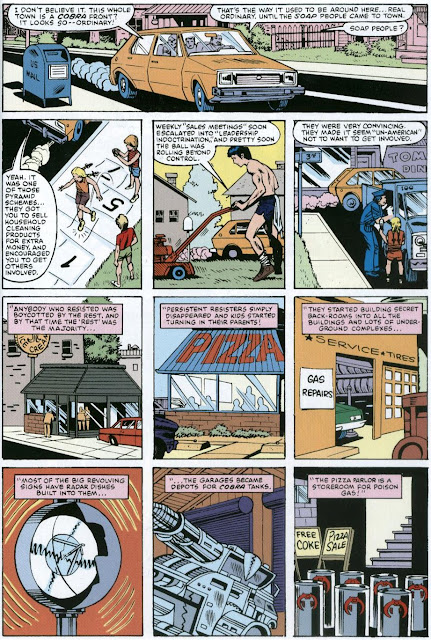
Larry Hama's deceptively nice suburb of Springfield beats David Lynch's equally deceptive Blue Velvet town of Lumberton to the punch by three years in G.I. Joe #10 by Hama, Mike Vosburg and Chic Stone.
The standout 1983 G.I. Joe issue that introduced Hama's Springfield--a town that's as rotten-at-the-core as Matt Groening's Springfield--is included in Classic G.I. Joe Volume 1, which collects the first 10 issues of the original 1982-1994 Marvel comic, most of them drawn by '70s Incredible Hulk artist Herb Trimpe in the classic '60s/'70s Marvel style. My tastes in espionage comics lean towards the more adult Queen & Country and Sleeper, so I found the dialogue in these early '80s G.I. Joe issues to be on the hokey side. Despite the hokey one-liners, as the Topless Robot blog noted last year, the original comic still kicks its cartoon counterpart's ass. Scarlett--the lone female Joe in these earlier issues, before Hasbro added Cover Girl and Lady Jaye to the cast--gets a bunch of thrilling take-charge moments in the 1983 issue that Janice lettered, a Mike Vosburg-drawn story in which Scarlett is assigned to protect a diplomat who's being targeted by Cobra (another highlight of the TPB, as well as one of the few issues in the collection that didn't involve either Hama or Trimpe).

I bet the old issues I read in Volume 1 even wallop the ass of G.I. Joe: The Rise of Cobra, which hired Hama as a creative consultant. I have no plans to watch the movie because it looks terrible and overly CGI'd in the TV ads (this was a much more expensive Paramount movie than Star Trek, yet they couldn't afford to get some decent-looking CGI that looks like 2009 CGI instead of 2002 CGI?). Director Stephen Sommers seems to have gotten the '80s toy lines-turned-cartoons mixed up. Exosuits?! (Or as the movie calls them, "accelerator suits"?!) That's Centurions, not G.I. Joe. The Funny or Die parody was better cast than the movie itself. Henry Rollins would have been a more charismatic Duke than Channing Tatum, whose acting coach was apparently a 3 3/4-inch Duke action figure. And what the hell is the very blond Sienna Miller doing playing the very dark-featured Baroness (who's portrayed in the Funny or Die spoof by a far more convincing-looking Olivia Wilde), and why was Miller directed to give the Russian villainess an American accent? To me, Miller will always be Eddie Arlette's prissy and spoiled British flatmate.

Judging from the ads, the only performer in The Rise of Cobra who's perfectly cast is Star Trek's scene-stealing Orion babe Rachel Nichols as Scarlett. She looks like she walked straight out of the issue that Janice lettered, which at one point has a shorty robe-clad Scarlett making a daring high-wire escape from an upper-story hotel window with her crossbow. The statuesque ex-Alias season 5 regular appears as if she were born to perform a sequence like that.
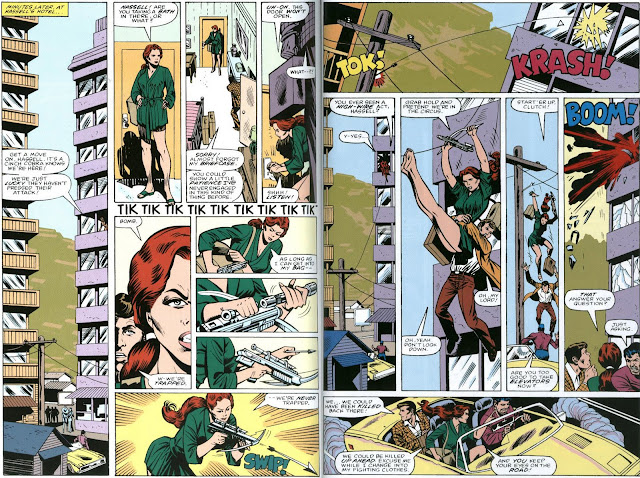
Nice stems, Scarlett. The crossbow-wielding hottie takes center stage in G.I. Joe #9 by Steven Grant and Mike Vosburg, with letters by Janice Chiang.
Speaking of destiny, artist Darwyn Cooke--a fan of the artwork on the '60s/'70s G.I. Joe action figure packaging--was born to bring his minimalist style to the late Donald E. Westlake's equally minimalist 1962 crime novel The Hunter, a book so nice moviemakers have filmed it thrice, as the badass Lee Marvin revenge flick Point Blank, the Chow Yun-Fat actioner Full Contact and the Mel Gibson vehicle Payback (the only one of the three loose screen adaptations of The Hunter I haven't watched, and that's partly because composer Chris Boardman's ripoff of David Shire's Taking of Pelham One Two Three main title theme indicates how tired and derivative Payback must be).

Mal Reese flashes back to the night he forced Lynn Parker to betray her husband in Darwyn Cooke's adaptation of The Hunter.
For those who have never read Westlake's original novel or watched either Point Blank, Full Contact or Payback, the brutal tale follows a ruthless career thief's vendetta against his former partners-in-crime, who left him for dead and screwed him out of his share of a successful heist. The vendetta escalates into a one-man battle against the mob, a.k.a. the Organization ("The funnies call it the Syndicate. The goons and the hustlers call it the Outfit."), as the crook, known simply as Parker, kills his way through the Organization's hierarchy to get back his skrilla.
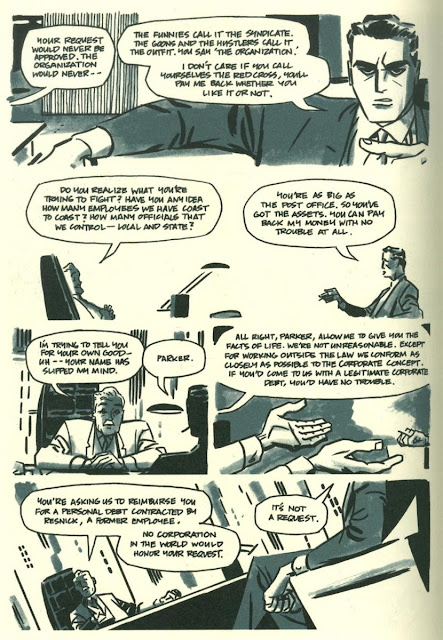
Parker strong-arms the Organization into handing over his money in The Hunter.
Under his Richard Stark pseudonym, Westlake wrote 24 novels featuring Parker--the original cold-blooded, unrepentant thief. Westlake's creation has clearly influenced so many similar thief characters in film and TV, particularly the protagonists in Michael Mann caper flicks like Thief. The climactic retribution that James Caan's self-made small businessman character unleashed against the control-freak boss who "owns the paper on his life" echoed Parker the similarly independent freelancer's confrontations with big business. Linda Fiorentino's Last Seduction antiheroine Bridget Gregory seemed to have inherited the Westlake character's amorality and relentlessness. Michael Westen, the blacklisted ex-spy and occasional safecracker in Burn Notice, inherited Parker's icy demeanor, professionalism and stubborn refusal to let a faceless, elusive corporation screw him over (in Michael's case, the shady character known only as "Management" and the nameless black ops organization that arranged to have Michael "burned"). Leverage co-creator John Rogers named Parker the possibly Asperger's-afflicted cat burglar chick after Westlake's equally antisocial thief. Parker has basically begat more offspring than Anthony Quinn.
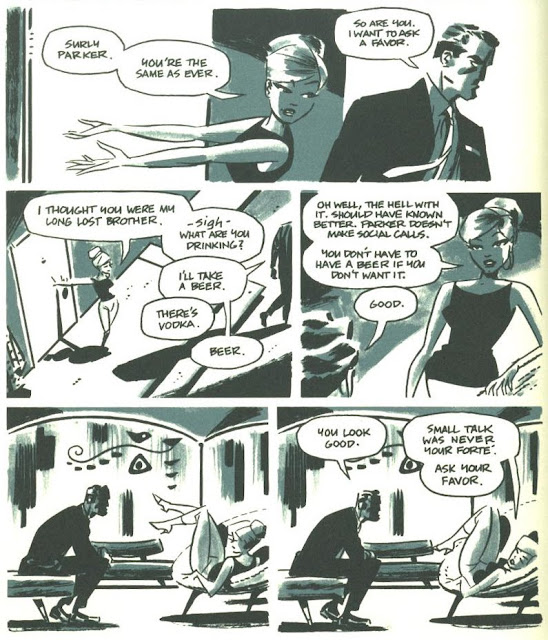
'Parker, you haven't changed a bit. You're just as warm and sociable as ever.'
Some readers have complained that Cooke's IDW adaptation of Westlake's first Parker story is overhyped. On what planet is this graphic novel overhyped? As a commenter on the Robot 6 blog noted, "In a world where Blackest Night is consuming 90% of the comics blogosphere's attention, this is overhyped?," but both Westlake's writing and Cooke's work have loyal cult followings, as evidenced by the slightly long line for Cooke's Hunter signing at the IDW booth--the only Comic-Con line I had the patience to stand in. I was lucky to nab a first-printing copy of The Hunter (wrapped in an exclusive Comic-Con dust jacket that I prefer over the regular white version of the jacket) before the hardcover novel sold out at its distribution level.
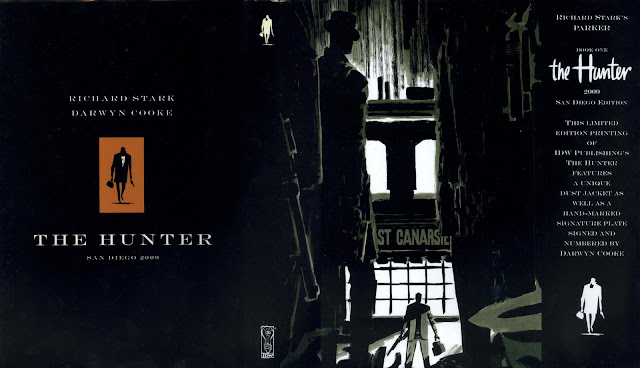
The Hunter's Comic-Con-only dust jacket is cooler than the jacket that's in bookstores now.
It's easy to see why The Hunter attracted a lengthy line that Friday, skyrocketed to #3 on the New York Times Graphic Books Best Seller List in its first week and is already on its way to a second printing. Cooke's spare, monochromatic and beautifully shaded artwork is extraordinary, whether it's visuals of sexy women or 1962 New York streetscapes. The DC: The New Frontier writer/illustrator told the L.A. Times that he intended his art in The Hunter to be as stripped-down as Westlake's prose, which was the crime author's experiment to see if he could tell a story without any emotional content and with an antihero who internalizes his emotions. The Cooke adaptation's first 16 pages are as coldly efficient as Parker himself. Cooke superbly establishes Parker's criminal skills and single-minded, amoral character without any dialogue. It's as ballsy an opening as the disorienting first few minutes of Point Blank.
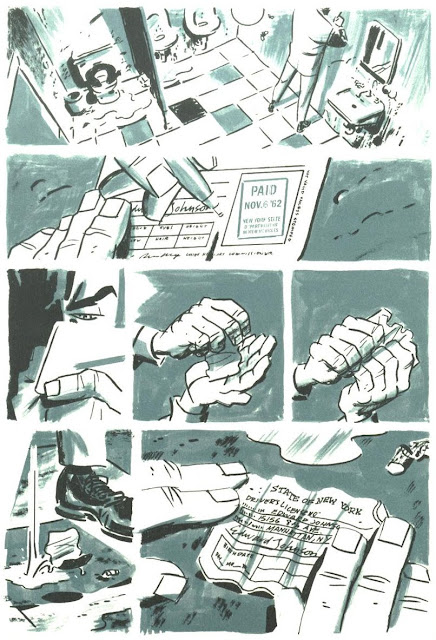
How to Forge a '60s Driver's License in Four Uneasy Pages
I never read the original source material, but the 1967 John Boorman film wowed me when I first saw it in university a decade ago, despite a puzzling ending that was initially frustrating (SPOILER: Patrick Duffy emerges from a shower and says "it was all a dream"). The Hunter doesn't quite do for crime comics what Point Blank did for '60s American crime flicks, which was revolutionize that genre with its fractured narrative and Euro art film-inspired sensibility. The Cooke version is just solid storytelling that makes the most of the strengths of comics as a visual medium, and like any good adaptation of a work from a different medium, it honors the source material without being overly reverential (for instance, Parker's resemblance to bodybuilder-turned-actor Edson Stroll, who played the leader of the exiled beautiful people in Twilight Zone's "Eye of the Beholder" ep, is quite a departure from Westlake's vision of Parker as a more rugged-looking Jack Palance type).

What does Parker want with Oprah's boyfriend?
I'm more acquainted with Cooke's animation and cover illustration work than his Catwoman and Spirit comics. The Hunter has made me want to check out more of Cooke's comics. These storyboards Cooke pencilled for Batman: The Animated Series' "Legends of the Dark Knight" homage to The Dark Knight Returns, which I've taken from Paul Dini and Chip Kidd's 1998 Batman: Animated coffeetable book, are Hunter-like in their intensity:

Batman: The Animated Series' 'Legends of the Dark Knight' storyboards by Darwyn Cooke and Glen Murakami
Westlake never granted Hollywood producers permission to use Parker's name in their adaptations of his novels because he would only allow them to retain the name if they agreed to do a series of Parker movies, and none of them had sequels on their minds (hence the name "Walker" in Point Blank, "McClain" in 1969's The Split and "Porter" in Payback). Cooke's novel is the first Parker adaptation in which Westlake gave the okay to use the name, possibly because Cooke planned on writing and drawing a four-volume series. Scheduled for summer 2010, Cooke's next Parker comic will adapt both The Man with the Getaway Face and The Outfit, which director John Flynn made into a solid 1973 Robert Duvall vehicle of the same title that's more straightforward than the stylized Point Blank, so it's blander in comparison, but it deserves as much notice as Boorman's movie (The Outfit isn't on DVD yet, although TCM occasionally broadcasts it).

Screw Avatar: The Next Whitewasher, The Twilight Saga: Emotards and the other unpromising blockbusters that are slated so far to hit theaters next summer. The one true blockbuster of summer 2010 will be found not in a multiplex, but in comic shops and bookstores.

Tuesday, 17 March 2009

Batman: Mask of the Phantasm score to get expanded reissue from La-La Land

Batman's got a bad case of propulsion envy.
Dammit, soundtrack labels, you need to stop releasing so many terrific score albums. My depleted-by-the-recession savings account can't take it.

I caught the following exciting bit of soundtrack news on the FSM Board:
La La Land will start taking orders on the following CDs next Tuesday, March 24 at 12 noon PST for the following titles:

BATMAN: MASK OF THE PHANTASM - score by Shirley Walker. This is the first release in our new line of EXPANDED ARCHIVAL EDITIONS. This cd features the complete score along with a few bonus tracks. It is limited to 3000 units. Retail Price: $19.98
And while we're at it, can we also get a Mask of the Phantasm special edition DVD with a remastered picture and a Batload of extras, like an Alan Burnett/Bruce Timm/Eric Radomski/Andrea Romano commentrak and the 1993 Mask of the Phantasm HBO First Look special that's currently on YouTube? Batman & Robin got better treatment on DVD for crying out loud.

Related posts:
"Batman: The Animated Series soundtrack: A Walker to remember"
"Five favorite expanded score albums or box sets of 2008"

Friday, 13 March 2009

About a Pinoy (Part 2)

Previously: Part 1.

Note: This is the second half of a bio I wrote about myself for my user profile at a Secret Identities: The Asian American Superhero Anthology creators' wiki on Wetpaint.com. I wrote this list a few weeks before I saw The Dark Knight, which would have wound up on the list had I seen the movie beforehand. Watchmen wouldn't have made the list though. I have mixed feelings about that film.(*)

---------------

5 FAVORITE SCREEN ADAPTATIONS OF SUPERHERO COMICS

'Harley and Ivy'
1. Batman: The Animated Series

Highlights: The revamped origins for Mr. Freeze and Two-Face, the early conflict between Batman and the police, the spectacular animation and Shirley Walker score during "Feat of Clay, Part 2," the Gray Ghost, "Harley and Ivy," Batman's hatred of It's a Wonderful Life, Kevin Conroy's performances in "Robin's Reckoning, Part 1," "Perchance to Dream" and "I Am the Night," the "death" of Batgirl, the Dark Knight Returns segment (and Joel Schumacher-bashing) in "Legends of the Dark Knight."

Worst moments: "I've Got Batman in My Basement," most of the episodes that were animated by AKOM (the worst of the many overseas studios that collaboed with Warner Bros. on B:TAS), Nightwing's mullet.

2. Batman Begins

Highlights: Wally Pfister's awesome cinematography, the realization during the Iceland-posing-as-Tibet sequences that this Batman wasn't going to be stagebound like the other films, Christian Bale's acting during the "party's over" speech, the excellent supporting cast, Jonathan Crane/Scarecrow's minimal dialogue, the lack of puns, "Do I look like a cop?!"

Worst moments: Why another love interest? Batman/Bruce has fuckbuddies, not soulmates. His one true love is his work.

3. Iron Man

Highlights: Robert Downey Jr.'s ad-libs, the Altman-esque dialogue, the performances by everyone in the cast, the character interplay, the evolution of the armor, Pepper saving Tony rather than the other way around, the final line before the closing credits.

Worst moments: Yinsen is essentially a rehash of the Magic Negro, despite a good performance by Shaun Toub.

Atom, you lucky motherfucker.
4. Justice League Unlimited

Highlights: The Cadmus arc, the sight of Batman trying to buy a cup of joe inside a coffeehouse to stay awake, the Justice Lords, the jabs at Bill O'Reilly, Green Arrow's evolution from skeptical outsider to team booster/conscience, the guest shots by Joss Whedon alumni, the Question's secret love for teenybopper music, the Ultimen, the sight of Wonder Woman tucking the Atom into her cleavage, the Superman/Captain Marvel battle, the writers' clever way of getting Michael Rosenbaum to temporarily play his own character from Smallville.

Worst moments: The Batman Beyond retcon, the mostly forgettable pre-Unlimited first season, the wonky CGI in the opening titles during the pre-Unlimited seasons, the absence of a B:TAS-style full orchestra.

5. Spider-Man 2

Highlights: Ock's hospital massacre, the fact that Peter has a crappy apartment, the J. Jonah Jameson scenes, the "Raindrops Keep Falling on My Head" montage, the el train sequence, Tobey Maguire doesn't cry too much in this one.

Worst moments: The Ock character was better fleshed out in Michael Chabon's early draft before it was script-doctored.

---------------

(*) During the sequence in which Dan Dreiberg gets a visit from the beans-craving Rorschach in his kitchen, the IMAX theater where I saw Watchmen experienced technical problems, and the projectionist had to stop running the film for about 15 minutes. The audience went apeshit, but they calmed down when the theater staff apologized and announced that they would offer re-admit passes to everyone at the end of the Watchmen screening. Luckily, the 15-minute interruption didn't ruin my enjoyment of the film.

Here are the things I love about Zack Snyder's adaptation of Alan Moore and Dave Gibbons' anti-superhero comic: the brilliant opening title sequence--the lesbian twist on the "V-J Day in Times Square" photo was the coolest and funniest part--and Jackie Earle Haley's fierce performance as the crazed Rorschach. I also think the film's modified climax works better than the rather screwy psychic squid master plan in the comic.


'Say hurm!'
But the film has pacing problems--it feels rushed, resulting in a film that plays like a two-hour-and-40-minute theatrical cut of a 12-hour network TV miniseries. For instance, you don't get enough of a sense of the impact of Veidt's actions, which Gibbons hauntingly captured in the final chapter of the comic. (Will the extended cut that Snyder has planned for DVD and Blu-ray rectify the pacing problems?) I also don't like the wonky CGI for Veidt's genetically engineered lynx Bubastis and some of the hackneyed music choices, like "Ride of the Valkyries" during Dr. Manhattan's attack on the Vietcong. The lack of Elvis Costello on the film's soundtrack--the comic quoted Costello's "The Comedians"--kind of bums me out.

I like what AICN's Alexandra DuPont says about the Laurie Juspeczyk character. DuPont always thought of Laurie as "Karen Allen feisty--you could see how she was the sort of fiery woman who would attract powerful men despite her '80s-coke-queen exterior." Had Allen been a couple of decades younger, she would have been a better Laurie/Silk Spectre than Malin Akerman, who's too young to be playing a world-weary ex-"costumed adventurer." Also, I would have preferred
Heroes' Jack Coleman as Dan/Nite Owl--he's the right age for Dan, plus Hollywood ought to hire Coleman, the best actor on Heroes, more often. But Patrick Wilson did a fine job and was more subtle than I expected as the washed-up, nerdy Dan.

God, I let this footnote go on too long. The end is nigh.

Wednesday, 31 December 2008

Five favorite expanded score albums or box sets of 2008

In this age of the cell phone, Metropolis no longer has phone booths that can double as changing rooms, so Superman is fucked.
5. Superman: The Music (Film Score Monthly)
This staggering eight-disc set compiles the scores from all four Christopher Reeve Superman movies and contains a beautifully designed mini-book filled with exhaustive liner notes. The expanded discs of the Ken Thorne scores from Supermans II and III were probably the main reason why Superman completists dove into savings that they otherwise reserve for their mortgage payments for their Luthor-owned condos in order to pay for this pricey set ($120!). I never liked Thorne's scores (the orchestra budget in II and III was clearly slashed, so Thorne's rearrangements of John Williams' music sounded tinny and undernourished). For me, the real previously unreleased gem of the set was the disc containing Ron Jones' energetic and underrated music from Ruby-Spears' decent '80s Superman animated series. Jones' Superman cues sound like the cues he later wrote for Star Trek: The Next Generation's "Best of Both Worlds" two-parter, which TNG showrunner Rick Berman reportedly disliked because he preferred the music on his show to sound boring.

Extraterrestrial ad agencies are so boring when it comes to ad design. They need someone like Salvatore from Mad Men to jazz up their shit.
4. They Live: 20th Anniversary Edition (AHI)
Obey. Consume. This expanded release of the bluesy score from John Carpenter's sharpest and cleverest post-Thing flick is your God.

This is black cowboy music right here, baby!
3. Blazing Saddles (La-La Land)
The only previous times any of the music from Blazing Saddles was made available were when Elektra/Asylum included three songs from Saddles on the 1978 High Anxiety soundtrack LP and when "I'm Tired" made its CD debut on Rhino's 1998 Warner Bros.: 75 Years of Film Music box set. The release of the cues from John Morris' short but fantastic score to the Mel Brooks classic--another one of my favorite movies--was long overdue. All the major cues are on there, including the Count Basie Orchestra's performance of "April in Paris," which is to black cowboy music what Jay-Z's "Roc Boys (and the Winner Is)..." is to black superhero music.

Shaft's Big Score car chase
2. Shaft Anthology: His Big Score and More! (Film Score Monthly)
FSM's Shaft set marked a couple of milestones: the first-ever release of the film versions of Isaac Hayes and J.J. Johnson's score cues from the first Shaft installment (the 1971 Enterprise/Stax soundtrack album was a re-recording) and the CD debut of Gordon Parks' Shaft's Big Score soundtrack. Though the release was actually sent to the pressing plant for manufacturing three weeks before Hayes' death, it ended up being the illest way to honor his memory.

Harley Quinn introduced millions of young Saturday morning viewers to the kid-friendly concept of Stockholm syndrome.
1. Batman: The Animated Series (La-La Land)
Unlike previous superhero cartoon shows, B:TAS didn't recycle the same four or five score cues or repurpose creaky old library music. Shirley Walker, one of the few female composers in the business, and her B:TAS team composed an original score for every episode. Their use of a full orchestra made other animated action shows look like that pathetic El Mariachi musician character who prefers a synthesizer over bandmates. Sadly, Walker didn't live to see the release of her lovingly crafted music from B:TAS (before her death in 2006, only her score from the Mask of the Phantasm spinoff movie was released). She would have been thrilled about La-La Land's two-disc set, which is dedicated to her and compiles scores from 10 B:TAS eps, including Harley Quinn's debut ep, "Joker's Favor" (pictured above). I've been a fan of B:TAS since its 1992 premiere, so I've waited 16 years for a release like this. I never said thank you, La-La Land. And then La-La Land will probably say the following in that Batrasp that sounds like a cross between a whitened-up Keak da Sneak and a Muppet: "And you'll never have to."

Thursday, 25 December 2008

Eartha Kitt (1927-2008): She was an awful good girl

Eartha Kitt (1927-2008)
Sheldon: That poster of Halle Berry is a little unnerving.

Howard: So don't look at it.

Sheldon: She's like my fourth favorite Catwoman.

Howard: No kidding.

Sheldon: Yeah, Julie Newmar, Michelle Pfeiffer, Eartha Kitt and then her.

Howard: What about Lee Meriwether?

Sheldon: Oh, I forgot about Lee Meriwether.

Howard: Well I'm glad that is settled.

Sheldon: That makes Halle Berry my fifth favorite Catwoman. It's Julie Newmar, Michelle Pfeiffer, Eartha Kitt, Lee Meriwether...

Howard: Please, I'm begging you. Go to sleep.

Sheldon: I'm trying. I'm counting Catwomen.

--The Big Bang Theory

Sheldon also forgot about Adrienne Barbeau (the voice of Catwoman on Batman: The Animated Series) and Gina Gershon (she assumed the role in 2004 on the imaginatively titled animated series The Batman). Sheldon's third favorite Catwoman, legendary "Santa Baby" singer Eartha Kitt, has died at 81 from colon cancer on the holiday that was the subject of her signature song.

Without Eartha Kitt, there'd be no Conan O'Brien.
Kitt was the purrrrrfect replacement for Julie Newmar when the statuesque dancer/actress was unable to continue playing Batman's most formidable female foe on the '60s series because she was busy filming MacKenna's Gold. No other Catwoman could purrrrr or grrrrrowl like Kitt did. How fitting that the role was assumed by someone named Kitt.

Who can forget when Kitt purred one of the greatest lines in an Eddie Murphy movie that weren't spoken by Murphy ("Marcus, darling... I don't have any panties on...")?

Kitt led an amazing life. She was a civil rights activist who was blacklisted for criticizing the Vietnam War and its negative effect on minorities and more recently, she expressed her joy over Senator Obama's rise as a presidential candidate ("It's one of the most wonderful things that can happen to this country") and supported her countless gay fans on the issue of same-sex marriage.
She goes on to say that the gay marriage issue is similar to what African-Americans experienced during the time of the Civil-Rights Movement. "We were not allowed to go through certain doors because of our race, our color," she says intensely. "It was so stupid that we were not able to sit at the counter of a restaurant because it was only for Anglo-Saxons. It's stupid when this country says it was born on "freedom for all," but it's "freedom for some"!
This Christmas is a bittersweet one due to the news of her passing on the day when she suggestively invited Kringle to "come and trim my Christmas tree." I usually get creeped out by songs that try to sex up Santa like he's the hero of a Judd Apatow movie, but Kitt's rendition of the frequently covered "Santa Baby" is awesome. Her version was the first version and it's still the sultriest.

Sunday, 21 December 2008

AFOS: "Yule Log" playlist

Happy holidays.

This week, I'm streaming the 2005 Fistful of Soundtracks: The Series episode "Yule Log" (WEB71), which consists of music from holiday-related movies and Christmas TV specials.

This is a reedited version of "Yule Log." I removed from the episode a Crash score cue by Mark Isham and a Family Stone score cue by Michael Giacchino and replaced them with Shirley Walker's cues from Batman: The Animated Series' "Christmas with the Joker" episode. The "Christmas with the Joker" tracks are part of La-La Land Records' new two-CD B:TAS set, the perfect Christmas present for anyone who's a B:TAS fan.

Ep WEB71 airs Monday and Wednesday at midnight, Tuesday and Christmas Day Thursday at 4am, 10am, 3pm, 7pm and 11pm, and Saturday and Sunday at 7am, 9am, 11am, 1pm, 3pm and 5pm.

'It's my way or the highway, this Christmas at my bar/I'll have to smash your kneecaps if you bastards touch my car!'
1. Danny Elfman, "What's This?," The Nightmare Before Christmas, Walt Disney
2. Vince Guaraldi Trio, "Christmas Time Is Here (vocal)," A Charlie Brown Christmas, Fantasy
3. Cowboy Timmy, "Mr. Hankey the Christmas Poo," Mr. Hankey's Christmas Classics, American/Columbia
4. Joel, Crow and Tom Servo, "(Let's Have) A Patrick Swayze Christmas," Clowns In The Sky Vol. 1, Best Brains, Inc.
5. Paul Reubens, Catherine O'Hara and Danny Elfman, "Kidnap the Sandy Claws," The Nightmare Before Christmas, Walt Disney
6. Michael Cohen, "The Hebrew Hammer Theme" (from The Hebrew Hammer), thehebrewhammer.com
7. Danny Elfman, "Introduction (Titles)," Edward Scissorhands, MCA
8. Badly Drawn Boy, "I Love NYE," About a Boy, ARTISTdirect/Twisted Nerve/XL/BMG
9. John Ottman, "The Fair/Main Titles," Kiss Kiss Bang Bang, La-La Land
10. Michael Kamen, "Gruber's Arrival" (from Die Hard), Varèse Sarabande: A 25th Anniversary Celebration, Varèse Sarabande
11. Thurl Ravenscroft, "You're a Mean One, Mr. Grinch" (from How the Grinch Stole Christmas), How the Grinch Stole Christmas & Horton Hears a Who!, Turner Classic Movies Music/Rhino Movie Music
12. Dick Shawn, "Snow Miser" (from The Year Without a Santa Claus), A Classic Cartoon Christmas, Too, Nick at Nite/Sony 550 Music/Sony Wonder
13. George S. Irving, "Heat Miser" (from The Year Without a Santa Claus), A Classic Cartoon Christmas, Too, Nick at Nite/Sony 550 Music/Sony Wonder
14. Shirley Walker/Lolita Ritmanis/Michael McCuistion, "Nutcracker Suite Medley" (from "Christmas with the Joker"), Batman: The Animated Series, La-La Land
15. Shirley Walker/Lolita Ritmanis/Michael McCuistion, "Pie in Batman's Face/Dangling Hostages Saved/Deck the Halls" (from "Christmas with the Joker"), Batman: The Animated Series, La-La Land
16. Badly Drawn Boy, "Donna and Blitzen," About a Boy, ARTISTdirect/Twisted Nerve/XL/BMG
17. Mick Jagger and Joss Stone, "Lonely Without You (This Christmas)," Alfie, Virgin
18. Leon Redbone & Zooey Deschanel, "Baby It's Cold Outside," Elf: Music from the Major Motion Picture, New Line

Now playing on the Fistful of Soundtracks channel:

Wednesday, 17 December 2008

Batman: The Animated Series soundtrack: A Walker to remember

Batman fires his grappling hook and pisses off the Five-0 in the Batman: The Animated Series pilot episode 'On Leather Wings.'
As a fan of Batman: The Animated Series, I've waited 15 years for the score cues from the groundbreaking show to be released on an album. Now the wait is finally over, thanks to La-La Land Records' Batman: The Animated Series score compilation, which the label released as a limited edition two-CD set on Tuesday (a week after Warner Bros. Records double-dipped the Dark Knight soundtrack with additional score cues). I'll be adding some of the music from La-La Land's release to rotation on A Fistful of Soundtracks' "Assorted Fistful" block.

Modeled in tone after Tim Burton's somber-looking, dark-humored Batman films but much more faithful to the comics, Bruce Timm's B:TAS was the first American superhero cartoon show that felt cinematic. B:TAS writer/producer Paul Dini, who scripted the landmark, Emmy-winning Mr. Freeze revamp "Heart of Ice," says in the soundtrack liner notes that the show's crew constructed each episode like a mini-movie.

The B:TAS crew must have heard Peter Bogdanovich's anecdotes about how Samuel Fuller mentored him during the making of the low-budget 1968 thriller Targets ("Never think about limitations! Only think about what you want!") because like Fuller, they clearly didn't let a TV budget stop them from doing what they wanted. They brought a cinematic approach to everything, from the way they paced the dialogue--B:TAS' minimal and terse dialogue was different from other superhero cartoons, especially the '90s Marvel shows, like Saban's X-Men and Marvel Films Animation's Spider-Man, which had nonstop, hurriedly delivered, Speed Racer-ish dialogue--to the original score music. Unlike past superhero cartoons, B:TAS didn't recycle the same four or five score cues or repurpose creaky old library music. Shirley Walker and her team of B:TAS composers, which included Lolita Ritmanis and Michael McCuistion, composed an original score for every ep and used a full orchestra at a time when most other animated action shows relied on chintzy-sounding, cost-saving synthesizer music.

Danny Elfman's B:TAS main title theme, a reworking of his own brooding and dashing-sounding main theme from the Batman movies, set the tone for the show's "dark swashbuckler" sound. Walker, who conducted Elfman's 1989 Batman score and worked for him as an orchestrator, wrote a new eight-note theme for the Batman character that sounds equally thrilling and kickass. It eventually supplanted Elfman's theme in the opening titles when Warner Bros. Animation made B:TAS into a feature film (Batman: Mask of the Phantasm) and then brought the show back to the airwaves under a new title, The Adventures of Batman & Robin.

Walker and her composers crafted a different motif for each villain. Mr. Freeze was accompanied by a mournful waltz (which can be heard during the 14-minute "Gotham City Overture," track 1 on the first disc), Two-Face was represented by an eerie soprano recorder melody ("Harvey's Nightmare/Dent's Soap Box" and "Bruce Wayne's Nightmare/Two-Face Remembers"), and the Penguin received a lumbering brass theme to match his bluster ("Birds of a Feather").

The Joker is such a beloved adversary that Walker gave him not just one but two motifs, a carnival-style melody and a secondary "Fanfare for Rocky"-style crime spree theme that was used only during the "Last Laugh" ep. The liner notes refer to the Joker's "Last Laugh" crime spree theme as "a hip-hop jazz theme," but it doesn't really sound like hip-hop. It's a middle-aged white person's idea of what they think a hip-hop beat sounds like. As an FSM Board poster says, it's more rock/funk than hip-hop. Still, Walker's "Last Laugh" theme is a lot of fun, and like all the other cues, I'm jazzed to finally have it on disc.

La-La Land Records' Batman: The Animated Series soundtrack coverAfter a solid film and TV score career that saw her alternating between the Timmverse and James Wong/Glen Morgan productions (Space: Above and Beyond, Final Destination), Walker died in 2006 and didn't live to see her B:TAS material get the kind of release that La-La Land has devoted to it. Though this release is loaded with over two hours of music, it's missing Walker's memorable Catwoman theme from "The Cat and the Claw, Part I," the first B:TAS ep that ever aired, Carl Johnson's lively score from the excellent "Beware the Gray Ghost" ep with special guest voice Adam West, and McCuistion's Lawrence of Arabia-style epic score from the "Demon's Quest" two-parter, which gives me hope about a Volume 2 from La-La Land.

The final track on the La-La Land album is a fitting tribute to Walker, in which she gets to finally speak, via an archival recording of her explaining her eight-note Batman theme and playing it in different variations on the piano. The subtle differences between each variation--like when Walker alternates between a somberly played second half of the theme and a more uplifting second half--are incredible. They show how much care was put into the music and the show itself.