Your friends do it and you've probably done it too: catch up on a show your lazy ass has put off watching by setting aside an entire weekend to view the DVD box set in one marathon sitting. Back when
24 first hit the DVD market, various writers who missed the first season chose to catch up with the show on DVD and recapped in real time what it was like to watch the first-season discs in one sitting, while a writer I used to work with picked the '80s version of
The Twilight Zone for his weekend DVD marathon. A couple of years ago, those writers inspired me to do a similar marathon thing with the box sets of another cult show:
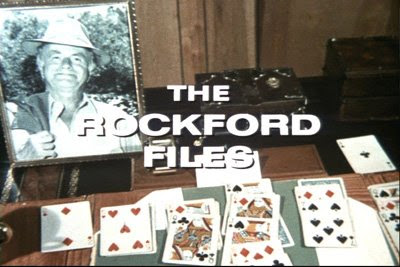
The Rockford Files, Stephen J. Cannell's clever reinvention of the private eye genre, which starred James Garner in his signature role as rugged everyman gumshoe Jim Rockford.
Alright, so it's not quite a marathon. I haven't even viewed all 123 episodes yet, but my goal is to eventually see them all on DVD or via Netflix's media player for PC users. As of this writing, I haven't reached season five yet. On Inauguration Day Tuesday, Universal Studios Home Entertainment will release
Rockford's sixth and final season.
I picked
Rockford because I was a fan of
Veronica Mars (which starred one of the world's hottest-looking
Star Wars geeks,
Forgetting Sarah Marshall's Kristen Bell, who should have Jedi mind-tricked the CW assclowns into bringing back her show). Before I started renting the
Rockford DVDs from Netflix, I had only caught
Veronica's spiritual granddaddy once or twice on cable, so I wanted to better acquaint myself with
Rockford on DVD, where it's uncut and commercial-free (on Hulu, it's not commercial-free). The older the series, the more it gets chopped up by syndicators to accommodate commercial breaks, which grow annoyingly longer with each passing year. So that must mean
Adventures of Superman reruns will eventually be edited down to 10 minutes, and George Reeves' flying sequences will be sped up so badly it'll look like the Metropolis underworld slipped some crank into the
Daily Planet watercooler.
Rockford still draws a cult that's pretty rabid, though not quite as huge as
Veronica's online fanbase. Slackers like the main character's pal in Ben Folds Five's
"Battle of Who Could Care Less" (the source of the title of this post) dig
Rockford reruns because Jim is one of them. They identify with a hero who'd rather go fishing with his father Rocky (Noah Beery) than do his job. The fans who still visit
the alt.tv.rockford-files newsgroup continue to exchange favorite Garner wisecracks, and a couple of fan sites list every wacky message Jim received on his answering machine during the opening credits.
On disc,
Rockford has aged better than most '70s shows, thanks to quirky, sharp and timeless scripts penned by staff writers like Cannell, future
Sopranos creator David Chase and Juanita Bartlett. Seventies TV comes in three modes: schlocky (the Krofft variety shows, anything with
Glen A. Larson's name on it), sanctimonious (
M*A*S*H, Norman Lear's shrill shoutcoms) or a hideous mash-up of both (
Hawaii Five-0, the "Fonzie gets a library card" era of
Happy Days).
Rockford is one of the few '70s shows I've seen that's neither of the above, and whenever the series did address a serious issue--like the flaws of the grand jury system in its most celebrated ep, the Bartlett-scripted
"So Help Me God"--it did it with class and zero preachiness.
If
Rockford were made today, it would be a perfect fit for USA's Thursday or Friday night lineup, alongside equally easygoing, character-driven detective shows like
Burn Notice,
Monk and
Psych. But when
Rockford first aired in 1974 on NBC, a comedic detective drama was considered an oddity and a huge risk. Part of
Rockford's charm was how it subverted hard-boiled gumshoe genre clichés (Rockford would always hurt his fist after punching somebody, he had an answering machine instead of a sexy secretary, he worked out of a rundown mobile home on the Malibu beach instead of an Art Deco-ish office in downtown L.A., etc.).
However, NBC found the tongue-in-cheek humor to be off-putting and wanted
Rockford to be dead-serious like its ratings competition at the time, the
CSI: Miami of the '70s, the stiff and banal
Hawaii Five-0, so they tried to interfere with the show's tone, resulting in an uneven first season (although season one has a few winners, like
the "Profit and Loss" two-parter that pits Rockford against corporate fraud).
Network interference ruined the second half of
Veronica's third and final season (
Veronica worked better as a serialized whodunit than as the case-of-the-week procedural it seemed to be morphing into in its last few eps). Decades before, that same predicament could have destroyed
Rockford, if it weren't for its defiant lead actor and his fierce protectiveness of the show's crew (Cannell once told an interviewer that Garner was one of the most polite and gracious actors he ever worked with, which made the
Rockford set a more pleasant workplace for Cannell than the
Baretta set, where Robert Blake behaved like a douchey little anti-Garner). In season two, Garner stood up for the showrunners--just as Rockford would valiantly do for his beleaguered clients, even if they stiffed him--and threatened to walk if NBC continued to tinker with the scripts. The network wisely realized you don't piss off Jim Rockford (something that eluded Universal, which later got itself embroiled in endless legal disputes with Garner), so it left the showrunners alone, and the Malibu P.I. who famously charged "$200 a day, plus expenses" stayed in business for four more years.
Here are five reasons why The Rockford Files are always worth reopening, despite the lack of substantial DVD extras (c'mon Universal, step your game up).1. The Rockford Reverse 180 is one of the coolest car chase maneuvers ever. Plus, Garner--star of
Grand Prix and a car-racing enthusiast--did his own stunt driving, and he never filmed his Pontiac Firebird sequences in front of a blue screen, unlike other '70s shows with car chases (I'm looking at you,
Dukes of Hazzard). If you forgot how to execute a Reverse 180 (also known as the J-turn, or as it's more commonly called today, "the Rockford"), which would come in handy whenever goons would corner Rockford in his Firebird, Jim would put his car in reverse, make a sweet 180 degree turn, and then drive off into the opposite direction--and the Car Chase Hall of Fame.
Here's a list of eps in which Rockford does the Reverse 180 (and when to skip to it on your DVD player). You could start a drinking game with this.
"Gearjammers (Part 1)" (season two): 00:22:19.
"The No-Cut Contract" (season two): 00:09:50.
"Foul on the First Play" (season two): 00:40:07.
"Return to the 38th Parallel" (season two): 00:28:02.
"Sticks and Stones May Break Your Bones, But Waterbury Will Bury You" (season three): 00:20:12. What makes this Reverse 180 particularly amusing is that Rockford smiles and waves at the bad guys before reversing.
"To Protect and Serve (Part 1)" (season three): 00:43:08.
"Second Chance" (season four): 00:22:16. Rockford drives into a dead-end alley, does the Reverse 180 and then cleverly pushes the Firebird into a trash bin so that he can crash the bin into the goons' car. There's also a blooper. The close-up shot of the right front tire as he drives in reverse is incorrect. It shows the Firebird going forward instead of in reverse. Aw, don't you just love rushed-into-broadcast '70s TV and its continuity errors?
"White on White and Nearly Perfect" (season five): 00:37:03. Instead of doing the Reverse 180 in the middle of a chase, Rockford does it while stealing a car to stake out the bad guys.
2. Trace how Rockford evolved in its first three seasons. Most of our favorite shows start off strongly and then gradually decline in quality, but
Rockford was the opposite. It got better as it went along. Season one tended to meander--you could tell the writers ran out of material if the car chase that week went on for an eternity. Season two was a slight improvement, but it lost points with viewers because they got sick of seeing clients take advantage of Rockford week after week, and they preferred it when their hero was the smartest guy in the room, not the dumbest.
Season three saw less of the pacing problems and repetitive Rockford-gets-played-again eps that plagued the first two years. For most fans, this is the season when
Rockford hit its stride. It's also the year when David Chase joined the writing staff. Chase, who previously wrote for
Kolchak: The Night Stalker, contributed exceptional eps like "Quickie Nirvana," "To Protect and Serve" and "Sticks and Stones May Break Your Bones, But Waterbury Will Bury You."
If you're a
Sopranos fan who's unfamiliar with Chase's earlier work on
Rockford, his eps are especially worth checking out because they hint at the brilliant melding of humor and angst he would later perfect on the mob opera. My favorite Chase-penned
Rockford ep is "Waterbury Will Bury You," a riff on Watergate. The "Waterbury" of the title is a corporate P.I. firm that eliminates the competition--smaller P.I. businesses like Rockford's--by causing the detectives to lose their licenses. The playful references to political scandal is a Chase trademark that seeped into
The Sopranos, most memorably during its final season, when Uncle Junior, institutionalized after shooting Tony, writes a letter to Dick Cheney: "Like yourself, I was involved in an unfortunate incident when a gun I was handling misfired..."
3. A great cast of supporting players backed up the superb Garner. Occasionally, Rockford's case of the week would be on the mundane side, but one particular element of the show was never dull: the character interplay. The core of the series was Rockford's richly drawn relationships with Rocky; Sgt. Dennis Becker (Joe Santos), his only friend on the police force; Angel (Stuart Margolin), a weaselly, love-him-or-hate-him ex-cellmate; and lawyer and on-and-off girlfriend Beth Davenport (Gretchen Corbett, the thinking man's '70s hottie, like Jan Smithers on
WKRP).
The
Rockford staffers also clearly had fun writing for characters of color, who rarely got to shine in the crime show genre in those days (Huggy Bear doesn't count). Cannell created memorable, nuanced characters who were the opposite of "scared brother on a police show," that hilarious category from
In Living Color's classic "Black People's Awards" bit. Rockford crossed paths with the likes of parole officer-turned-P.I. Marcus "Gabby" Hayes (Garner's
Skin Game co-star Louis Gossett Jr.), whose affinity for lavish expenses irritated Rockford the Jack Benny-esque cheapskate, and ex-felon Gandolph "Gandy" Fitch (the late Isaac Hayes), whose signature quirk was to still call Rockford by what must have been his prison nickname, "Rockfish." If you only know Hayes for his Chef character on
South Park, then the second-season fan favorite
"The Hammer of C Block," in which Gandy searches for the person who framed him 20 years before for the murder of Gandy's girlfriend, will be a revelation because of Hayes' dramatic turn.
Cannell even tried using
Rockford as a launching pad for a show concept that was considered more outlandish than a comedic detective drama: an action drama anchored by two African American leads. The concept is still deemed a risky venture by the networks, which appear to be more comfortable with having all-black casts in sitcoms rather than dramas. Whenever a drama with a predominantly ethnic cast does make it to the schedule, the network either fails to promote it or tinkers with it so much that it ends up being unappealing to viewers of any race (exhibit A: the heavily watered-down
Shaft TV series). But the failures of the small-screen
Shaft and two other '70s detective shows with black leads,
Get Christie Love! and
Tenafly, didn't stop Cannell from pairing up Gabby the sharp-dressed smoothie with Gandy the hotheaded ex-thug in 1977's
"Just Another Polish Wedding," which served as a backdoor pilot for a Gabby and Gandy spinoff that, of course, never got off the ground. It's a shame we never got to see Gossett and Hayes together again because they played well off each other, like during a raucous sequence in which Gabby and Gandy stumble into a neo-Nazi bar. Five years later, Eddie Murphy found himself in a similar jam in
48 Hrs. and trash-talked his way into movie history. But Gossett and Hayes did the intimidate-a-dive-full-of-racists thing first on
Rockford.
4. See where Keith Mars and his daughter Veronica inherited their sense of humor and disdain for upper-class arrogance. We never knew if Keith's parents were still alive, but his unseen dad must have been Rockford himself or a Rockford type. Veronica has often been compared to Nancy Drew, which is silly because snarky Veronica has more in common with the equally sardonic, ramshackle Rockford than with Nancy the earnest preppie chick.
- Rockford adored his trucker dad; Veronica adored her dad, a P.I. and former sheriff of Santa Cruz-like Neptune, California.
- Rockford worked hard to restore his reputation after doing a five-year bid in San Quentin for a robbery he didn't commit. Veronica worked hard to restore her reputation (and help Keith pay the bills) after being ostracized and humiliated by the 09ers--the wealthy douchebags in Neptune--because Keith accused an 09er of murder.
- Rockford often found himself protecting his clients from rich bullies like the "Fiscal Dynamics" CEO played by Ned Beatty in "Profit and Loss," an interesting precursor to the corporate bigwig Beatty would portray in
Network two years later. Veronica had to put up with her 09er classmates almost every week.
- Rockford didn't get along with the cops, except for Sgt. Becker; Veronica didn't get along with the self-centered, incompetent Sheriff Lamb.
- Rockford was jealous of suave, sharp-dressed rival sleuth Lance White, played by a pre-
Magnum Tom Selleck. Mars Investigations' main rival was lowlife detective Vinnie Van Lowe (Ken Marino, in a scene-stealing role originally written for Marino's
Wet Hot American Summer co-star Paul Rudd), who craved publicity like White but was hardly as refined--his collection of Members Only jackets rivaled Richie Aprile's.
- Rockford concocted undercover identities like the folksy oilman "Jimmy Joe Meeker;" so did Veronica. (Kristen Bell has a knack for goofy voices and accents. Also peep her killer Russell Brand impression in
Forgetting Sarah Marshall. Bell has a future as a cartoon voiceover actor.)
- Rockford hated violence. He carried an unlicensed gun but rarely used it ("I don't shoot it, I just point it"). Veronica also didn't have the stomach for fighting. She relied on either a taser or her pitbull Backup to fend off thugs and frat-boy douches. (One of the reasons why I love
Veronica Mars is because creator Rob Thomas resisted making his heroine a clichéd butt-kicking babe, unlike all the other producers who have tried to clone
Buffy and suck at it.)
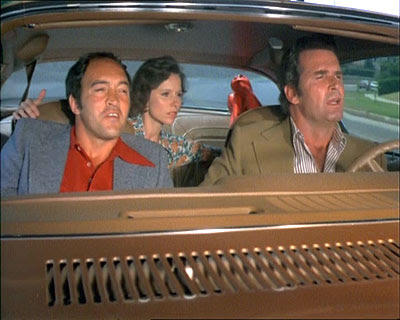 5. Rockford is also the spiritual granddaddy to the grifter heroes of the BBC/AMC hit Hustle. Plus, who can resist an unlikely hero helping the downtrodden?
 Before
Hustle and its clones (like NBC's short-lived
Heist) came along, TV rarely allowed con artists to be heroes. The networks used to be run by puritanical killjoys who wanted prime-time protagonists to always be good, upstanding citizens who "drink their school, stay in drugs and don't do milk," as the Robert Smigel version of Mr. T would put it. Though Rockford did drink his milk and was often seen enjoying a glass with the Oreos that shared cookie jar space with his gun, he was a unique TV detective hero because of his ex-con past and reliance on conman tricks like fake aliases and phony business cards he made from a mini-printing press he kept in the back of his Firebird. Rockford's roguish nature flew in the face of the straight-arrow Jack Webb/Jack Lord vision of crime show heroism. (Garner's lovable outsider was a modern-day variation on the actor's Wild West conman persona Bret Maverick, who was also conceived by
Rockford co-creator Roy Huggins.)
The
Hustle characters must be fans of the second-season ep
"The Farnsworth Stratagem," in which Sgt. Becker and his wife seek Rockford's help after they're tricked by condo developers into buying outrageously overpriced property. Posing as oil magnate "J.W. Farnsworth," Rockford turns the tables on the mob-connected developers by having an oil-drilling rig constructed right in the middle of their property.
Speaking of Southern California scams involving real estate, a couple of years before the foreclosure crisis hit the rest of America, several Orange County homeowners wound up homeless or broke due to "foreclosure rescue" scams.
If only those former homeowners had Rockford by their side.


