Showing posts with label Jerry Goldsmith. Show all posts

Friday, 20 August 2010

Scott Pilgrim's precious little logo

Scott Pilgrim and Ramona Flowers cosplayers
(Photo source: "The 30 Best IRL Ramona Flowers")
Like the "Sundance Curse" on indie films that take the festival by storm and then tank outside Park City, there seems to be a Comic-Con curse on films that garner enormous buzz within the halls of the San Diego Convention Center and then somehow fail to interest non-geeks when they hit theaters. Unfortunately, Edgar Wright's Scott Pilgrim vs. the World is the latest blockbuster to join that list of films that flopped after the SDCC hype (they've included Grindhouse and The Spirit).

It's unfortunate because Scott Pilgrim, a perfect marriage of source material and director, is in no way a two-hour piece of fecal matter like most of those other flops, due to Wright's respect for--and enhancement of--Bryan Lee O'Malley's material and inventive gags like what has to be the most amusing cover of the Universal logo music to ever open a Universal picture.

Not the Scott Pilgrim version of the Universal logo, of course. To get a picture of that 8-bit logo, I'd have to take a cell phone camera to the theater, and like the script for Vampires Suck, my camera doesn't work.O'Malley's creation is partly influenced by 8-bit video games, so legendary Radiohead producer Nigel Godrich redid Jerry Goldsmith's Universal fanfare in 8-bit form. It accompanies an NES-style version of the Universal globe that's as charmingly pixelly as all those title screen graphics that would open NES games I used to play as a kid. The enthusiastic audience that was treated to an advance Scott Pilgrim screening at Comic-Con went so wild over this opening gag that a Wired blogger couldn't even hear the drowned-out 8-bit logo music and wondered in his post if the opening piece was the Legend of Zelda theme. The redone fanfare also opens Godrich's digital-only Scott Pilgrim score album.

Another studio logo music parody I like is the J.B.'s-style cover of the 20th Century Fox fanfare at the start of White Men Can't Jump (one of many instances where a Fox release spoofed the fanfare--another example was Alien³). Alfred Newman never sounded so funky.

Monday, 17 August 2009

The Judge Dredd trailer music is like Jerry Goldsmith's two-minute Ramones song

In this 1999 photo, Jerry Goldsmith tells a UCLA film music class that if you ever run into one of those record company execs who are responsible for those 'Music from and Inspired by...' collections of songs that aren't even in the movie, feel free to kick the shit out of him.
I included the Royal Scottish National Orchestra's out-of-print performance of the late film music legend's kickass theme for the much-maligned 1995 Judge Dredd feature film's trailer in one of this month's A Fistful of Soundtracks mini-playlists. I've also cobbled together the trailer theme and some photos of Goldsmith at work as a conductor for my not-so-active YouTube channel--it's the first video I ever made on Adobe Premiere, which I've used since 1999 to edit together anything I record for AFOS. At under a minute, the hard-hitting, energetic theme is way too short. A film composer who's got the brass ones to tackle Goldsmith ought to take this too-brief Goldsmith masterpiece and write an expanded concert version.

Most listeners' first exposure to the Judge Dredd trailer theme was the trailer itself, but I first noticed the theme when it was used in the 1997 Lost in Space teaser trailer, where it wasn't drowned out so much by gunfire noise and a shouty Sylvester Stallone that you could barely hear Goldsmith's music.

Tuesday, 23 June 2009

Five definitive Star Trek cues

Space hippie instruments furnished by Fat Albert and the Cosby Kids.
I was hoping a May 21 post about my unpublished 2007 wish list for J.J. Abrams' Star Trek prequel or reboot or preboot or whatever would be my last Trek-related post for a while. No dice.

A Film Score Monthly blogger recently posted a list of five Trek score cues that best sum up or represent the venerable franchise. It's a nice list--it's cool to see Gerald Fried get some love, and though I still think the nearly wordless Star Trek: The Motion Picture travel pod sequence (in which Admiral Kirk looks like he wants to take his own starship behind a Spacedock and get her pregnant) is overlong, it's hard to dispute the post's argument that the pod sequence contains one of Jerry Goldsmith's most sublime moments as a film composer. The list inspired me to post my five favorite cues from the franchise and stream a block of these five tunes on the Fistful of Soundtracks channel all through August.

1. Charles Napier, "Heading Out to Eden," Star Trek ("The Way to Eden")
This "Way to Eden" number is one of Trek's proudest musical moments.


2. Charles Napier, "Hey Out There!," Star Trek ("The Way to Eden")
This other "Way to Eden" highlight is such a poignant expression of Gene Roddenberry's philosophy of IDIC (Infinite Diversity in Infinite Combinations).


3. Charles Napier, "The Good Land," Star Trek ("The Way to Eden")
Aw, Trek, you can do no wrong.


4. Kirk Thatcher, "I Hate You," Star Trek IV: The Voyage Home
This touching melody was written and performed by a Trek IV visual effects PA who was promoted to associate producer and even got to appear onscreen as a mohawked miscreant Earthling during the playing of his own composition.


5. Bruce Hyde, "I'll Take You Home Again, Kathleen," Star Trek ("The Naked Time")
Not a dry eye in the house.

Alright, I'm kidding.

Not exactly a shining moment in the career of legendary female Trek scriptwriter D.C. Fontana (who hid behind an even more male-sounding pseudonym for the heavily rewritten "Way to Eden"), Trek's atrocious space hippies episode is proof that network TV series writers in their 30s or 40s aren't the best people to turn to when you need someone to capture the pulse of the counterculture.

"I Hate You" is such an ersatz punk tune Avril Lavigne mistook it for the real thing.

It's funny that Thatcher complained about the inaccurate sound of the music that was previously selected for the Trek IV bus scene because lyrics-wise, the song he contributed ended up sounding only slightly more authentic. A real punk band would never say "Screw you!" like Thatcher's "Edge of Etiquette" did during "I Hate You."

Seriously, here are my actual five definitive Trek cues.

The heat from those soundstage lights must be killing Kirk.
1. Gerald Fried, "The Ritual/Ancient Battle/2nd Kroykah," Star Trek ("Amok Time")
Fried would bristle whenever the show would recycle cues like what I think is his crowning achievement, the piece that launched a million Trek music parodies ("Sometimes, I thought it was ludicrous what they did [to keep the series' music budget down], and sometimes, I think, 'Well yeah, alright, it sort of works.'"), but after the show's post-network success, I bet he's been touched by how much recognition and spoofage his catchy fight theme receives.

2. Sol Kaplan, "Kirk Does It Again," Star Trek ("The Doomsday Machine")
Oh, so that's where John Williams got his Jaws theme from.


3. Jerry Goldsmith, "Spock Walk," Star Trek: The Motion Picture
The cue that best captures the cerebral and mysterious feel of The Motion Picture isn't the rousing but somewhat out-of-place main title theme. It's the eerie "Spock Walk," which accompanies the movie's only genuinely thrilling sequence (besides the still-dazzling opening shot of the Klingon armada and the upgraded Enterprise's launch sequence): Spock's thruster-suited trip into the v'gina of V'Ger. As a Trek installment, ST:TMP is uninvolving, witless and flat (the original cast comes off as nervous and stiff in their first feature film together), but it's a triumph of mood and atmosphere, especially during the spacewalk sequence and the sterling Goldsmith cue that accompanies it.

Young Kirk's apple in the 2009 Star Trek is a shout-out to this Wrath of Khan scene.
4. James Horner, "Battle in the Mutara Nebula," Star Trek II: The Wrath of Khan
My favorite Trek II cue, which kicks off when Kirk bites into his apple and tells Saavik, "I don't like to lose," accompanies the perfectly paced sequence in which the Enterprise and the Reliant circle each other like a matador and a bull with nacelles instead of horns.

5. Michael Giacchino's Star Trek main title theme (not found on the score album--the brief cue is most likely just snippets of "Enterprising Young Men" edited together)
The moment this enjoyably pompous new theme played over the opening title image of the gleaming Starfleet arrowhead insignia, I knew Trek was back--even though the theme wasn't Alexander Courage's classic fanfare. Like the rest of Giacchino's new material during the score, Kirk's theme, in its various forms, perfectly embodies the spirit of classic Trek.

Some viewers are disappointed that Courage's fanfare doesn't appear until the film's climax. Have they forgotten this is a prequel? To borrow Giacchino's own words, this film is about everything that came before the Trek we know. Delaying the classic Trek theme (a la the late appearance of "The James Bond Theme" in David Arnold's Casino Royale score to enhance the moment when the upstart hero finally comes into his own) was a bold and fitting move.

Friday, 19 June 2009

"I Need to Score" T-shirt by Shelf Life

The Deuce's PopeyePete linked in a recent tweet to a bunch of ill exploitation cinema-related T-shirts by the Cleveland-based Shelf Life Clothing. Here's the illest of them all:

Finally a film music T-shirt that doesn't look dorky.

These are the legendary film music composers whose faces are on the shirt:

Love the shirt, but where's Elmer Bernstein?

Shelf Life's shirt design for their film music tee is way better than the shirt design I came up with for my CafePress store a long time ago:

Coming soon: a 'Horner Recycles' shirt.

'Morricone Rocks' T-shirt by Jimmy J. Aquino

In a hipster T-shirt market with too many racist companies and not enough Blacklavas, it's nice to see Shelf Life defy the market and be pro-Asian for a change:

'No Dogs and Chinese Allowed' was a musical number deleted from Snoopy Come Home.

I like that this Bruce Lee shirt's got the same colors as his Game of Death tracksuit. They ought to make panties in those Game of Death colors too because that would be a dope gift for my girlfriend.

Tuesday, 16 June 2009

Time 4 sum aksion: AFOS June and July 2009 segment playlists

Starting today, these June and July '09 playlists (intro'd by yours truly, of course) will air Tuesdays and Thursdays at 4am, 10am, 3pm, 7pm and 11pm, and Saturdays and Sundays at 7am, 9am, 1pm, 3pm and 5pm all through the rest of June and the first half of July on the Fistful of Soundtracks channel.

The '90s action score cues block came about after I rattled off names of my favorite original cues from '90s action flicks on Facebook's LivingSocial app and Twitter and then realized all those tracks together would make for a great block on AFOS.

The toaster looks like it's about to do that John Woo hold-the-guns-sideways thing. Woo flicks are apparently big at the Caprica City Cinemark.
"Love Theme Three-Way":
1. Isaac Hayes, "Love Scene Ellie (Ellie's Love Theme)" (from Shaft), Shaft Anthology: His Big Score and More!, Film Score Monthly
2. Vangelis, "Love Theme," Blade Runner, Atlantic
3. Bernard Herrmann, "Conversation Piece," North by Northwest, Turner Classic Movies Music/Rhino Movie Music

"Adams Family Values":
4. Bear McCreary, "Cybernetic Life Form Node," Caprica, La-La Land
5. Bear McCreary, "Caprica End Credits," Caprica, La-La Land

"Favorite '90s Action Score Cues":
6. Mark Mancina, "Footchase," Original Score from the Motion Picture Bad Boys, La-La Land
7. Nick Glennie-Smith, Hans Zimmer and Harry Gregson-Williams, "Hummel Gets the Rockets," The Rock, Hollywood
8. Bruce Broughton, "The Launch," Lost in Space: Original Motion Picture Score, Intrada
9. Bruce Broughton, "You're No Daisy; Finishing It," Tombstone: Complete Original Motion Picture Soundtrack, Intrada
10. James Horner, "The Flying Circus," The Rocketeer, Hollywood
11. David Arnold, "White Knight," Tomorrow Never Dies: The Original Motion Picture Score, Chapter III
12. Jerry Goldsmith, "End of a Dream," Total Recall: The Deluxe Edition, Varèse Sarabande
13. Shirley Walker, "Ski Mask Vigilante (Expanded)," Batman: Mask of the Phantasm, La-La Land
14. Danny Elfman, "The Chase," Sleepy Hollow, Hollywood
15. Basil Poledouris, "Klendathu Drop," Starship Troopers, Varèse Sarabande
16. Jerry Goldsmith, "The Fire Dragon," The 13th Warrior, Varèse Sarabande
17. Jerry Goldsmith, "Red Alert," Star Trek: First Contact, GNP/Crescendo
18. Trevor Jones, "Promentory," The Last of the Mohicans, Morgan Creek
19. James Horner, "The Ride," The Mask of Zorro, Sony Classical/Sony Music Soundtrax
20. Jerry Goldsmith, "Arthur's Farewell," First Knight, Epic Soundtrax
21. Danny Elfman, "Zoom B," Mission: Impossible: Original Motion Picture Score, Point Music

"Buttercream-Frosted Murdercake Mix":
22. J.G. Thirlwell, "Assclamp!," The Venture Bros.: The Music of JG Thirlwell, Williams Street
23. J.G. Thirlwell, "Bolly," The Venture Bros.: The Music of JG Thirlwell, Williams Street

"Movement of Giacchino":
24. Michael Giacchino, "To Boldly Go," Star Trek, Varèse Sarabande
25. Michael Giacchino, "End Credits," Star Trek, Varèse Sarabande

There won't be any more new episodes of A Fistful of Soundtracks: The Series. I've dumped the one-hour episodic format for the lengthier, more flexible and Scion Radio-inspired format that you see here. You'll still be able to check out past eps of AFOS: The Series Wednesdays at 10am and 3pm.

Monday, 8 June 2009

Nothing but net: Favorite basketball movie scores

Hoosiers game sequence
Basketball fans are currently swept up in NBA Finals Fever, so it's the perfect time to look back at how film and TV composers have musically interpreted the game in three of the best basketball movie scores.

Hoosier daddy
Hoosiers (Jerry Goldsmith)

I'm waiting for Superbad soundtrack musicians Bootsy Collins, Bernie Worrell, Clyde Stubblefield, John "Jab'o" Starks and Phelps "Catfish" Collins to reunite for that great funktastic basketball comedy score that hasn't been written yet. I doubt the funk legends will collaborate again for a movie score, but if this dream team did so for my dream basketball flick score, the result would probably end up going neck-and-neck with Jerry Goldsmith's beloved work from 1986's Hoosiers for the spot of greatest b'ball score.

Goldsmith preferred to approach period pieces like Hoosiers (known as Best Shot outside America), Chinatown and L.A. Confidential as if they were contemporary. On paper, a partially synthesized, anachronistic score for a movie set in the early '50s reads like an epic fail. Somehow, Goldsmith made it work. His musical vision of basketball-as-Americana, which combined a full orchestra with drum machines, doesn't sound dated.

(On the other hand, the completely synthesized "Theme from Hoosiers" concert arrangement that Goldsmith and his son Joel created specially for the soundtrack album is on the dated side. When I first heard that track several years ago, I thought it sounded like theme music for a huffing and puffing T.J. Hooker in an LCPD gym, attempting to block a shot with his beer gut.)

I always dug how Goldsmith's percussion, like in "The Coach Stays" and the Aaron Copland-esque "The Pivot," imitated the sound of a basketball being dribbled.

Goldsmith and Hoosiers director David Anspaugh later reteamed for Rudy, another rousing sports flick that turns grown men into teary-eyed Oprah's Favorite Things audience members. The Goldsmith/Anspaugh partnership produced two powerful and rich scores that even someone who's not a sports fan can appreciate.

Back to that unwritten funkdafied basketball flick score. If I composed it, it would probably sound like "Sportscaster," which Freaks and Geeks and Donnie Darko composer Michael Andrews (a.k.a. Elgin Park) wrote for his band, the Greyboy Allstars.

Little Morpheus
Cornbread, Earl and Me (Donald Byrd)

Below CBSSports.com's Movie Madness list of Top 10 Basketball Movies, a commenter says the early Laurence Fishburne movie Cornbread, Earl and Me belongs on the list simply because of the Blackbyrds theme song ("He's a man with the plan/He's got a basketball in his hand!").

Glory Road dunkageCornbread contains the only film score written by jazz-funk legend Donald Byrd. The Blaxploitation.com review of the Cornbread soundtrack says "it's not up to the standard of their early studio LPs," but I'll take the Byrd & the Blackbyrds sound any day over a James Horner interpretation of the drama both on and off the court.

Glory Road (Trevor Rabin featuring Alicia Keys)

The only Bruckheimer movie scores I've liked are from Beverly Hills Cop (Harold Faltermeyer), Bad Boys (Mark Mancina), Crimson Tide (Hans Zimmer), The Rock (the Media Ventures Mafia) and Remember the Titans (Trevor Rabin). The score from Bruckheimer's basketball flick about the first integrated NCAA team, the 1965-66 Texas Western Miners, which unites Titans' Rabin with Alicia Keys, isn't too shabby either.

The former Yes-man was no stranger to the sport. He wrote both the NBA on TNT theme and the Coach Carter score.


Other noteworthy basketball movie scores: Hoop Dreams (Ben Sidran), White Men Can't Jump (Bennie Wallace), Love & Basketball (Terence Blanchard), Coach Carter (Rabin), Inside Moves (John Barry), The Fish That Saved Pittsburgh (Thom Bell) and Fast Break (David Shire and James Di Pasquale).

He Got Game doesn't count because other than a theme tune performed by Public Enemy, there's no original music during the movie. Spike Lee used Copland pieces for the score to reflect his Goldsmith-like vision of hoops-as-Americana.

(Is Theodore Shapiro's Semi-Pro score any good? I haven't watched Semi-Pro yet.)

On the small screen, inner-city high school basketball served as the backdrop for The White Shadow, which featured a theme from Rockford Files and A-Team composers Mike Post and Pete Carpenter at the height of their partnership.

No discussion of basketball-related original score music would be complete without the most famous tune of them all, "Roundball Rock," the now-retired NBA on NBC theme. Forget the Gatorade "Be Like Mike" jingle that's synonymous with Michael Jordan. "Roundball Rock" is the theme for His Airness. It was composed by New Age musician and frequent Late Night with Conan O'Brien punching bag John Tesh, who didn't have access to a piano at the time he wrote it, so he had to sing it into his own answering machine.

Related links:
Hoosiers score CD review and release history [Filmtracks]
"THE 'REEL' DREAM TEAM" [High Socks Legend]
"That Guy Salute: The Coach in Teen Wolf" [Intensities in Ten Suburbs]

Wednesday, 6 May 2009

Gerald's game: Star Trek composer Gerald Fried opened hailing frequencies with A Fistful of Soundtracks back in 1999

Gerald FriedIn his stand-up act, Dana Gould hilariously envisioned the composer of the Spock bass guitar theme from the original Star Trek as a tortured drug addict cursing loudly at four in the morning like a junkie version of Don Music from Sesame Street while trying to come up with the perfect theme for Spock. The calm and genial Gerald Fried--the now-retired TV and film composer who penned both Spock's theme and Kirk's frequently spoofed fight theme for Star Trek's 1967 "Amok Time" episode--isn't exactly Don Music on smack.

As I await both J.J. Abrams' new Star Trek feature film and its Michael Giacchino score--which I've refused to hear excerpts from until I see the film itself--I thought it would be the perfect time to transcribe half of a phoner I recorded with Fried (pronounced "freed") for the terrestrial radio incarnation of A Fistful of Soundtracks in 1999. (Almost all the pre-2000 broadcasts of A Fistful of Soundtracks were pre-recorded on audiocassette, and I don't have the equipment to transfer audiocassette content to computer--the audio quality would suck anyway--so I'd rather just post text of the interview below.)

During our conversation, Fried promoted the 1999 Silva Screen Records release Dr. Strangelove: Music from the Films of Stanley Kubrick, which contained re-recordings of themes Fried composed for the first few films of his childhood friend Kubrick. But what I was most interested in was Fried's TV work, which he loved doing despite the rushed schedules and older TV's tendency to recycle score music to cut costs ("As a composer, it's disturbing to hear music I wrote for one scene appear somewhere else," said Fried in a 1991 Starlog magazine interview). I particularly enjoyed talking with Fried about his scores for the Roots miniseries, which I first caught when the Family Channel (now ABC Family) reran it while I was in high school, and the original Star Trek, which I grew up watching and is now being relaunched by Abrams on the big screen.

Young Spock gives 90210 Kirk an 'Amok Time'-style ass-whupping.
Jimmy J. Aquino: Now Jerry Goldsmith wrote the theme to The Man from U.N.C.L.E. Lalo Schifrin wrote the theme to Mission: Impossible. Alexander Courage wrote the theme to Star Trek. When you worked on those shows, were you ordered by the producers to compose in their styles or were you allowed artistic freedom?

Gerald Fried: We had to refer to the theme, which was okay with me. I think both those themes... The Sandy Courage thing, you know, that female voice--that was kind of stupid to me. Jerry's theme and Lalo's theme from Mission: Impossible are just fine. I had no problem using them.

As far as style goes, the first year, Jerry Goldsmith, I think, scored most of the Man from U.N.C.L.E.s, and it was a kind of symphonic style. Then they brought me in the second year, and Lalo also did a few of them, and we were the ones who changed it into a kind of Latino jazz... you know, the... [Hums his faster-paced arrangement of Goldsmith's U.N.C.L.E. main title theme.] That was my kind of contribution. They wanted style change from Jerry's style, and then it stuck pretty much like that for the next two or three years, however long the series ran.

JJA: Yeah, when it changed to color, they got campier and less serious.

GF: Yeah, which was part of the joy of doing it.

JJA: Now I want to talk about what I remember you the most for, your work for Star Trek. You did a total of five episodes: "Shore Leave," "Amok Time" I remember most fondly, as well as "Catspaw," "Friday's Child" and "The Paradise Syndrome." Was Star Trek taken seriously in the industry when it initially aired on NBC like it was by the sci-fi community or did everybody you know in the industry dismiss it as, you know, shallow, Flash Gordon-type hokum?

GF: Somewhere in between. They had no idea that it would become part of Americana. But neither did they see it as a piece of junk. You got some pretty classy writers--Harlan Ellison and some of the big sci-fi writers--so I think it was respected, and Gene Roddenberry was kind of an impressive guy. But certainly, they had no idea that it was going to take hold as it did.

JJA: I remember reading reviews from the '60s when it premiered, and Variety and TV Guide dismissed it as being shallow and just another space opera.

GF: Heh! Okay. I hope Gene Roddenberry is enjoying that statistic wherever he is.

JJA: He got the last laugh.

GF: Yes, he sure did.

JJA: Now for "Shore Leave," you wrote two unforgettable themes: the love theme for when Kirk is reunited with Ruth, his first love, and the Irish tune for Finnegan, Kirk's bully from his academy days. Tell me about writing those themes.

GF: Well, the love theme--the flute solo--was just kind of a movie-type pop thing, which I thought was appropriate and immediately accessible. The other one--I figured, well, how do you do it? It was an opportunity to write something special, kind of like an epic Irish fistfight. Remember the movie The Quiet Man? Something like that. To keep it Irish and keep it large and keep it insouciant like the Finnegan character was. So it seemed like a jig would be a good idea, and I was nervous about it because whenever you take a gamble, you're always in danger of having some conservative person throw it out. Well, [Bob] Justman and Roddenberry did not throw it out. But you do get nervous when you take chances like that, which I always do because I think any good composer... Jerry Goldsmith is the greatest chance-taker, probably of all time, and Elmer Bernstein... Yeah, I love them for that, for letting me do something with some kind of left-field imagination.

JJA: Now in "Amok Time," you created a theme for Spock for bass guitar. Let's talk about that. Why a bass guitar for Spock?

GF: Spock had a lot of trouble with emotion. If he did have any, he hardly knew how to get it out. Now if you try to play a lyrical line on a big thumpy bass guitar, you're gonna have trouble sounding lyrical, so I thought it would be a match to write a lyrical theme but put it on the bass guitar. It somehow parallels Spock's trouble and confusion with emotion.

JJA: Who played the bass guitar?

GF: Barney Kessel.

JJA: What were some of his previous credits? Did he work with you before?

GF: Yeah, he was a studio guitarist by the time I came to him, but before that, he was one of the half-dozen greatest jazz guitarists in history. You'll find him on records like with Art Tatum and Earl "Father" Hines. He's right up on the top. In fact, he, Herb Ellis, Joe Pass, Kenny Burrell, Eddie Lang and Charlie Christian--I just named to you the half-dozen great guitar players of all time.

JJA: Before you wrote the scores for the Star Trek episodes, were you handed the script or did you watch the episode first? The dailies?

GF: Yeah, there were no videocassettes in those days, so you get a chance to see... no, not the dailies. They called it then a workprint, and that was usually like about 10 or 12 days before airtime, so it was very scary. You just go home and work practically 22 hours a day for an intensive five or six days. You see it once. At first, Bob Justman--and maybe even Roddenberry for the first one--sit there with you and then we talk about where the music should go. The last few, they were so busy and so tired and so worried about the next show that I just thought by myself with the music editor in the room and just chose where the music goes and what I should do by myself.
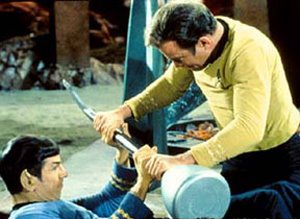
'Spock, let go! This big-ass Hershey's Kiss on a stick is MINE!'JJA: Now your music for the Kirk/Spock fight scene in "Amok Time" has been called the greatest fight music ever written for television. It's even been quoted in parodies of Star Trek.

GF: Oh yeah. [Laughs.]

JJA: For instance, the characters on Mystery Science Theater 3000 would hum the fight music whenever they saw a B-movie fight scene.

GF: [Laughs.] That's funny. I know. I get royalties from The Simpsons and The Cable Guy. I know it was used there.

JJA: Do fans at the Star Trek cons come up to you and hum the fight music?

GF: Yeah, I actually attended two or three of those Star Trek conventions. There was a program. I made a suite of all my main themes from Star Trek into sort of a concerto for oboe, which I played myself. I'm still an oboe player. Yeah, some people would come up and talk mostly about those specifically.

JJA: I know that in television, like you said before, composers don't have much time to work with. Do you feel your music is better when it's written in such a limited amount of time or do you feel the opposite?

GF: I had only one opportunity to find out because 100 percent has been on a rushed schedule. The exception is the documentary Birds Do It, Bees Do It. I had lots of time for that. That was my one and only Oscar nomination, so maybe there is a correlation. Except for that, I have no way of knowing!

The 'Amok Time' action figure set: for lonely Trekkie housewives who want to reenact the 'Amok Time' fight with their Kirk and Spock dolls but always thought, 'Oh, why can't it be gayer?'
JJA: Now themes from your Star Trek scores would be recycled in many episodes. Were you flattered by this or did you find that practice inappropriate?

GF: Well, if I were to give a speech on the aesthetics of film composing, I'm sure I would rant and rave about "music must be composed specifically for this and that." But when you get your music, for one thing, played on network television, you've got a helluva lot of money, and that kind of tempers your thinking... It doesn't temper your thinking. It tempers your mouth, so I didn't do any public complaining. Sometimes, I thought it was ludicrous what they did, and sometimes, I think, "Well yeah, alright, it sort of works." But generally, I'd like to go down in the books as saying it's a bad policy. It makes a product out of movie and TV stuff. I still like to consider it a great art form, so with that high road in mind, I come down against it.

JJA: So how do you feel when people come up to you and say, "Oh, I like that love theme from 'This Side of Paradise,'" but it was the love theme from "Shore Leave"?

GF: Yeah. [Laughs.] I smile. What are you gonna do? Read them a lecture on cinematic aesthetics?

JJA: Anybody who has worked on the original Star Trek, whether they're an actor, a writer or a composer, is always stopped on the street and remembered for their contribution even if it was only a guest stint. Why do you think Star Trek has been so popular?

GF: I think the intent and quality of the writing and the concept of it, to try and comment on earthly problems in terms of outer space... The dynamics of jealousy, rage, envy, power, lust and all those things were commented on intelligently and fairly. I think they reflected--as all good writing does--on the conditions of all the people down here on Earth, and I think that came through.

JJA: Any advice for anybody who took one listen to your music from Star Trek and said, "I wanna do that too"?

GF: [Laughs.] Yeah, it's possible. There will always be music for movies and television. It's hard to get into because a lot of people want to do it, but if there's a major motivation, and the person is willing to do the work and the research and become an all-around person in music... The days of having specialists are over. Producers need to hire a composer who they know has enough range, so that they can handle whatever problem might come up. Yeah, my advice is go for it.

Tuesday, 31 March 2009

List habit

Terence Blanchard's 'Fruit of Islam' is one of the few film score instrumentals that spawned a music video for airplay on MTV or in 'Fruit of Islam''s case, BET. 'Duel of the Fates,' 'Axel F' and the Chariots of Fire theme are some other instrumental themes that got video channel airplay.
Matthew from the Culture Kills blog says he would like me to post what my 10 favorite film scores are.

That's too much pressure, Matt! I dig so many of them. Scores come in many different categories or genres (film, TV, synthesizer, 80-to-100-piece-orchestra, blaxploitation, espionage, poliziotto, lederhosen porn...). It's too broad a question, and it'd be difficult to narrow them down to 10.

I don't spend much time on Facebook(*) anymore (mostly because I now prefer the more stripped-down Twitter), but there's one thing I enjoy doing on Facebook: making lists(**) of my favorite pieces of music on Facebook's LivingSocial and iLike apps.

(*) Damn, even Facebook's CFO doesn't like the new Facebook either. He hates it so much he quit!

(**) The title of this post refers to the "List Habit" tag that Kim Morgan uses for her list-crazy posts.

In LivingSocial's case, the app has you post Top 5 lists of your favorite things. So instead of a "Top 10 favorite scores" list, I'll repost the Top 5 lists of favorite score cues (or scores) under certain categories that I've been posting on LivingSocial and Twitter.

Five favorite marches from original film or TV scores
5. John Williams, "The Imperial March (Darth Vader's Theme)," The Empire Strikes Back
4. John Williams, "March from 1941"
3. Jerry Goldsmith, "Main Title," Star Trek: The Motion Picture
2. John Williams, "Main Title," Superman: The Movie
1. Terence Blanchard, "Fruit of Islam," Malcolm X

God, the Oscars are a joke. How could they not nominate Terence Blanchard for his 1992 Malcolm X score, which is filled with awesome themes like "Fruit of Islam," the cue he wrote for the film's Harlem march sequence? What was the score that won in 1993? Oh right, Aladdin. Give me a break.

Gene Roddenberry dug the Star Trek: The Motion Picture march so much that he recycled it for Star Trek: The Next Generation in 1987. TV composer Dennis McCarthy wrote an updated arrangement of the march, and it was performed by an orchestra that was smaller than the 90-piece orchestra that performed it back in 1979. That explains why the TNG version lacks oomph. I prefer the original 1979 rendition. I like how the brass sounds jazzier.

Five other favorite marches
5. Ennio Morricone, "March of the Beggars," Duck, You Sucker
4. Jerry Goldsmith, "Attack," Patton
3. Elmer Bernstein, "Main Title," The Great Escape
2. Elmer Bernstein, "Stripes March"
1. John Williams, "End Credits," Raiders of the Lost Ark

Five favorite film scores frequently sampled by beatmakers
5. The Mack (Willie Hutch)
4. Superfly (Curtis Mayfield)
3. Trouble Man (Marvin Gaye)
2. Enter the Dragon (Lalo Schifrin)
1. The Taking of Pelham One Two Three (David Shire)

Five favorite Danny Elfman film scores
5. Dead Presidents
4. Pee-wee's Big Adventure
3. Mission: Impossible
2. Batman
1. Midnight Run

Five favorite original TV themes
5. It Takes a Thief (third season version) (Dave Grusin)


4. I Spy (Earle Hagen)


3. Barney Miller (Jack Elliott and Allyn Ferguson)
2. The Persuaders! (John Barry)
1. Cowboy Bebop (Yoko Kanno)


Listeners like Portland film critic and CulturePulp artist Mike Russell have told me they became Yoko Kanno fans after hearing her Cowboy Bebop score tracks on my station.

On the opposite end of the spectrum, what's the crappiest original TV theme of all time? I was going to say Enterprise, but then I remembered the Diane Warren-penned "Where My Heart Will Take Me" wasn't an original work. It was recycled from Patch Adams, of all movies. (In a sketch I wrote for A Fistful of Soundtracks' 2002 Halloween special, gangbangers torture a hostage by subjecting him to the Enterprise theme.)

The worst original TV theme is Joanie Loves Chachi, hands down. Click at your own peril.

Tuesday, 17 February 2009

AFOS: "Galloping Around the Cosmos" playlist

Airing this week on the Fistful of Soundtracks channel is the 2008 Fistful of Soundtracks: The Series episode "Galloping Around the Cosmos" (WEB94), which focuses on the music from the original series era of the Star Trek feature films. J.J. Abrams' new Trek film is being scored by frequent Abrams collaborator Michael Giacchino, whose scoring sessions were captured by ScoringSessions.com with tongue firmly planted in cheek.

I'll take 'Things That Make a Commitmentphobe Run the Fuck Away' for $200, Alex.
1. Jerry Goldsmith, "Ilia's Theme," Star Trek: The Motion Picture: 20th Anniversary Collector's Edition, Columbia/Legacy
2. Jerry Goldsmith, "Main Title/Klingon Battle," Star Trek: The Motion Picture: 20th Anniversary Collector's Edition, Columbia/Legacy
3. James Horner, "Genesis Countdown," Star Trek II: The Wrath of Khan, GNP/Crescendo
4. James Horner, "Epilogue/End Title," Star Trek II: The Wrath of Khan, GNP/Crescendo
5. Leonard Rosenman, "Chekov's Run," Star Trek IV: The Voyage Home, MCA
6. Leonard Rosenman, "Home Again: End Credits," Star Trek IV: The Voyage Home, MCA
7. Ray Heindorf & the Warner Bros. Studio Orchestra, "Main Title" (from East of Eden), A Tribute to James Dean, Sony Classical
8. Cliff Eidelman, "Sign Off," Star Trek VI: The Undiscovered Country, MCA
9. Cliff Eidelman, "Star Trek VI Suite," Star Trek VI: The Undiscovered Country, MCA

Repeats of A Fistful of Soundtracks: The Series air Monday night at midnight, Tuesday and Thursday at 4am, 10am, 3pm, 7pm and 11pm, Wednesday night at midnight, and Saturday and Sunday at 7am, 9am, 11am, 1pm, 3pm and 5pm.

Tuesday, 4 November 2008

"AFOS A-Go-Go" 11/04/08-11/10/08 playlist

R.I.P. Audrey II1. Neal Hefti, "The Odd Couple," The Odd Couple, Dot
2. Neal Hefti, "Man Chases Man," The Odd Couple, Dot
3. Neal Hefti, "Batman Theme," Batman, Film Score Monthly
4. Royal Scottish National Orchestra, "Batman (T.V. Theme)," The Batman Trilogy, Varèse Sarabande
5. The Four Tops, "Are You Man Enough?," Shaft in Africa, Hip-O Select/Geffen
6. Levi Stubbs and Chorus, "Mean Green Mother from Outer Space," Little Shop of Horrors, Geffen
7. Ben Taylor, "Dolemite," Dolemite: Special Edition, R N P Muzak
8. W.G. Snuffy Walden, "West Wing Main Title," Music by W.G. Snuffy Walden, Windham Hill
9. W.G. Snuffy Walden, "West Wing Suite," Music by W.G. Snuffy Walden, Windham Hill
10. Sean Callery, "Palmer's Theme" (from 24 episode #118), 24, Varèse Sarabande
11. Bear McCreary featuring Raya Yarbrough, "A Distant Sadness" (from the Battlestar Galactica episode "Occupation"), Battlestar Galactica: Season 3, La-La Land
12. Jerry Goldsmith, "Welcome Aboard, Sir," Air Force One, Varèse Sarabande
13. Brian Tyler, "Ready or Not," Finishing the Game, Brian Tyler
14. Bernard Purdie, "Hap'nin," Lialeh, Light in the Attic
15. Stan Ridgway and Stewart Copeland, "Don't Box Me In," Rumble Fish, A&M
16. Jeff Beal, "Riding Off, Appaloosa End Credits," Appaloosa, Lakeshore
17. Jerry Goldsmith, "Lost in the Wild" (from The Edge), Jerry Goldsmith at 20th Century Fox, Varèse Sarabande
18. Neal Hefti, "End Title," The Odd Couple, Dot

"AFOS A-Go-Go" airs every Tuesday, Thursday, Saturday and Sunday in November (except the week of Thanksgiving) on the Fistful of Soundtracks channel.