
I finally finished reading all the books I bought during my one-day trip to Comic-Con. In
an August 6 post, I discussed the first book I grabbed there that day,
The Middleman: The Doomsday Armageddon Apocalypse, Javier Grillo-Marxuach's adaptation of the unproduced final episode of his prematurely cancelled TV series version of
The Middleman.
I also picked up a TPB of Tyler Chin-Tanner's self-published miniseries
Adrenaline, Debbie Huey's
Bumperboy and the Loud, Loud Mountain, IDW's
Classic G.I. Joe Volume 1 and an exclusive Comic-Con edition of Darwyn Cooke's eagerly anticipated IDW adaptation of
The Hunter, the first Parker novel by Richard Stark, a.k.a. the late Donald E. Westlake. My tastes in comics aren't usually this wide-ranging--I stick to a steady diet of mature crime or espionage titles--but this list of books I grabbed in San Diego was an exception.
I first met Tyler at
the Asian American ComiCon, where we had Artists Alley tables, and I ran into him again at the SDCC, where the AACC was still on our minds (the much smaller AACC was
a far more enjoyable experience than SDCC, despite the occasional moments of
insensitive Artists Alley behavior). Tyler is currently
at work on American Terrorist, a comic about ordinary citizens who go on the lam after they're branded as terrorists for criticizing the government (
the first issue is available to iPhone and Google Android users).
Like
American Terrorist,
Adrenaline is ripped from the headlines, and it centers on Dr. Saida Nri, a young Nigerian physician who gets roped into competing for a $4 million grand prize on a sensationalistic, globetrotting reality show of the same title--think a sleazier version of
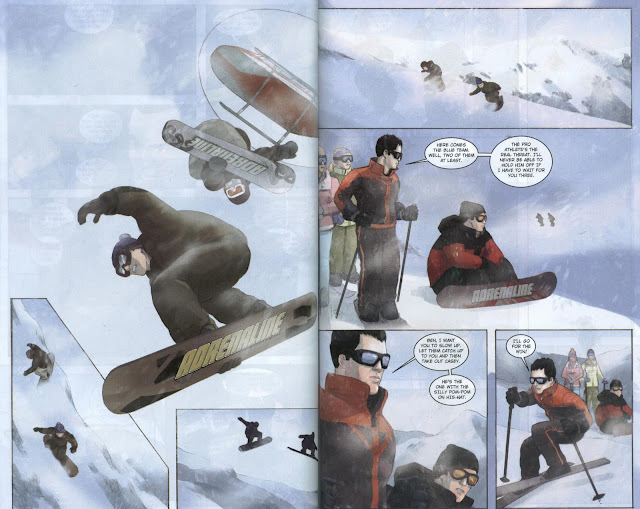
The Amazing Race. This enjoyable actioner, which Tyler wrote and drew layouts for (with epic-looking artwork provided by penciller/colorist James Boyle and inker/letterer Fabio Redivo), is a gentle sendup of reality TV and its frequent co-opting of the extreme sports craze. Alex Lowder, the
Adrenaline show's wealthy host/creator (and he's not only the host, but he's also a contestant), is a mash-up of
the douchey, culturally clueless Jeff Probst and an extreme sports nut.

In some moments, the comic reminded me of director Daniel Minahan's 2001 reality TV spoof
Series 7: The Contenders. The most biting part of
Series 7's critique of reality TV was its comparison of the genre to snuff films, whereas
Adrenaline's sharpest jabs are directed towards the rigged nature of reality shows and their showrunners' callous treatment of foreign cultures, which is depicted through Alex's poaching of a lion on a Tanzanian wildlife preserve in the series' first few pages. The illegal hunt enrages Saida, who runs a small health clinic near the preserve. In a slightly ridiculous but literally gripping action sequence, Saida displays the agility of a parkour athlete--the doctors on NBC's
ER were never this agile--when she leaps onto Alex's copter to stop him from escaping from the local authorities. She gets knocked unconscious during a scuffle in the copter with one of Alex's tough bodyguards and winds up kidnapped in a moment that strains credibility (in real life, Alex would be locked up for abducting Saida, despite his power and wealth), but I let it slide because
Adrenaline is essentially an over-the-top Bond film, except Bond is a compassionate Nigerian female doctor-turned-reality show contestant who's trying to save her struggling clinic (and her Maasai patients) instead of the world.
 Adrenaline
 is loaded with thrilling sequences straight out of Bond films, from a wordless, beautifully illustrated scuba diving sequence to a downhill race between snowboarders and skiers that goes awry. In fact, as I read the TPB, I kept choosing John Barry 007 score cues that would have served as perfect musical accompaniment for those Bond-like moments (
Thunderball's "Bond with SPECTRE Frogmen" for the underwater sequences,
A View to a Kill's "Snow Job" for the snow race).
One of the many reasons why I despise the reality genre is because too many of those shows regurgitate the same old racial stereotypes--especially the programs on VH1, home of Flavor "No sellout" Flav--but in fairness to the genre,
it has also influenced scripted network shows like Lost and Heroes to opt for racially diverse casts. Because
Adrenaline is about a reality show, it contains an equally diverse cast of characters, from Saida ("What we don't see are the many strong native Africans who are leading the way in resuscitating their country. I felt they needed to be the hero of a comic book," said Tyler in
a 2007 interview about Adrenaline) to Ben Wong, a brash Asian American stuntman who has a tryst with a female teammate in a romantic subplot that's a nice little up-yours to Hollywood and its emasculation of Asian guys.
Debbie Huey's
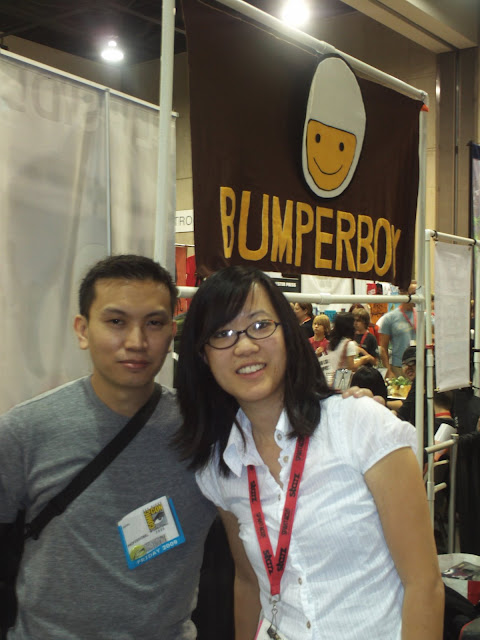
Bumperboy has plenty in common with
Adrenaline's Saida. They're both unlikely action heroes who are unafraid to stand up to corporate greed when it endangers the well-being of their neighbors, whether they're humans, animals--or talking mountains. In Debbie's inventive AdHouse Books graphic novel, 2006's
Bumperboy and the Loud, Loud Mountain, the rubber-suited Bubtopian and his canine sidekick Bumperpup travel through a magical portal called a "borp hole" to a faraway land where they encounter a lonely and chatty mountain named Jumbra.

The duo also befriends a band of armless, marshmallow-shaped creatures known as the Grums, who speak only in Bumperpup's language of Pictonese (in which the speaker communicates by projecting pictures, much like
X-Factor character
Artie Maddicks) and help keep the childlike Jumbra alive by planting Grum fruit trees on his back. Without giving away too much of this second installment in the Bumperboy series, an unknown menace is causing Grums to disappear from their home, and it's up to Bumperboy and B-pup to rescue the missing Grums, save Jumbra's life and restore order to the disrupted ecosystem.

All-ages comics are not my forte, but I picked up Debbie's book because Bumperboy's ability to "borp" to distant lands is an appealing hook (it's reminiscent of one of my favorite Warner Bros. animated shorts, Robert McKimson's 1955 cartoon
"The Hole Idea," about a professor who invents the portable hole, a gadget that was later featured in
Who Framed Roger Rabbit), and I wanted to support a fellow
Slug, especially someone who I recently discovered was involved with the same campus newspaper where I used to be a staff writer.
As with any of the best all-ages comics, kids will be entertained by
Bumperboy and the Loud, Loud Mountain because of its resourceful heroes and offbeat supporting characters, while older readers will enjoy it for its wonderful black-and-white art and subtle social commentary. The book decries child labor practices and environmental racism without turning into a preachy
G.I. Joe "Knowing is half the battle" PSA. Speaking of which...
The next post will focus on the rest of my Comic-Con purchases:
Classic G.I. Joe Volume 1 and
The Hunter.


